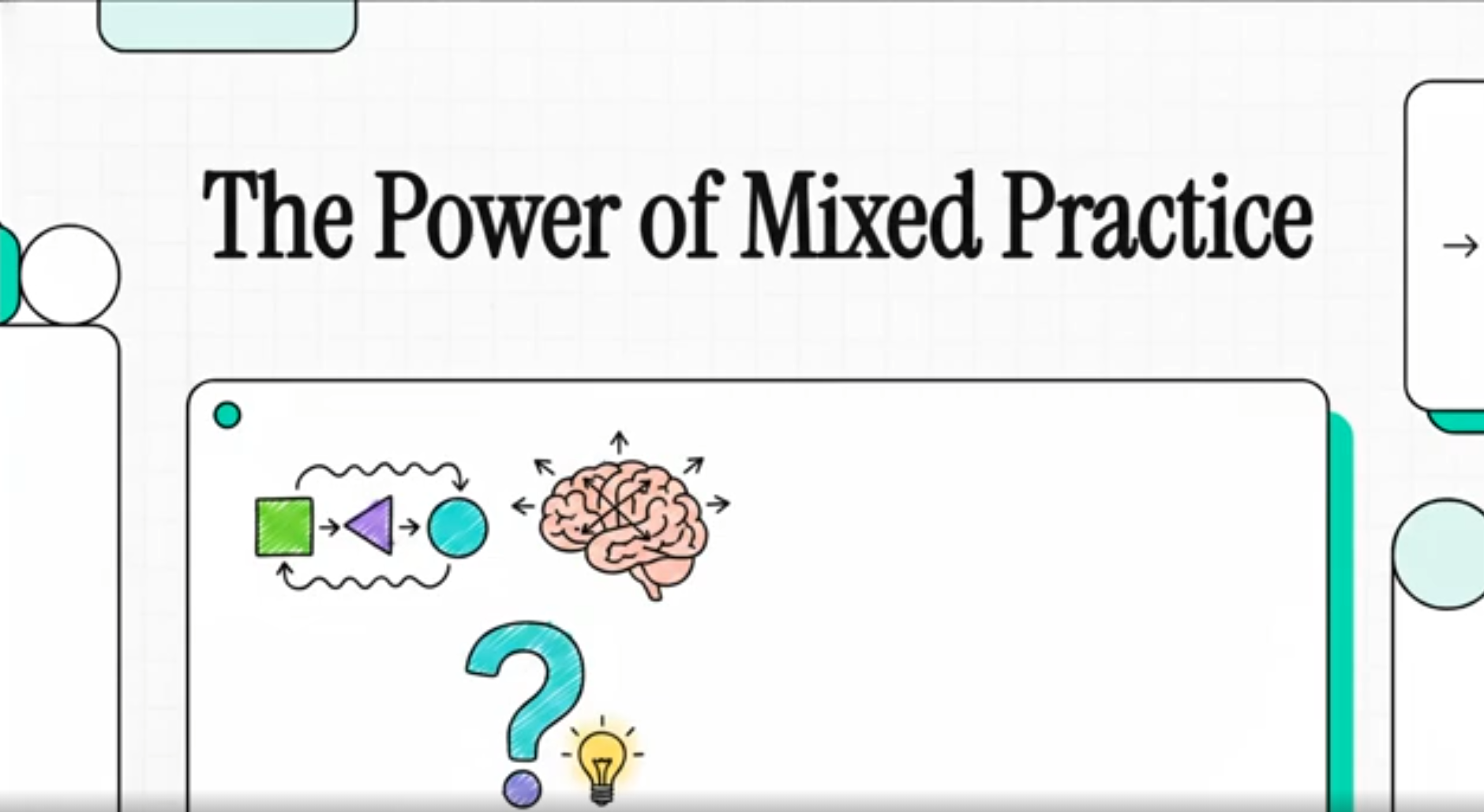
Have you ever spent hours working through identical algebra problems, or the same set of flashcards? The problems and flashcards became easier, almost as if you knew the answer before even reading the question because of habit. This made you feel great, but all that knowledge seemed to disappear a week later. If this sounds like you, you’re not alone.
Spending hours on identical problems can create a false sense of mastery. That feeling that you knew the answer before the question, is your brain on autopilot. That’s not good for studying. Instead, you should use interleaving, otherwise known as mixed practice. This is a learning technique, backed by cognitive science, that has you mix related topics, skills, and problems during a single study session. You’ve combined the topics instead of trying to master the topics one by one.
What is interleaving? It’s simply switching between different topics. An important note, the topics need to be different but also related. This isn’t just randomized concepts. If you are learning topics A, B, and C, many people use blocked practice which is to focus on A until it is mastered, then moving on to B, and finally to C. So it looks like AAA, BBB, CCC. Interleaving has you mix these topics dynamically throughout your study session. So, it would look like ABC, BAC, CAB. You will still master the techniques, but you will do so more efficiently.
So, how do you implement mixed practice? Your first step is to choose 3 or 4 related topics or concepts. Again, make sure that they are related and not just random topics. As an example, you can choose different types of math equations as your related concepts. You should not choose a math equation with spanish conjugation.
Your second step is to break up your study session. Let’s say that you set aside 2 hours for studying. Instead of using all 2 hours on one topic, break it down into 15-20 minutes. Each subset will be its own concept. So, concept 1 will be the first 15 minutes, then switch to concept 2, then to concept 3. You rotate through until the 2 hours are up. Don’t be afraid to switch up the order instead of continuing 123, 123, 123.
The third step is easier said than done. You will have an urge to master a topic before you move on. A lot of students have been trained to do this. You need to resist that urge. It’s ok to switch to the next topic before you feel completely comfortable with the topic that you are working on. Embrace the difficulty because it is where your memory will be built.
The final step is using something called discriminative testing. This is simply asking yourself what kind of problem you are facing. Which tool do you need and how do you use that tool correctly? So, for our example with math problems. If you are doing blocked studies of just repeated derivative problems, you never need to ask yourself what type of problem it is. Your brain knows that it’s asking for a derivative just like the previous 50 questions. With interleaving, you need to look at the problem and see if it is a derivative problem, or another type.
This discriminative testing is one reason why mixed practice works so well. Another reason this works is because it improves our problem categorization. In the real world, our problems don’t come labeled. By interleaving, we are training our brains to recognize patterns and selecting the right tool for the job. Think about construction. If you only face problems that require a hammer, you’ll never learn to know when a screw would work better. The last reason I’ll mention here is that interleaving gets rid of that false sense of competence. As stated at the beginning, when you do the same thing over and over again, you start to feel comfortable but you forget everything by the next week. Interleaving prevents you from getting this false sense of competence.
One last example I’ll give is in sports. If you are playing tennis and you are working on forehands, backhands, and serves. Instead of hitting 100 forehands in a row, then 100 backhands, and then 100 serves, it would be better to mix. Have a partner send unpredictable shots your way to mimic real match play. Instead of being able to predict what is coming next, you’ll be training yourself to react in real time.
Leave a Reply