Category: Study Tips

Freshmen want to excel academically and often seek advice on how to study effectively. They may ask for tips on taking notes, memorizing information, and preparing for exams.

  • The Power of Mixed Practice: Why “Interleaving” Is the Secret to Faster Learning

    The Power of Mixed Practice: Why “Interleaving” Is the Secret to Faster Learning

    Have you ever spent hours working through identical algebra problems, or the same set of flashcards? The problems and flashcards became easier, almost as if you knew the answer before even reading the question because of habit. This made you feel great, but all that knowledge seemed to disappear a week later. If this sounds like you, you’re not alone.

    Spending hours on identical problems can create a false sense of mastery. That feeling that you knew the answer before the question, is your brain on autopilot. That’s not good for studying. Instead, you should use interleaving, otherwise known as mixed practice. This is a learning technique, backed by cognitive science, that has you mix related topics, skills, and problems during a single study session. You’ve combined the topics instead of trying to master the topics one by one. 

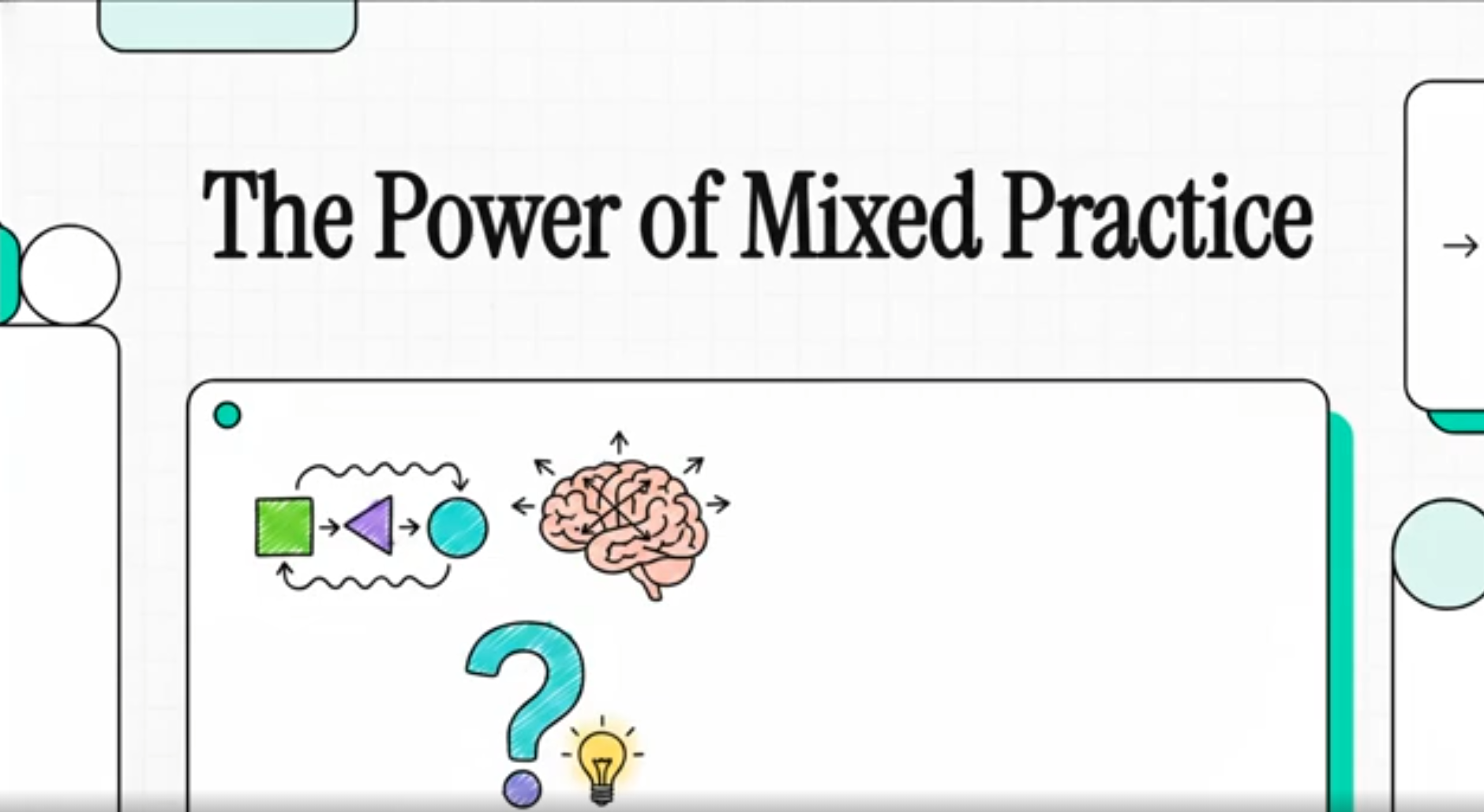
    What is interleaving? It’s simply switching between different topics. An important note, the topics need to be different but also related. This isn’t just randomized concepts. If you are learning topics A, B, and C, many people use blocked practice which is to focus on A until it is mastered, then moving on to B, and finally to C. So it looks like AAA, BBB, CCC. Interleaving has you mix these topics dynamically throughout your study session. So, it would look like ABC, BAC, CAB. You will still master the techniques, but you will do so more efficiently.

    So, how do you implement mixed practice? Your first step is to choose 3 or 4 related topics or concepts. Again, make sure that they are related and not just random topics. As an example, you can choose different types of math equations as your related concepts. You should not choose a math equation with spanish conjugation.

    Your second step is to break up your study session. Let’s say that you set aside 2 hours for studying. Instead of using all 2 hours on one topic, break it down into 15-20 minutes. Each subset will be its own concept. So, concept 1 will be the first 15 minutes, then switch to concept 2, then to concept 3. You rotate through until the 2 hours are up. Don’t be afraid to switch up the order instead of continuing 123, 123, 123.

    The third step is easier said than done. You will have an urge to master a topic before you move on. A lot of students have been trained to do this. You need to resist that urge. It’s ok to switch to the next topic before you feel completely comfortable with the topic that you are working on. Embrace the difficulty because it is where your memory will be built. 

    The final step is using something called discriminative testing. This is simply asking yourself what kind of problem you are facing. Which tool do you need and how do you use that tool correctly? So, for our example with math problems. If you are doing blocked studies of just repeated derivative problems, you never need to ask yourself what type of problem it is. Your brain knows that it’s asking for a derivative just like the previous 50 questions. With interleaving, you need to look at the problem and see if it is a derivative problem, or another type. 

    This discriminative testing is one reason why mixed practice works so well. Another reason this works is because it improves our problem categorization. In the real world, our problems don’t come labeled. By interleaving, we are training our brains to recognize patterns and selecting the right tool for the job. Think about construction. If you only face problems that require a hammer, you’ll never learn to know when a screw would work better. The last reason I’ll mention here is that interleaving gets rid of that false sense of competence. As stated at the beginning, when you do the same thing over and over again, you start to feel comfortable but you forget everything by the next week. Interleaving prevents you from getting this false sense of competence.

    One last example I’ll give is in sports. If you are playing tennis and you are working on forehands, backhands, and serves. Instead of hitting 100 forehands in a row, then 100 backhands, and then 100 serves, it would be better to mix. Have a partner send unpredictable shots your way to mimic real match play. Instead of being able to predict what is coming next, you’ll be training yourself to react in real time.


  • The Ultimate Guide to Elaborative Interrogation: The Science-Backed Way to Make Information Stick

    The Ultimate Guide to Elaborative Interrogation: The Science-Backed Way to Make Information Stick

    Have you ever heard of the power of why? Some say that it is a major factor in deciding what our brains remember and what they forget. We are wired to forget random facts. However, we love to remember stories and reasons. This is why rote memorization, which is just repeating facts over and over again, doesn’t lead to long term memory. So what can we do to remember new information? One solution is elaborative interrogation.

    Have you ever been around a younger sibling or cousin who just kept asking why? Children are naturally curious and this is how they learn. If you don’t want to be compared to a child, then think about detectives, trying to make connections and find out why something is true. Either way, you are practicing elaborative interrogation. You are taking new information and questioning why it is, how it is, or even, why it matters. You answer the question with information that you already know.

    Elaborative interrogation is easily defined by its two words. Elaborative means expanding information and you do this by connecting the new information to existing memory. Interrogation is questioning the material, the new information. This works because memory is what sticks and stays with us after a thought. A great way to remember a new fact is to think deeply about its meaning instead of focusing solely on surface-level keywords.

    There are three steps to elaborative interrogation.

    The first is obviously to identify the fact or concept that you are trying to learn. Look through chapter or lecture notes and just choose one to start with. As an example, use the fact that the human heart has four chambers.

    The second step is to ask the why question. To follow our example, why does the human heart have four chambers? You could also ask, why does the heart not just have one chamber.

    The third and final step is to answer. This step is where you can connect to existing knowledge or dig in deeper to understand the new topic. Back to our example of the heart, it can’t be a single chamber because it needs to keep oxygen-rich blood and oxygen-poor blood separate. It has four chambers so it can act as a dual pump to efficiently pump blood to the lungs at lower pressure and to the rest of the body with higher pressure.

    This works for a few reasons that are backed by cognitive science. First, similar to Feynman Technique, it removes the illusion of competence. Instead of explaining it in simple terms, elaborative interrogation forces you to answer why it is true. If you can’t explain why it is true, then you can find weak spots in your understanding. Second, by elaborating on the topic, you are increasing the encoding of the information into your memory. Think of this as your brain saving information to a hard drive. Since you connected the new information to existing memory, you’ve increased the chances that you can retrieve it later on. Third, this creates a conceptual schema in your mind. It turns an individual trivia fact into a web of logic. This makes it more difficult to forget as compared to an isolated flashcard. 

    Now that you know about elaborative interrogation, be sure to use it during your next study session. Learning new information shouldn’t be collecting facts like stamps, it should be about building a web of connections. 

  • The Feynman Technique: The Best Kept Secret for Mastering Complex Subjects 

    The Feynman Technique: The Best Kept Secret for Mastering Complex Subjects 

    Have you ever spent hours studying and not remembered a thing? It can be extremely frustrating. It feels like you’re reading the same thing over and over, putting in all your effort, and having nothing to show for it. In this post, we will go over a 4-step model based on the simple idea that if you can’t explain it, then you don’t understand it. This is based on the Great Explainer, Richard Feynman, who was able to explain complex quantum mechanics in simple ways. After mastering this technique, the Feynman Technique, you will be able to have shorter study sessions, increase retention of information, and gain real understanding of the topics you are focused on.

    The Feynman Technique is a framework that helps you identify gaps in your understanding. It does this by forcing you to explain concepts in plain, simple language. It’s ‘explain like I’m 5.’ The philosophy behind this technique is that comprehension isn’t about memorizing, but grabbing the core essence of the topic, the fundamental principles and turning that into actionable knowledge. This is another form of active learning. Compared to passive learning of rereading or highlighting, this method helps you retain information by focusing on the topic and clarifying the points that you don’t fully understand.

    Let’s move on to the 4 simple steps that you need to follow. 

    • First, you need to choose your topic. What are you studying? Write the title of the concept at the top of a sheet of paper.
    • Second, write out an explanation of the topic. Remember, use simple words and short sentences. Remove all the jargon and technical terms. This is where you explain like I’m 5.
    • Third, review the explanation and compare it to what you are studying. So, if your topic is the current chapter you are studying, you’ll compare your explanation to your text book. Look at where you got stuck in your explanation or where you accidentally used jargon. Use the book to fill in the gaps until you can explain it easily.
    • Fourth, refine your explanation. Read the definition outloud to hear if it sounds confusing and needs to be further simplified. It often helps to create an analogy. For instance, electricity flowing through a wire is like water flowing through a hose. 

    Now that we know the steps, why does it work? The Feynman Technique forces metacognition. It makes you think about your own thinking. It also shows you what you don’t understand, instead of mistaking familiarity with comprehension. Also, by removing jargon and technical terms, you force your brain to build new connections rather than just parroting a memorized phrase. Combined with spaced repetition, this technique strengthens neural pathways by engaging brain activity and converts the short-term memory into long-term knowledge.

    Learning doesn’t have to be a grueling, never-ending study session focused on memorization. Stay curious, ask how and why, and explain topics as simply as possible. 

  • Spaced-Repetition

    Spaced-Repetition

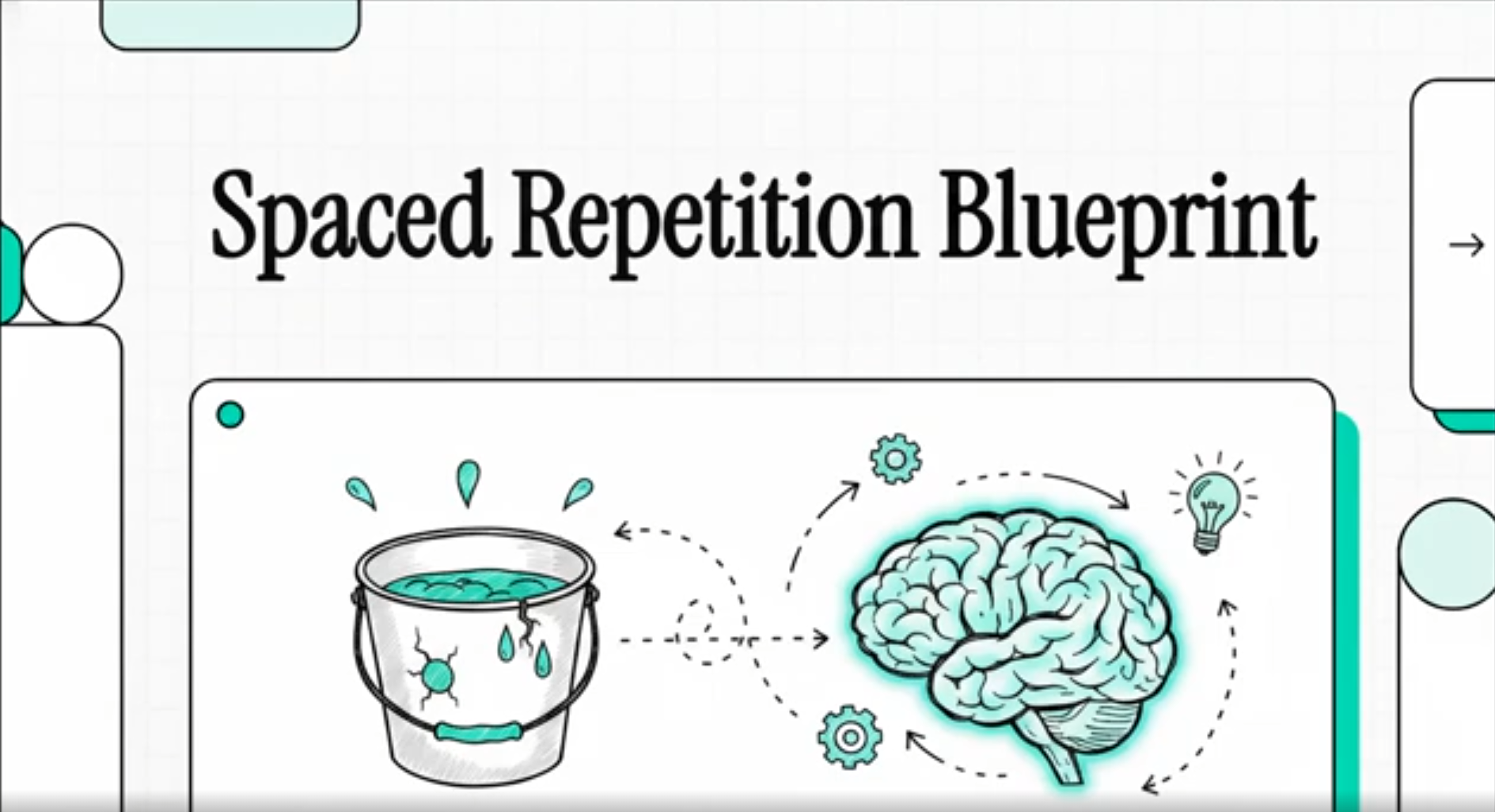
    Have you ever crammed for an exam only to forget the information the next day? Or studied a topic for hours on end, only to forget it during the exam? These are both common frustrations among students. The solution is simpler than you are probably thinking. You don’t necessarily need to study more, you just need to study smarter. This is where spaced repetition comes in. In this blog post we will cover what spaced repetition is, why it works, and how to do it. We will also cover the benefits and give an example.

    Let’s start with what spaced repetition is. It is a study technique where you review material over gradually increasing intervals of time. So, you start looking at the information every other day, then every few days, then once a week, etc. This way, as soon as you are about to forget it, your brain is forced to actively recall the information. This works with research on forgetting. Hermann Ebbinghaus discovered a now famous curve of forgetfulness. His research explains that if we periodically retrieve information, it will allow us to remember that information for longer. This repeated strengthening of memory will lead you to be more successful than an all night cram session. 

    There are a lot of benefits of using spaced repetition to study. Since it works based on the forgetfulness curve, it improves long-term memory. This is great for when you have cumulative exams and when information is built on from one semester to the next. This method also allows you to spend less time relearning material. In addition, since you are taking breaks and spreading it out, spaced repetition makes studying more effective. As an added bonus, the repeated recall will increase your confidence before an exam. This and more explains why spaced repetition is better than cramming.

    Now that we’ve covered what space repetition is and why it’s beneficial, let’s focus on how to use it. I’ve used spaced repetition for a variety of information. For instance, vocabulary and definitions, facts and concepts, and formulas. You can study these topics with spaced repetition by creating flashcards, prompts, practice quizzes, and even summary notes. As the name suggests, an important part of this method is the spacing. So, be sure to create a review schedule that works. Start off with reviewing a topic often and extend the intervals as your memory improves.

    Here are some examples for spaced-repetition. Let’s say that we are learning vocabulary. We can create flashcards. We write the word on one side and the definition on the other. Go through each card until you get the definition and the word correct. Repeat the next day, then in three days, then in 5 days. If you get a word correct each time, put it in a separate pile to review less often. This makes sure that you are reviewing all of the material and you aren’t wasting too much time on information that you have already mastered.

    As with most study methods, there are some common mistakes that you should avoid. Don’t wait too long to start. Since the intervals between sessions need to increase, you should start this method far enough in advance of the exam. For instance, if you are preparing for a final exam, you should start at least a month or two ahead of time. You will be tempted to just read the flashcard or other information. You have to ignore the temptation and truly test yourself. It’s just studying, there’s no penalty if you don’t know the information yet. So, take your time and do it properly.

    Focus on the difficult material. As mentioned above, once you get a question right repeatedly, move it to another pile so that you can focus on the topics that you are having trouble with.

    The last mistake is giving up after missing a review session. Life happens. Sometimes we will miss a day or two of studying. If that happens, just continue where you left off. Don’t stop completely and don’t just cram at the last minute.

    Just some final tips for spaced repetition. Keep review sessions short and take breaks. Use the pomodoro technique to balance time and avoid burnout. Be sure to really test yourself instead of just reading the answer. Start slow and build up as you master this study technique. Good luck on your exams!

  • Active Recall

    Active Recall

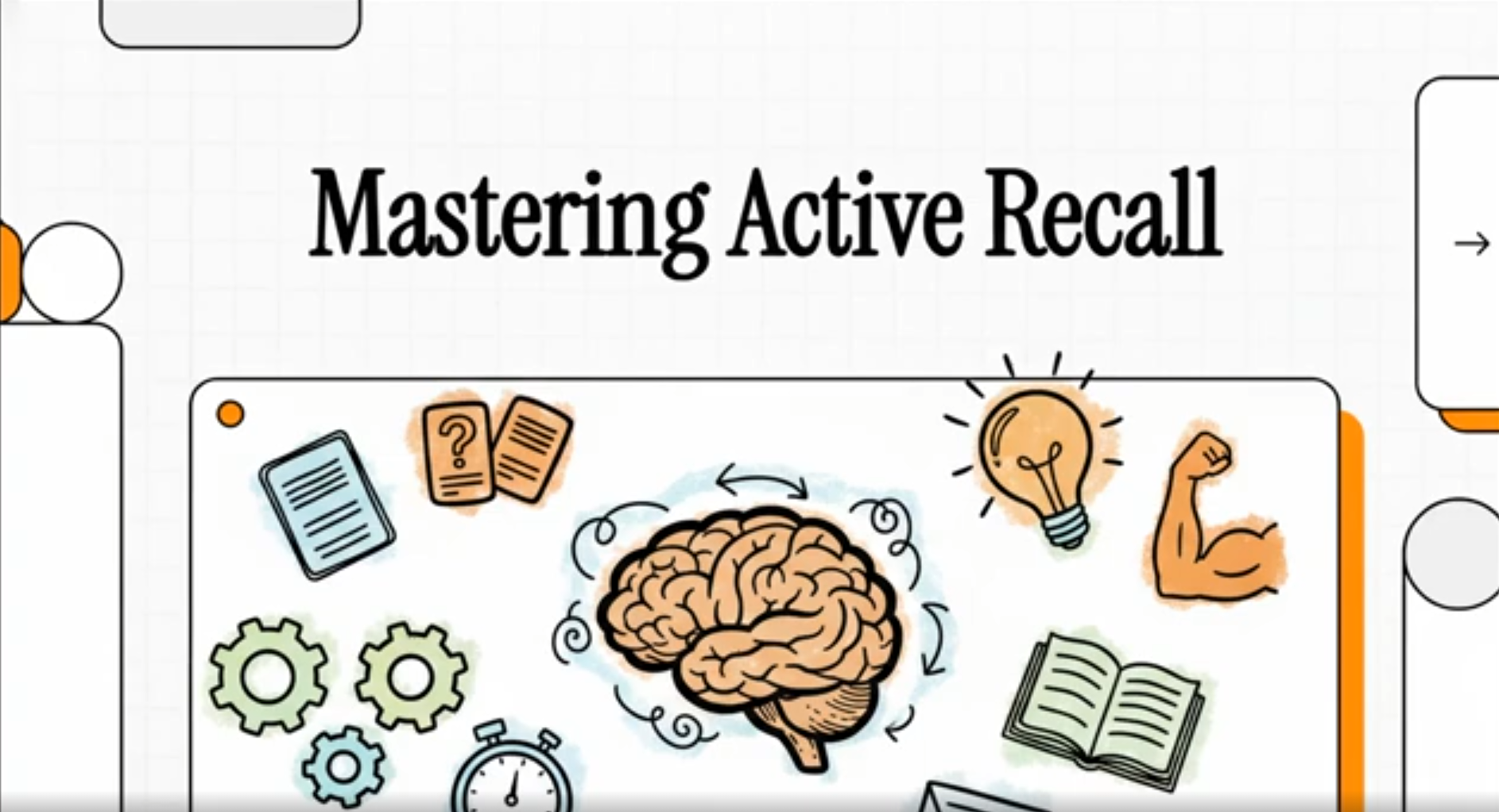
    The study tip for this week is active recall. Active recall is a study technique that forces you to pull information from your memory, rather than just reading notes off of a page.This is why it is considered active, because you are not just passively reviewing your notes. You are consciously attempting to remember all the information that you have learned. This is an excellent technique to move information into long-term memory. 

    One of the more obvious ways to do active recall is through flash cards. Most people know flashcards because of vocabulary. You write the word on one side of the card and the definition on the other side of the card. You then create a deck of cards with all of the new words that you are trying to learn and flip through the cards as you pick up new vocabulary. 

    This technique is useful for more than just vocabulary. You can use this technique for dates, people, etc. Even for philosophies. You can put the philosophy on one side of the card, and the 3 main points of that philosophy on the other. You can also start with either side of the card. So going back to the vocabulary example, you can read off the definition and then give the word. You can also read the word and give the definition. This ensures that you will be able to recall the information on the day of the test, no matter how the question is worded. 

    Another way to study with active recall is to give yourself a practice test. This allows you to practice your new knowledge but also to become more comfortable with taking tests. Before the day of the test, try to practice with not only the information but also the method of testing. To do this, you might want to ask your instructor what the test looks like. Will it be multiple choice, short answer, or an essay? It could be a mixture of these as well. Then, you create the same style of questions to be your practice test.

    This still qualifies as active recall because you are consciously grabbing the information from your memory instead of just passively reading over your notes. This also helps you write out your answers and thoughts, in a way that flashcards don’t always allow for. So, not only are you more likely to remember the information but you have practiced how best to write out the information. This can also lead to you remembering more details and can help build your confidence before the test.

    Active recall is a great way to study for a test and confirm what you know. There’s many ways of doing it, so find which way works best for you and give it a try.

  • Mastering the Pomodoro Technique

    This week, we will cover the importance of taking breaks. The best technique for this, that I’m aware of, is the Pomodoro Technique. This relatively straightforward technique requires only a timer and discipline.

    At its core, the Pomodoro Technique is breaking work down into intervals of time. The first intervals that I used were 25 minutes of work followed by 5 minutes of a break. I would complete 4 work sessions and then take a longer break of 30 minutes. I found that these were the best balance of work and rest during my study sessions.

    There are 4 steps for the Pomodoro Technique. The first step is to identify the tasks that you want to work on. For your first session, I suggest sticking to one subject or chapter. The second step is to break this task into chunks. For instance, if your task is a chapter, then break the chapter into sections. The third step is to gather everything that you need. Grab your laptop, textbook, notes, etc. The final step is to choose a reliable timer. This can be on your phone, computer, or even a kitchen timer. Once these steps are completed, you can begin your study session.

    When you are ready to begin, set your timer for the chosen interval. Once you start your timer, focus solely on the task you selected. Work without interruptions. If you are interrupted, record the interruption. This will help avoid it in the future. Then, return to your task. At the end of the interval, take a break. Good job! You have completed the first interval and can now repeat until you have finished your entire session.

    As you continue to practice studying with the Pomodoro technique, you will find ways to maximize efficiency. Use what works best for you, but I have found that these tips help me. 

    First, test a variety of lengths for your intervals and sessions. I find that a 25:5 ratio is often best for me, even now. During my undergraduate studies, I had a job. I found that 30-60 minutes was often the most time that I could easily block together in my schedule. However, for my graduate studies, I was able to create 4-hour blocks of study time. Sometimes, I even managed 8-hour blocks. The 25:5 ratio was easy to scale.

    My second tip is to remove all distractions. For  me, if I questioned if something could become a distraction, I moved it. Some days this meant that I was facing a wall and nothing was on my desk but my books and paper. A friend of mine would turn his phone and computer to grayscale so that they would be so tempting. Others just turn off notifications or set the phone as ‘Do Not Disturb.’ Sometimes you will be more easily distracted and so you should always think about what might distract you before you start each session.

    This leads to creating or choosing a conducive environment. Select a space that fits you. Some people need the ambiance of a cafe or the imposing silence of a library. Some like the quiet, private space of their bedroom while others like a park. The Pomodoro technique can be used wherever you are. The important thing is to find a place where you can focus on your task.

    It is equally important to take meaningful breaks. In order for the Pomodoro technique to prevent burnout, you need to take real breaks that pull you away from your task. These should act as a type of reset. Don’t just switch to another mentally draining task or doomscrolling. Personally, I use this time to meditate and clear my mind. I focus on my breathing, my posture, and clear away any thoughts or items that are threatening to distract me. It’s also a good pause to grab a quick cup of tea or something to drink while you work. Whatever you choose to do, the break should be a relaxing reset to prepare you for the next interval.

    There are many benefits to taking breaks and using the Pomodoro technique. It provides structure and direction. Once you set your timer, you don’t have to worry about how much longer you should study. Since you’ve already chosen your time ratio, you also don’t have to worry about taking too long of a break. By eliminating these worries, you enable yourself to maintain focus and increase productivity.

    It may seem counter-intuitive, but planned breaks help renew focus, enhance productivity, increase creativity, and reduce stress. No one can remain focused on a topic or project forever. Taking a break allows you to clear your mind and recharge. It’s like working out, you need some rest time to alleviate fatigue. In this case, it’s mental fatigue. Also similar to breaks during a workout, these breaks will help boost cognitive performance and, with persistence and consistency, they can also improve your attention span.

    Continuing with the workout analogy, breaks allow us to maintain our productivity levels. They allow us to remain energized, motivated, and in proper form. As we continue these focus times, we will become more energized and more motivated to continue focusing and improve our study routines. With increased energy and motivation, we won’t be as easily overwhelmed by the amount of studying. This will reduce stress levels and keep our mental health in check for when projects are due or when exams are on the horizon.

    Some people also say that taking breaks leads to creative thinking. Removing focus temporarily can stimulate your creativity and overcome mental blocks. Oftentimes, when you are stuck on a problem, it’s best to take a break, step back, and try a new approach. Sometimes those short breaks can improve your problem-solving skills and innovative thinking.

    Remember, taking care of yourself is an investment in your long-term academic and personal achievements.

  • Staying Calm During Midterm Exams

    After all your work and preparation, midterm exams have arrived. These exams bring a lot of stress and anxiety, especially the first year. Don’t worry, you’ve got this. You’ve been preparing for this week, so focus, review, and don’t cram.

    For this week, remove all distractions that you can. Cancel plans that aren’t necessary and make your study sessions count. Don’t overdo it. A good night’s worth of sleep beats an all-night study session in the library. Additionally, make sure you get some exercise and fresh air. This will help increase focus and relieve stress naturally. Finally, be sure to eat a balanced diet. This also helps you focus and make sure that you don’t have brain fog.

    You’ve done the studying and now you have a plan for mitigating stress. Let’s move on to some test taking strategies. 

    When you first begin the test, look it over. Read all of the questions and answer the obvious questions. After you have marked all the obvious questions, go back to the beginning. Don’t get stuck on the questions that you don’t know. Just mark the questions that you aren’t sure of and move on. When reading a question, make sure you read the entire question and the answers. On multiple choice exams, you can usually eliminate an option or two that are obviously wrong. If you must guess, this elimination will at least increase your chances of being correct.

    For essay questions, create an outline to stay organized. If there are also multiple choice questions, they may have some information you can use as ideas or reminders for the essay, so be sure to read them before writing. 

    Exam anxiety is a real thing that often occurs before or during the exam. When you notice that your anxiety is building, take a deep breath, you’ve got this under control. Take a moment to focus on your breath and settling down. When you finish the exam, spend a few minutes reviewing your answers before submitting.

    When you have finished all your midterms, go celebrate! You’ve worked hard and have earned a break. Don’t worry about the exams anymore, there is nothing you can do about them now. So, relax and enjoy a break until the second half of the term begins. And congratulations and making it through midterms!

  • Preparing for Midterms

    Preparing for Midterms

    Now that the semester is underway, it’s time to prepare for midterms. This week we will cover different techniques for taking notes in class and different ways to study. I recommend that you try each process and then think about which one worked best for you. We will first look at studying before class, the class lecture, and then studying after class.

    You should always read the chapter before you go to class. This allows you to understand more of the lecture and will also notify you of any topics that you might need to ask questions on. Most textbooks are written in a way that will guide  you in preparation. For instance, it might have a section at the beginning on how to use the book. Most chapters will start with a list of the topics covered, new vocabulary, and what objectives you should understand by the end of the chapter. Some will also include chapter outlines, or end the chapter with review questions. Use these to your advantage.

    When I would first approach a chapter, I would first look at all the section headings. This is a great way to get a quick overview of how the information is organized. I would then look at the learning objectives to see what was important in this chapter. Then I would make flashcards of all the key terms that I wasn’t familiar with.

    I would then read the introduction and conclusions, if there was one, to again, get a quick view of what would be covered. Then, I would read through the chapter. I would generally just read once and have organized notes on a separate piece of paper. I know people who read the chapter three times. The first is just a quick skim, the second highlights or questions, and the third read is a comprehensive read.

    When it came to taking notes on the chapter, I would summarize each section, in a couple of sentences or so. I would also try to connect the information to a subject I already knew. These are excellent examples of proactive reading that will help you retain the information rather than just reading on its own. When you’re done reading the chapter, complete the chapter review questions and also ask yourself if you understand the learning objectives for that chapter. Write down any questions that you have and you can ask your study group or instructor, during class, or at office hours.

    Now that you’ve read the chapter, it should be easier to follow along with the lecture. Be sure to take good notes as you listen, but don’t write everything down verbatim. Trying to copy down every signal word is stressful and then you miss one word and while you’re trying to figure it out, you’ve fallen behind. Instead, summarize key points. You can also prepare your notes a bit before class. Check if your instructor posted the presentation in the LMS. If so, you can download or print it out with note sections for each slide. If not, don’t worry. There are plenty of other techniques like outlining, mind mapping, and Cornell Notes. Also, you can pool notes together with your study group to make sure that everything is covered.

    Let’s look at these techniques one at a time. The first one is outline. This helps keep your notes organized and is sometimes more easy to focus on compared to a long block of text. This technique can also force you to be more succinct in your paraphrasing or summary. An easy example of outline would look like the following:

    1. Chapter 1: Introduction to Psychology
      1. Working in Psychology
        1. Learning Objective 1: Define Psychology
          1. Psychology is the study of behavior and mental processes
        2. Learning Objective 2: Fields of Psychology
          1. Behavioral neuroscience – examines the biological basis of behavior

    Personally, I find outlining easier with reading than with lecture, but I know a lot of people who have found success using outlines during lecture.

    The next technique is mind mapping. This tends to take up a lot of space and may be easier with a computer, but it is possible to do it by hand. Using the outline example, the mind map would look something like this:

    Mind mapping is customizable and you can base it on whatever connections you see. You also don’t need to complete it in the same block style that I used in the example. You can draw it however you find easiest to visualize the information. One of my students told me that when they draw mind maps, they picture each thing as a cloud and therefore spread them all over the page. Another student saw the main heading as a hub and all the other items as spokes, and together would create a wheel.

    My go to note-taking system was Cornell Notes. For this system, you’ll break your page into three sections. The left column will be topic cues or questions and the right column will be a bit wider and will be the bulk of your notes and key thoughts. The third section will be about the bottom quarter of the pager. This space will be for summarizing your notes for the section.

    You’ve now read the chapter and had a lecture on it. Now it’s time to fill in any missing information or answer those last few questions. Once you do, you can then start studying and find ways to make sense of and remember all of the information so that you are ready for the exam. We’ll cover 3 study techniques that I’ve had success with. First, active recall; second, mixing topics; and third, the Feynman Technique.

    Active recall is when you retrieve information instead of just reading it. For instance, after reading a section, close your book and recall what you just read. Are you able to remember all the important points? This is a good way to find out which sections you should spend more time on.

    The second technique is mixing topics. If you study topics in the same order, you start getting the right answer because you are aware of the pattern after you’ve gone through it so many times. So, once you’ve gotten them all right, shuffle the topics and see if you can still get them all right. If you can, it’s a good sign that you know the information well enough to recall it on the exam, no matter the order.

    The third study technique is the Feynman Technique. In this technique you learn by teaching. Grab a friend and teach them what you’ve learned and get feedback. Ask if there were details you got wrong or if you didn’t cover something in enough depth. Teaching not only helps us understand, but it also points out areas that we don’t confidently know. This is a great activity to complete with your study group. Divide the chapter into equal parts, assign one per person, and teach the group on your assigned section.

    None of these techniques are one and done. Choose which one, or a combination of them, that you want to utilize and repeat it over and over again in a strategic manner. This is called spaced repetition. Hermann Ebbinghaus, a psychologist, studied memory and forgetfulness. He found that after just one day, people could forget up to 70% of new information. It is a really steep drop with just the first learning. However, you can lengthen the curve by reviewing the information multiple times. So, be sure to study repeatedly, such as the day after lecture, then 2 days later, and again 3 days after that. It will become easier each time and then you’ll just need a quick review for exams.

    The last thing we’ll cover here regarding study sessions is the importance of study breaks. Taking breaks helps calm you down during frustrating situations and prevents burnout. One technique I use is the Pomodoro Technique. For this, you usually will work for 25 minutes and then break for 5 minutes. If it’s something that needs more time, you can work for 50 minutes and then take a 10-minute break, just keep that ratio the same. Also, remember that you can work for 25 minutes, break for 5 minutes, and then work for 25 minutes again. The Pomodoro technique is for this type of repeating, rather than working for 90 minutes straight and taking a 20-minute break.

  • Unlocking Success: The Power of Keeping a Journal for First-Year University Students

    Unlocking Success: The Power of Keeping a Journal for First-Year University Students

    Entering university is an exhilarating yet challenging experience. Amidst the whirlwind of lectures, assignments, and newfound independence, it’s easy to feel overwhelmed. However, there’s a simple yet powerful tool that can aid in navigating this transitional period: keeping a journal. Journaling isn’t just for creative writers or introspective individuals; it’s a practice that can benefit all students, especially those embarking on their first year of university. Let’s delve into the myriad benefits of journaling and how it can specifically assist first-year students in their academic and personal journey.

    1. Clarifying Thoughts and Emotions

    Transitioning to university life can evoke a multitude of emotions, such as, excitement, nervousness, homesickness, and everything in between. Journaling provides a safe space to unpack these emotions and reflect on the experiences encountered each day. By putting pen to paper (or fingers to keyboard), students can gain clarity on their thoughts, identify recurring patterns, and articulate their feelings in a constructive manner. This process of self-reflection fosters emotional intelligence and cultivates a deeper understanding of oneself, which is invaluable during the formative years of university.

    2. Setting Goals and Tracking Progress

    Setting academic and personal goals is crucial for success in university. Whether it’s acing a particular course, joining a club, or maintaining a healthy work-life balance, journaling can serve as a tool for goal-setting and progress tracking. By jotting down aspirations and breaking them down into actionable steps, students can hold themselves accountable and stay motivated throughout the semester. Regularly revisiting journal entries allows for reflection on progress made, adjustments to strategies, and celebration of achievements, no matter how small.

    3. Managing Stress and Enhancing Well-Being

    The academic rigors of university life can sometimes lead to stress and burnout. Journaling serves as an effective stress management tool by providing an outlet for expressing worries, fears, and frustrations. By externalizing these emotions onto paper, students can alleviate mental clutter, gain perspective on challenging situations, and explore potential solutions. Additionally, incorporating gratitude journaling, where one reflects on things they’re thankful for, can foster a positive mindset. I can also enhance overall well-being, even during demanding times.

    4. Improving Critical Thinking and Creativity

    Journaling is not only about recording daily events; it’s also a space for exploration and experimentation. Engaging in freewriting exercises, brainstorming ideas, or jotting down reflections on course material can stimulate critical thinking and creativity. By allowing thoughts to flow freely without judgment, students can unlock new insights. They can also make connections between disparate concepts and cultivate a more nuanced understanding of their coursework. Over time, this practice enhances cognitive flexibility and problem-solving skills. Bot are indispensable assets in both academic and professional realms.

    5. Building a Personal Archive

    University is a time of growth, discovery, and transformation. Journaling serves as a personal archive, chronicling the journey of one’s undergraduate years. From the excitement of orientation week to the triumphs of graduation, documenting experiences allows students to capture fleeting moments, preserve memories, and reflect on their evolution over time. Years down the line, flipping through old journals serves as a poignant reminder of the challenges overcome, lessons learned, and the resilience that propelled them forward.

    In conclusion, keeping a journal is a transformative practice that offers myriad benefits for first-year university students. From fostering self-awareness and emotional resilience to enhancing academic performance and creativity, the act of journaling equips students with invaluable skills. These can be used for navigating the complexities of university life and beyond. So, grab a notebook or open a digital document, your journey to success begins with a single word.

  • Mastering the MLA Citation Style: A Guide for First-Year University Students

    Mastering the MLA Citation Style: A Guide for First-Year University Students

    As you embark on your academic journey in your first year of university, you’ll quickly realize that proper citation is a fundamental aspect of scholarly writing. One of the most widely used citation styles is the Modern Language Association (MLA) style. Mastering the MLA citation style is not only a requirement for maintaining academic integrity, but it also enhances the credibility of your work. In this comprehensive guide, we will walk you through the ins and outs of the MLA citation style, providing you with essential tips and insights to succeed in your academic endeavors.

    Understanding the Basics of MLA Citation Style

    To begin our exploration of the MLA citation style, let’s delve into the basics.

    The MLA citation style, developed by the Modern Language Association, is commonly used in the humanities, including disciplines like literature, history, and art history. It offers a standardized format for acknowledging sources within your research papers, essays, and other scholarly documents.

    Now that we’ve established its significance, let’s move on to understanding the key components of an MLA citation.

    A typical MLA citation includes two main components: in-text citations and the works cited page. In-text citations are brief references within your text that point readers to the full citation in the works cited page. This enables your readers to locate the sources you’ve used in your research easily.

    With a grasp of the foundational components, let’s explore how to format in-text citations in MLA style.

    Formatting In-Text Citations

    When incorporating information from a source into your writing, whether it’s a direct quote or a paraphrase, it’s crucial to provide proper credit through in-text citations. In MLA style, this is done by including the author’s last name and the page number where the information is found.

    Moving forward, let’s discuss how to cite different types of sources within your text.

    Citing Various Sources

    MLA citation style requires slightly different approaches for different types of sources. For a book, you would include the author’s last name and the page number, like this: (Smith, 42). If the author’s name is already mentioned in your text, you can simply include the page number in parentheses.

    Now, let’s turn our attention to citing electronic sources, such as online articles.

    When citing online articles, use the author’s last name and a page number if available. If no page number is provided, you can use a section or paragraph number. If the source has no author, use a shortened version of the title in quotation marks.

    Next, we’ll explore how to construct the works cited page.

    Constructing the Works Cited Page

    The works cited page is a separate page at the end of your paper that lists all the sources you’ve referenced in your text. It provides your readers with the necessary information to locate and verify the sources you’ve used.

    Let’s delve into the specifics of how to format different types of sources on the works cited page.

    Entries on the works cited page are organized alphabetically by the author’s last name. For a book citation, include the author’s name, the title of the book in italics or underlined, the publisher’s name, the publication year, and the medium of publication.

    Now that we’ve covered the basics of formatting citations and constructing the works cited page, let’s address some common pitfalls to avoid.

    Avoiding Common Citation Mistakes

    One of the most frequent mistakes students make is not citing their sources accurately or omitting citations altogether. Remember, proper citation isn’t just about avoiding plagiarism; it’s a way to acknowledge the intellectual contributions of others and give credibility to your work.

    Another common error is failing to include all the necessary details in the works cited entry.

    Each type of source has a specific format that you need to follow diligently. Forgetting to include crucial information, such as publication dates or page numbers, can lead to inaccurate citations.

    To wrap up our guide, let’s talk about the resources available to help you navigate MLA citation style.

    Utilizing Resources for Success

    Learning a new citation style can be overwhelming, but you’re not alone in this journey. Your university’s library is an invaluable resource that can provide you with detailed guides, workshops, and one-on-one assistance for mastering the MLA citation style.

    Additionally, online citation generators can simplify the process of creating accurate citations.

    Websites and tools like Citation Machine, EasyBib, and RefWorks can generate citations for various sources once you input the necessary information. However, it’s essential to double-check the generated citations for accuracy, as errors can occur.

    Conclusion

    As you conclude your first year of university, you’ve not only gained knowledge in your field of study but also honed your skills in academic writing and proper citation.

    Remember that mastering the MLA citation style is a journey that requires practice and attention to detail. By using in-text citations correctly and constructing a well-organized works cited page, you showcase your commitment to academic integrity and strengthen the credibility of your research.

    With these newfound skills, you’re well-equipped to tackle the challenges of future research papers and essays.

    As you continue your academic voyage, never underestimate the power of accurate citations in contributing to the scholarly conversation. The MLA citation style, though intricate, empowers you to engage with the ideas of others while establishing your own voice in the academic discourse.

    So, first-year university students, embrace the MLA citation style as an essential tool in your academic toolkit. Let it guide you in acknowledging the voices that have paved the way before you and in crafting your own meaningful contributions to your chosen field of study.

  • Mastering APA Citation Style: A Comprehensive Guide for First-Year University Students

    Mastering APA Citation Style: A Comprehensive Guide for First-Year University Students

    As first-year university students, you’re stepping into a world where academic writing takes center stage. One of the key elements of producing high-quality research papers and essays is accurate and consistent citation. In the realm of academic writing, the American Psychological Association (APA) citation style stands as a beacon of clarity and precision. In this comprehensive guide, we will delve into the intricacies of the APA citation style, providing you with the tools and knowledge to navigate the world of citations with confidence.

    Understanding APA Citation Style

    At its core, APA citation style is designed to ensure that your work is easily traceable and verifiable, allowing readers to follow your sources and confirm the validity of your arguments. This style is commonly used in fields such as psychology, social sciences, education, and business.

    In-text Citations: Supporting Your Claims

    In-text citations are the bread and butter of APA style, guiding readers to the exact source of your information. When integrating a source into your text, the author’s last name and the publication year are placed within parentheses. For example: (Smith, 2020). If the author’s name is mentioned in your sentence, only the publication year is enclosed in parentheses: According to Smith (2020),…

    Transitioning to the Reference List

    Your in-text citations are like stepping stones that lead readers to your comprehensive list of references at the end of your paper. This list provides full details about each source you’ve used. Each entry should follow a specific format, ensuring consistency and ease of access for anyone who wishes to delve deeper into your sources.

    Crafting the Perfect Reference Entry

    Books

    When referencing a book, the author’s last name, initials, publication year, book title (in italics or title case), and publisher’s location and name should be included. For instance:

    Smith, J. D. (2021). The Power of Imagination: Unleashing Creativity in Everyday Life. APA Publishing.

    Journal Articles

    When citing a journal article, include the author’s last name, initials, publication year, article title (in sentence case), journal name (in italics or title case), volume number (italicized), issue number (in parentheses), and page range. For example:

    Johnson, L. M. (2019). The Impact of Climate Change on Biodiversity. Environmental Studies, 25(2), 112-130.

    Websites and Online Sources

    Online sources require a slightly different approach. Include the author’s last name, initials, publication date (or n.d. if not available), page title (in sentence case), website name, URL, and the retrieval date. Here’s an example:

    Parker, S. (2022, July 15). Exploring the Wonders of Deep Sea Ecosystems. Nature Explorations. https://www.natureexplorations.com/deep-sea-ecosystems Retrieved on August 10, 2023.

    Mastering the Art of Paraphrasing and Quoting

    Paraphrasing

    Paraphrasing is the art of rephrasing a source’s ideas in your own words. This is an essential skill to master, as it showcases your understanding of the material and avoids plagiarism. When paraphrasing, ensure you maintain the original author’s meaning while using your own language and sentence structure.

    Quoting

    Direct quotes are used when you want to preserve the author’s exact words. Enclose the quote in double quotation marks and provide the page number in your in-text citation. For longer quotes (40 words or more), format them as a block quote, indented from the left margin.

    Avoiding Plagiarism and Building Credibility

    Plagiarism: A Critical Concern

    Plagiarism, the act of using someone else’s work without proper attribution, is a serious academic offense. APA citation style acts as your shield against unintentional plagiarism by making it clear which ideas are your own and which belong to others.

    Building Credibility through Citations

    Citations not only prevent plagiarism but also lend credibility to your arguments. They demonstrate that your work is rooted in established research and that you’ve engaged with scholarly conversations in your field. This strengthens your own voice as a scholar.

    Tools and Resources for Effortless Citations

    Online Citation Generators

    Numerous online tools can help you generate accurate citations effortlessly. Websites like Citation Machine and EasyBib allow you to input source details and generate citations in APA format.

    Reference Manuals and Guides

    The official APA Publication Manual is your ultimate guide to mastering APA citation style. This manual provides detailed instructions for citing various types of sources, clarifying any uncertainties you may have.

    University Writing Centers

    Most universities offer writing centers that provide guidance on academic writing, including citation styles. Seek assistance from tutors or resources available at your institution.

    Navigating the World of APA Citations with Confidence

    In your journey as a first-year university student, mastering APA citation style is a crucial step toward becoming a proficient academic writer. Clear and consistent citations not only enhance the credibility of your work but also contribute to the scholarly conversations within your chosen field. By understanding the fundamentals of in-text citations, crafting accurate reference entries, and avoiding plagiarism, you’re setting the stage for a successful academic career.

    As you embark on this new phase of your educational journey, remember that APA citation style is your ally, guiding you through the intricate labyrinth of research and academic writing. With practice and dedication, you’ll soon find that citing sources in APA style becomes second nature, empowering you to contribute your unique perspectives to the academic discourse.

    So, equip yourself with this knowledge, embrace the challenge, and let APA citation style be your beacon as you navigate the exciting world of academia. Your ability to cite with precision will not only enhance your own learning experience but will also contribute to the broader community of knowledge that you are now a part of.

  • Conquering Exam Stress: A Comprehensive Guide for University Freshmen

    Conquering Exam Stress: A Comprehensive Guide for University Freshmen

    Starting university is an exhilarating experience filled with new friendships, academic challenges, and personal growth. However, it also brings along a significant amount of stress, particularly when it comes to exams. Exam stress can affect your well-being, academic performance, and overall university experience. This article aims to provide a comprehensive guide for university freshmen to help them understand and effectively manage exam stress. By implementing these strategies, you can navigate the exam season with confidence and achieve your full potential.

    Understanding Exam Stress:

    Exam stress is a common phenomenon experienced by students at all academic levels. It arises from the pressure to perform well, fear of failure, and the anticipation of upcoming exams. The symptoms of exam stress can vary from person to person, but they often include anxiety, restlessness, difficulty concentrating, sleep disturbances, and even physical symptoms like headaches or stomachaches. It is important to recognize these signs to address them proactively.

    Developing Effective Study Habits:

    One of the primary causes of exam stress is inadequate preparation. By cultivating effective study habits, you can minimize stress levels and increase your chances of success. Start by creating a study schedule that allows for regular breaks and ensures adequate time for each subject. Break down your study material into smaller, manageable chunks and employ active learning techniques such as summarizing, teaching others, or creating flashcards. Find a study environment that suits your preferences, whether it’s a quiet library or a bustling coffee shop. Experiment with different techniques to discover what works best for you.

    Managing Time Wisely:

    Time management plays a crucial role in reducing exam stress. Plan ahead and allocate time for studying, relaxation, and leisure activities. Prioritize your tasks based on urgency and importance. Avoid procrastination, as it only amplifies stress levels. Break down larger tasks into smaller, achievable goals and reward yourself upon completion. Additionally, practice self-discipline by avoiding distractions, such as excessive use of social media or spending excessive time on non-academic activities.

    Maintaining Physical and Mental Well-being:

    Exam stress can take a toll on both your physical and mental health. It is essential to prioritize self-care during the exam period. Engage in regular physical exercise to relieve stress and improve concentration. Get enough sleep to rejuvenate your mind and body. Maintain a healthy diet, ensuring you eat nutritious meals that provide sustained energy. Practice relaxation techniques, such as deep breathing exercises or meditation, to calm your mind and reduce anxiety. Reach out to university resources, such as counseling services, if you feel overwhelmed and in need of professional support.

    Building a Support Network:

    Sharing your exam stress with peers who are experiencing similar challenges can be immensely helpful. Build a support network of friends and classmates with whom you can discuss your concerns and share study strategies. Organize group study sessions or form study groups to enhance collaboration and exchange knowledge. Moreover, don’t hesitate to seek guidance from professors, teaching assistants, or academic advisors who can provide valuable insights and resources to aid your exam preparation.

    Cultivating a Positive Mindset:

    Your mindset plays a crucial role in managing exam stress. Instead of focusing solely on the outcome, shift your perspective to view exams as an opportunity for growth and learning. Embrace a positive mindset by setting realistic expectations, acknowledging your efforts, and celebrating small victories along the way. Practice positive self-talk, replacing negative thoughts with affirmations and confidence-boosting statements. Visualize success and envision yourself performing well during exams. Remember that your worth as an individual extends beyond your academic achievements.

    Exam stress is an inevitable part of university life, but with the right strategies, it can be effectively managed. By understanding the causes of exam stress, developing effective study habits, managing time wisely, maintaining physical and mental well-being, building a support network, and cultivating a positive mindset, university freshmen can navigate the exam season with resilience and achieve their academic goals. Remember, exams are just one aspect of your university journey, and taking care of your overall well-being is equally important. Best of luck in conquering your exam stress!

  • Boost Your Productivity: Crafting the Ultimate Study Playlist for First-Year University Students

    Boost Your Productivity: Crafting the Ultimate Study Playlist for First-Year University Students

    As first-year university students, embarking on the exciting journey of higher education brings forth a multitude of challenges and responsibilities. Among these, the art of effective studying is a crucial skill to master. With the advent of technology and a plethora of distractions at our fingertips, cultivating an environment conducive to focused learning is paramount. One powerful tool in this pursuit is the creation of a well-curated study playlist. In this blog post, we’ll delve into the science behind study playlists, explore the ideal elements to include, and provide you with a step-by-step guide to craft your personalized auditory motivation, all aimed at enhancing your productivity.

    Understanding the Science Behind Study Playlists

    Before diving into the intricacies of crafting your ideal study playlist, it’s important to understand the science that supports the use of music as a study aid. Research has shown that music can have a profound impact on concentration, mood, and cognitive function. The Mozart Effect, for instance, suggests that listening to certain types of music can enhance spatial-temporal reasoning, a skill crucial for subjects like mathematics and physics. Moreover, familiar and instrumental music with a steady tempo can create a rhythm that helps to synchronize your cognitive processes, fostering a sense of focus.

    Choosing the Right Genre: Finding Your Groove

    When it comes to selecting the genre for your study playlist, the options are vast. From classical compositions to ambient electronic beats, each genre offers unique benefits. Classical music, for instance, is often favored for its soothing and non-intrusive nature. Pieces by renowned composers like Beethoven and Chopin provide a serene backdrop for intense study sessions. Alternatively, instrumental and electronic genres such as lo-fi hip-hop or ambient music can create a calming atmosphere that bolsters concentration.

    Crafting the Perfect Playlist: Key Elements to Include

    Creating an effective study playlist involves more than just randomly selecting tracks. The arrangement and variety of music are vital to maintaining your engagement and focus. Incorporating these key elements will optimize your playlist for productive study sessions:

    1. Variety in Tempo and Energy Levels: Transitioning between tracks with varying tempos and energy levels prevents monotony and helps sustain your focus. Start with slower, calming tracks to ease into your study session, gradually moving into more upbeat tunes during breaks to rejuvenate your mind.
    2. Instrumental and Vocals Balance: While lyrics in songs can sometimes be distracting, instrumental tracks are excellent choices for studying. However, if you find instrumental tracks too monotonous, opt for songs with minimal vocals or lyrics in a language you don’t understand, reducing the risk of your mind wandering.
    3. Familiarity and New Discoveries: Strike a balance between including familiar tunes that offer comfort and new discoveries that keep your interest piqued. Familiar tracks can create a sense of security, while new ones introduce novelty and excitement.
    4. Personal Connection: Infuse your playlist with tracks that hold personal significance. Whether it’s a song that reminds you of an inspiring moment or a track associated with achievement, these connections can motivate and uplift your spirits during intense study sessions.

    Step-by-Step Guide: Crafting Your Ultimate Study Playlist

    Define Your Study Goals:

    Consider the subjects you’re tackling and the specific goals you want to achieve during your study session. Are you aiming to grasp complex concepts, complete assignments, or review for exams? Your goals will influence the type of music you choose.

    Genre Selection:

    Identify the genre that resonates most with you and aligns with your study goals. Classical, instrumental, ambient, or even video game soundtracks can be excellent starting points.

    Curate a Pool of Tracks:

    Create a preliminary list of tracks that match your chosen genre. Don’t worry about order at this stage; focus on building a pool of options.

    Organize for Flow:

    Listen to your chosen tracks and arrange them in a sequence that transitions smoothly from one to the next. Group slower, calming tracks together for focused study periods, and intersperse them with slightly more energetic tracks for breaks.

    Experiment and Adjust:

    Your study playlist is not set in stone. As you use it during your study sessions, take note of how different tracks affect your focus and mood. Remove any tracks that consistently prove distracting and add new ones that enhance your concentration.

    Duration Consideration:

    Depending on your study session’s length, ensure your playlist is appropriately sized. A playlist that’s too short may lead to repetition-induced distraction, while one that’s excessively long might become tiresome.

    Regular Updates:

    Just as your academic journey evolves, so should your study playlist. Regularly refresh your playlist by adding new tracks or making adjustments to keep it engaging.

    As you embark on your first year of university, the creation of a purposeful study playlist can be a game-changing asset in your academic arsenal. The combination of science-backed principles, genre selection, and personalized curation can transform your study sessions from mundane to motivational. Remember that the effectiveness of your playlist lies not only in the music itself but also in your engagement and focus. Experiment, refine, and tailor your study playlist to your unique preferences, and watch as it becomes an invaluable tool in your pursuit of excellence. With the right tunes accompanying your journey, you’ll find yourself navigating the academic landscape with newfound confidence and productivity.

  • Navigating the Seas of Scholarship: Demystifying Citation Styles for First-Year University Students

    Navigating the Seas of Scholarship: Demystifying Citation Styles for First-Year University Students

    As you embark on your academic journey as a first-year university student, one of the critical skills you’ll need to master is citing sources properly. The world of academia is built upon the foundation of intellectual integrity and the free exchange of ideas, which is why citing sources accurately is of paramount importance. In this blog post, we’ll delve into the realm of citation styles, exploring what they are, why they matter, and how you can navigate them with finesse. So, let’s set sail on this voyage of understanding!

    Understanding Citation Styles: What and Why

    Before diving into the intricacies of various citation styles, it’s crucial to grasp the fundamental concept of what citations are and why they matter. In scholarly writing, citations serve several purposes. First and foremost, they give credit to the original authors and thinkers whose work has influenced your own ideas and arguments. Secondly, citations allow readers to trace back and verify the information you’ve presented, thus enhancing the credibility of your work. Lastly, citations foster a spirit of scholarly dialogue by acknowledging the ongoing conversations within the academic community.

    Common Citation Styles: Navigating the Landscape

    The academic world features several citation styles, each tailored to suit different disciplines and publishing outlets. Three of the most widely used styles are the Modern Language Association (MLA), the American Psychological Association (APA), and the Chicago Manual of Style. Let’s set sail into the specifics of each style, guiding you through the nuances of their usage.

    Modern Language Association (MLA)

    MLA is frequently employed in humanities disciplines such as literature, philosophy, and the arts. It emphasizes simplicity and straightforwardness. When citing sources within your text, use the author’s last name and the page number in parentheses. For example, (Smith 45). In your Works Cited page, list all the sources alphabetically by the author’s last name. Remember, consistency is key – ensure that your in-text citations correspond precisely with your Works Cited entries.

    American Psychological Association (APA)

    In the realm of social sciences, psychology, and education, the APA citation style reigns supreme. APA has a more structured approach, utilizing the author’s last name and the year of publication for in-text citations: (Smith, 2023). Your reference list should provide a detailed account of each source, including publication dates, titles, and other essential information. Pay close attention to capitalization, italics, and punctuation – these details can make or break the accuracy of your citations.

    Chicago Manual of Style

    The Chicago Manual of Style offers two primary citation systems: notes and bibliography (used in humanities) and author-date (used in social sciences). In the notes and bibliography system, you use footnotes or endnotes to cite sources within the text and provide full citations in your bibliography. In the author-date system, in-text citations include the author’s last name, publication year, and sometimes page numbers, like this: (Smith 2023, 56). Whichever system you use, maintain consistency throughout your work.

    Navigating the Seas of Style: Tips and Best Practices

    Citing sources accurately might initially feel like charting uncharted waters, but fear not! Here are some tips and best practices to steer you in the right direction:

    1. Start Early: Don’t wait until the last minute to tackle your citations. As you research and gather sources, jot down the necessary information to create accurate citations later.
    2. Consult Style Guides: Each citation style has a comprehensive style guide that serves as your North Star. These guides provide detailed instructions on how to format citations for different types of sources, from books and articles to websites and interviews.
    3. Use Citation Generators Sparingly: While online citation generators can be handy, they’re not infallible. It’s crucial to understand the principles behind citations so that you can correct errors generated by these tools.
    4. Be Mindful of Plagiarism: Plagiarism, intentionally or unintentionally presenting someone else’s work as your own, is a serious offense in academia. Proper citations are your armor against this academic misconduct.
    5. Proofread Diligently: Accurate citations are a mark of your attention to detail and commitment to your academic work. After completing your citations, proofread them meticulously to catch any errors.
    6. Ask for Help: If you’re uncertain about a particular citation, don’t hesitate to ask your professors or university writing center for guidance. They’re there to support your academic growth.

    Sailing Towards Scholarly Excellence

    As you embark on your university journey, mastering citation styles might feel like navigating through uncharted waters. However, armed with the knowledge of various citation styles and their nuances, you’re well-equipped to steer your academic ship towards scholarly excellence. Whether you’re in the humanities, social sciences, or any other discipline, accurate citations are your compass, ensuring that you contribute ethically to the ongoing conversations within your field. So, hoist your citation sails high and set forth on your academic adventure with confidence!

  • Unlocking Academic Triumph: Decoding the University Syllabus for Success

    Unlocking Academic Triumph: Decoding the University Syllabus for Success

    Embarking on an Academic Odyssey: Understanding the University Syllabus as Your Guiding Map. Serving as a comprehensive document delineating course objectives, content, assignments, assessments, and expectations, the university syllabus plays a vital role in guiding students through their academic journey. However, the true significance of comprehending this crucial roadmap is often underestimated, resulting in confusion and missed opportunities. In the following blog post, we will delve into the essential steps to skillfully decode a university syllabus, empowering students to traverse their courses with confidence and unlock the path to academic excellence.

    Read the Syllabus Carefully

    The first step in comprehending a university syllabus is to read it thoroughly. Skimming through it may lead to important details being overlooked. Pay close attention to the course title, instructor’s name, office hours, and contact information. Familiarize yourself with the course description, learning objectives, and any prerequisites required.

    Understand the Course Structure

    Syllabi generally provide an outline of the course structure. Look for information about the number of lectures, tutorials, or labs per week, and the distribution of credits. This will give you an idea of how much time you should dedicate to the course and its overall workload.

    Identify Learning Objectives

    Learning objectives articulate what you should achieve by the end of the course. These objectives set the foundation for what you will be learning, and they can guide your study efforts. Make sure you understand the knowledge and skills you are expected to acquire.

    Grasp the Assessment Criteria

    Knowing how you’ll be evaluated is essential for successful performance in a course. Pay close attention to the grading system, including the weightage of assignments, exams, and participation. Additionally, familiarize yourself with the criteria for each assessment to understand what the instructor expects from you.

    Be Aware of Important Dates

    Syllabi often contain crucial dates such as exam schedules, assignment due dates, and special events. Transfer these dates to your planner or digital calendar to stay organized and avoid missing deadlines.

    Recognize Required Readings and Resources

    Most syllabi list required textbooks, supplementary readings, or online resources. Acquire the necessary materials early to ensure you have ample time to study and prepare for assignments.

    Identify Course Policies

    Course policies address matters like attendance, late submissions, academic integrity, and accommodations for students with disabilities. Familiarize yourself with these policies to ensure you adhere to the instructor’s guidelines.

    Communicate with the Instructor

    If you have any doubts or concerns about the syllabus, don’t hesitate to seek clarification from your instructor. They are there to help you understand the course better and succeed academically. Engaging in proactive communication can also leave a positive impression on the instructor.

    Plan Your Study Strategy

    Once you understand the syllabus and its components, devise a study plan. Break down the material into manageable chunks and create a schedule to cover all topics systematically. Staying organized and disciplined in your approach will greatly contribute to your academic success.

    Understanding a university syllabus is a crucial skill that all students should master. By carefully reading and comprehending the syllabus, you gain valuable insights into the course’s expectations, structure, and content. This knowledge empowers you to plan effectively, manage your time efficiently, and excel in your studies. Remember, the syllabus is not just a piece of paper; it is a valuable resource that can pave the way to a successful academic journey. So, embrace it, decode it, and let it be your guiding light towards a fulfilling university experience.

  • Note-Taking Techniques for First-Year University Students: Master Your Studies with these 10 Proven Methods!

    Note-Taking Techniques for First-Year University Students: Master Your Studies with these 10 Proven Methods!

    Welcome, first-year university students, to the beginning of an exciting academic adventure! As you embark on this new chapter, note-taking will become an invaluable skill that will pave the way for your success. In this blog post, we’ll explore the top 10 note-taking techniques to equip you with the tools you need to conquer your studies with confidence.

    1. The Cornell Method: Organize and Conquer

    The Cornell Method is a game-changer for effective note-taking. By dividing your page into distinct sections for cues, notes, and summaries, you’ll create a structure that enhances comprehension and recall. Learn how to apply this method across various subjects, and you’ll soon see how organized notes lead to a deeper understanding of your course material.

    2. Mind Mapping: Unlock Your Creativity

    Immerse yourself in the world of Mind Mapping, a visual technique that stimulates your creative thinking. By using diagrams and connecting ideas with colors and images, you’ll unleash your brain’s full potential. This technique is especially useful for subjects that involve complex relationships and interconnected concepts.

    3. The Feynman Technique: Master the Art of Simplification

    The Feynman Technique encourages you to teach yourself as if you were explaining the subject to someone else. Embrace this method to break down complex topics into simple, easy-to-understand explanations. You’ll discover that simplifying information leads to a deeper grasp of the subject matter.

    4. Outline Method: Structure Your Learning

    If you prefer a more structured approach to taking notes, the Outline Method is your ally. Learn how to create clear hierarchies and organized lists to capture essential information. This technique works wonders for courses that present information in a logical order.

    5. Charting Method: Visualize Data for Mastery

    For those studying scientific or mathematical subjects, the Charting Method is a treasure trove. Transform your notes into charts and tables to gain a clear overview of data-driven concepts. This method helps you spot patterns and correlations more effectively.

    6. Flow-Based Note-Taking: Stay in the Zone

    Capture ideas as they flow with the Flow-Based Note-Taking technique. Embrace spontaneity and keep your notes open to interpretations, making them a perfect companion during discussions and brainstorming sessions. Stay engaged with the material and experience a surge in creativity.

    7. Mapping Method (Concept Mapping): Make Connections

    Unleash the power of connections with Concept Mapping. By creating a visual representation of related ideas, you’ll reinforce your understanding of complex topics. Embrace this technique to delve deeper into the intricacies of your coursework.

    8. Sentence Method: Traditional and Trustworthy

    The Sentence Method is a classic note-taking technique for a reason. Learn how to craft concise yet comprehensive sentences that capture the essence of your lectures. This method offers a reliable and time-tested way to maintain organized notes.

    9. Revision and Review Strategies: Sharpen Your Memory

    Taking effective notes isn’t complete without a solid revision and review strategy. Discover the art of active recall and spaced repetition to reinforce your learning and cement essential concepts in your long-term memory. Embrace these techniques to boost your confidence during exams.

    10. Note-Taking Tools and Technology: Embrace the Digital Age

    Embrace the digital revolution and explore various note-taking tools and apps that cater to different learning styles. From traditional digital notes to interactive multimedia platforms, discover the technology that suits your preferences and enhances your note-taking experience.

    Congratulations, students! Armed with these 10 note-taking techniques, you are now equipped to navigate your academic journey with confidence and success. Embrace experimentation, find what works best for you, and remember that effective note-taking is a skill that grows with practice. As you embrace these techniques, your academic endeavors will become more enjoyable, and your understanding of complex subjects will deepen. Embrace the power of note-taking and get ready to excel in your studies!

  • Ultimate Guide for First-Year University Students: How to Catch Up on Work and Excel Academically

    Ultimate Guide for First-Year University Students: How to Catch Up on Work and Excel Academically

    Welcome, first-year university students, to an exhilarating journey of academic growth and self-discovery! As you embark on this new chapter of your life, we understand that managing coursework and assignments might seem overwhelming. Fear not! In this comprehensive guide, we will equip you with effective strategies to catch up on work and navigate university life with confidence.

    Understanding the Importance of Catching Up:

    As you settle into your university routine, it’s crucial to grasp the significance of staying on top of your workload. Firstly, falling behind can lead to unnecessary stress and hinder your academic progress. Consequently, keeping up with assignments and deadlines is of utmost importance. Additionally, it’s essential to keep in mind the stories of successful students who mastered the art of catching up. By learning from their experiences, you can gain valuable insights into effective strategies and time management techniques. Ultimately, their dedication yielded outstanding results, showcasing the positive impact of staying ahead.

    Assessing the Current Workload:

    To begin your catch-up journey, firstly, take a moment to evaluate your current workload. Subsequently, organize assignments and prioritize tasks based on their deadlines and complexity. Moreover, utilize helpful productivity tools and apps to stay organized and manage your time efficiently. By doing so, you can streamline your efforts and make the most of your study sessions.

    Creating a Catch-Up Plan:

    Catching up on work requires a well-thought-out plan. Set realistic goals and break down larger tasks into manageable milestones. Embrace time-blocking techniques to allocate focused study sessions. Remember, small, consistent efforts yield remarkable outcomes.

    Utilizing Campus Resources:

    Universities offer an array of valuable resources to support your academic journey. Reach out to tutoring centers, writing labs, and professors for guidance and clarification. Study groups and peer collaboration can foster a dynamic learning environment, enhancing your understanding of the coursework.

    Effective Study Techniques:

    Discover study techniques that complement your unique learning style. Engage in active learning methods, such as note-taking and summarizing, to reinforce your understanding. Embrace mnemonic devices and visual aids to enhance memory retention and recall.

    Time Management and Avoiding Procrastination:

    Time management is the key to maintaining balance in university life. Overcome procrastination by breaking tasks into smaller, less daunting chunks. Learn to focus on the present moment and resist distractions to make the most of your study time.

    Maintaining Mental and Physical Well-Being while Catching Up on Work:

    Remember, your mental and physical well-being play a crucial role in your academic success. Take care of yourself by managing stress, practicing mindfulness, and engaging in regular physical activity. A healthy mind and body will fuel your productivity and motivation.

    Overcoming Setbacks and Celebrating Progress:

    Facing setbacks is a natural part of the learning process. Instead of being discouraged, view them as opportunities for growth. Persevere with determination and celebrate each milestone you achieve. You are on a journey of continuous improvement, and every step counts.

    Congratulations, first-year university students, on taking the initiative to master the art of catching up on work! With practical strategies and a resilient mindset at your disposal, you are well-prepared to conquer any academic challenge that comes your way. Embrace this exciting phase of your life with confidence, for your commitment to catching up will undoubtedly lead you to academic excellence and personal growth. Moreover, remember that you have the power to shape your own success, and undoubtedly, you will make the most of it!

  • Stress Management 101: 10 Healthy Ways to Handle Stress for First-Year University Students

    Stress Management 101: 10 Healthy Ways to Handle Stress for First-Year University Students

    Welcome, first-year university students! Congratulations on embarking on this exciting journey filled with new experiences and opportunities for growth. As you navigate through this transformative phase of life, it’s essential to equip yourselves with healthy coping strategies to maintain balance and confidence. In this blog post, we’ll explore ten healthy ways to handle stress that will leave you feeling empowered and ready to conquer any challenge that comes your way.

    Understanding Stress and Its Sources

    Stress is a natural response to various demands and changes, and as first-year university students, you might encounter stressors related to academics, social life, and personal development. Understanding the impact of stress on your mental and physical well-being is the first step toward taking charge of your stress levels.

    The Benefits of Managing Stress

    Before diving into the strategies, let’s take a moment to highlight the incredible benefits of managing stress effectively. By adopting healthy coping mechanisms, you’ll experience improved mental health, enhanced academic performance, and stronger personal relationships, all of which will contribute to your overall well-being and success in university.

    Top 10 Healthy Ways to Handle Stress

    1. Practice Mindfulness and Meditation

    Mindfulness and meditation are powerful practices that can help you stay present, focused, and calm amidst the chaos of university life. Embrace mindfulness exercises and meditation routines to cultivate a sense of inner peace and reduce stress.

    2. Engage in Regular Physical Activity

    Physical activity isn’t just essential for your physical health; it also works wonders for your mental well-being. Incorporate exercise into your routine to release endorphins, boost your mood, and reduce stress levels.

    3. Develop Effective Time Management Skills

    Balancing academics, extracurriculars, and social life can be overwhelming, but mastering time management will help you stay organized and in control. Prioritize your tasks and set realistic goals to manage stress efficiently.

    4. Foster a Supportive Social Network

    Surrounding yourself with a positive and supportive social network is crucial during your university years. Lean on your friends and loved ones during challenging times, and be there for them as well. Together, you’ll navigate the ups and downs of university life with confidence.

    5. Practice Deep Breathing Techniques

    When stress starts to build up, take a moment to practice deep breathing exercises. Deep breaths can instantly calm your nervous system, providing clarity and relaxation when you need it most.

    6. Get Sufficient Sleep

    Adequate sleep is the cornerstone of good physical and mental health. Prioritize your sleep schedule to improve focus, memory, and overall well-being. Quality rest ensures you’re ready to face each day with renewed energy.

    7. Adopt a Balanced and Healthy Diet

    Nourishing your body with wholesome, nutritious food is essential for managing stress effectively. Opt for a balanced diet that includes fruits, vegetables, whole grains, and lean proteins to fuel your mind and body.

    8. Engage in Creative Outlets and Hobbies

    Explore your creative side and indulge in hobbies that bring you joy and relaxation. Whether it’s painting, writing, dancing, or playing a musical instrument, creative outlets provide a valuable escape from stress.

    9. Seek Professional Help and Counseling

    Remember, it’s okay to seek professional help if stress becomes overwhelming. University campuses offer counseling services to support students, so don’t hesitate to reach out for guidance when you need it.

    10. Practice Positive Self-Talk and Cognitive Restructuring

    Your thoughts can greatly influence how you perceive and handle stress. Embrace positive self-talk and cognitive restructuring to develop a resilient mindset that helps you face challenges with confidence and optimism.

    Integrating Healthy Coping Strategies into University Life

    Now that you’re aware of these stress-busting techniques, it’s time to create your personalized stress management plan. Embrace these strategies and adapt them to fit your unique journey in university. Emphasize self-compassion, and don’t be too hard on yourself if you encounter setbacks along the way. Remember, you’re learning and growing every step of the way.

    As you embark on your first year of university, know that you have the power to manage stress effectively and thrive in this new environment with healthy coping strategies. By incorporating these ten healthy coping strategies into your life, you’ll build a strong foundation for personal growth, academic success, and overall well-being. Believe in yourself, be kind to yourself, and face every challenge with the confidence of knowing you have the tools to handle stress in a healthy and positive way. Your university journey is yours to embrace, and with these strategies at your disposal, you’re ready to conquer the world! Best of luck, and may this chapter of your life be filled with growth, joy, and success. You’ve got this!

  • Avoiding All-Nighters as a College Freshman

    Avoiding All-Nighters as a College Freshman

    As a college freshman, you’re probably used to pulling all-nighters to study for exams. But all-nighters are a bad idea for a number of reasons.

    First, all-nighters can lead to sleep deprivation. When you don’t get enough sleep, you’re not able to think clearly or focus. This can make it difficult to learn new material or retain information.

    • Sleep deprivation can impair your ability to learn and remember information. A study by the National Sleep Foundation found that sleep-deprived students were more likely to make careless mistakes on exams and to forget information they had learned.
    • Sleep deprivation can also impair your judgment and decision-making skills. This can make it more difficult to make sound decisions about your studies and your life.
    • Sleep deprivation can also lead to mood swings, irritability, and anxiety. This can make it difficult to focus on your studies and to interact with others in a positive way.

    Second, all-nighters can lead to fatigue. When you’re tired, you’re more likely to make mistakes. This can lead to poor performance on exams or assignments.

    • Fatigue can impair your ability to think clearly and to make decisions. This can lead to careless mistakes on exams or assignments.
    • Fatigue can also make it difficult to stay focused and to pay attention. This can make it difficult to learn new material or to retain information.

    Third, all-nighters can lead to health problems. When you don’t get enough sleep, your body’s immune system is weakened. This makes you more susceptible to illness.

    • Sleep deprivation can weaken your immune system, making you more likely to get sick. A study by the University of California, Berkeley found that sleep-deprived students were more likely to get colds than students who got enough sleep.
    • Sleep deprivation can also increase your risk of developing chronic health problems, such as heart disease, diabetes, and obesity.

    Fourth, all-nighters can lead to stress. When you’re sleep-deprived, you’re more likely to feel stressed. This can lead to anxiety, depression, and other mental health problems.

    • Sleep deprivation can increase your levels of stress hormones, such as cortisol. This can lead to feelings of anxiety, depression, and irritability.
    • Sleep deprivation can also impair your ability to cope with stress. This can make it more difficult to deal with difficult situations or to manage your emotions.

    So, what can you do to avoid all-nighters? Here are a few tips:

    • Start studying early. Don’t wait until the night before an exam to start studying. Give yourself plenty of time to learn the material.
    • Create a study schedule. Break down the material into manageable chunks and schedule time to study each chunk.
    • Take breaks. Don’t try to study for hours on end without taking a break. Get up and move around every 20-30 minutes.
    • Get enough sleep. Aim for 7-8 hours of sleep each night.
    • Eat healthy foods. Eating healthy foods will give you the energy you need to stay focused and alert.
    • Manage your stress. Find healthy ways to manage stress, such as exercise, yoga, or meditation.

    If you do find yourself pulling an all-nighter, there are a few things you can do to minimize the damage. First, make sure you get some sleep before the all-nighter. Even if you can only sleep for a few hours, it will help you stay alert. Second, take breaks throughout the all-nighter. Get up and move around, or step outside for some fresh air. Third, eat healthy snacks and drink plenty of water. This will help you stay energized.

    All-nighters are a last resort. If you can avoid them, do so. But if you do find yourself pulling an all-nighter, follow these tips to minimize the damage.

    Here are some additional tips for avoiding all-nighters:

    • Join a study group. Studying with other people can help you stay motivated and focused.
    • Use online resources. There are a number of online resources that can help you learn the material.
    • Ask for help from your professors or TAs. They are there to help you succeed.
    • Don’t be afraid to take a break. If you’re feeling overwhelmed, take a break from studying and come back to it later.

    **I hope these tips help you avoid all-nighters

  • How to Deal with Failure as a College Freshman

    How to Deal with Failure as a College Freshman

    Failure is a part of life, and it’s something that everyone experiences at some point. However, it’s important to learn how to deal with failure in a healthy way. As a college freshman, you’re likely to experience failure at some point. Whether it’s failing a test, not getting into a club, or not getting the job you wanted, failure can be tough to deal with. But it’s important to remember that failure is not the end of the world. It’s just a setback.

    Here are some tips on how to deal with failure as a college freshman:

    Acknowledge your feelings. It’s okay to feel disappointed, angry, or frustrated when you fail. Allow yourself to feel these emotions, but don’t dwell on them. It’s important to acknowledge your feelings so that you can process them and move on.

    • For example, if you fail a test, you might feel disappointed, angry, or frustrated. It’s okay to feel these emotions, but don’t let them consume you. Allow yourself to feel them for a while, but then try to focus on moving forward.

    Analyze what went wrong. Once you’ve acknowledged your feelings, take some time to analyze what went wrong. What could you have done differently? What did you learn from the experience? This will help you avoid making the same mistakes in the future.

    • For example, if you failed a test because you didn’t study enough, you might learn that you need to start studying earlier for tests. Or, if you failed a test because you didn’t understand the material, you might learn that you need to ask for help from your professor or classmates.

    Don’t give up. Failure is not the end of the world. It’s just a setback. Learn from your mistakes and keep moving forward. Don’t let failure discourage you from achieving your goals.

    • For example, if you didn’t get into the club you wanted, don’t give up on your dream of joining a club. There are many other clubs out there, and you’ll eventually find one that’s a good fit for you.

    Talk to someone you trust. Talking to someone you trust can help you process your feelings and get some support. This could be a friend, family member, therapist, or academic advisor.

    • For example, if you failed a test, you might talk to your parents or a friend about how you’re feeling. They can offer you support and help you figure out what to do next.

    Focus on your goals. Don’t let failure derail your goals. Keep your eye on the prize and keep working hard. Remember why you started your journey and don’t let anything stand in your way.

    • For example, if you failed a test, but you still want to get a good grade in the class, don’t give up. Keep studying and working hard, and you’ll eventually get the grade you want.

    Give yourself time to recover. It takes time to get over failure. Don’t expect to bounce back overnight. Be patient with yourself and allow yourself to heal.

    • For example, if you failed a test, it might take you a few days or even a few weeks to feel better. Don’t pressure yourself to feel better right away. Just give yourself time to heal and you’ll eventually get there.

    Don’t compare yourself to others. Everyone fails at some point. Don’t compare yourself to others and beat yourself up. Everyone is on their own journey and everyone learns and grows at their own pace.

    • For example, if you failed a test, don’t compare yourself to your friends who passed the test. Everyone learns at their own pace, and there’s no shame in failing a test.

    Remember that you’re not alone. Everyone experiences failure. You’re not the only one who has ever failed. There are many people who have gone through what you’re going through and have come out stronger.

    • For example, if you failed a test, remember that you’re not alone. Many people have failed tests before, and they’ve all gone on to succeed in college.

    Learn from your mistakes. The only way to avoid repeating your mistakes is to learn from them. Take some time to reflect on what went wrong and how you can do better next time. This will help you improve your chances of success in the future.

    • For example, if you failed a test because you didn’t study enough, learn from your mistake and start studying earlier for tests in the future.

    Failure is a part of life, and it’s something that everyone experiences at some point. However, it’s important to learn how to deal with failure in a healthy way. By following the tips in this blog post, you can learn how to overcome failure and move on to achieve your goals.

    Bonus tip: View failure as an opportunity to learn and grow. Failure can be a valuable learning experience. It can teach you about yourself, your strengths and weaknesses, and what you need to do to succeed. So don’t be afraid to fail. Embrace it as an opportunity to learn and grow.

    Here are some additional tips for dealing with failure:

    • Don’t take it personally. Failure is not a reflection of your worth as a person. It just means that you didn’t succeed at something.
    • Don’t let it define you. Failure is just one part of your story. Don’t let it define who you are.
    • Get back up and try again. The only way to overcome failure is to keep trying. So don’t give up on your dreams.

    Remember, failure is not the end of the world. It’s just a setback. Learn from your mistakes and keep moving forward. You can achieve your goals if you never give up.

    I hope this blog post has helped you learn how to deal with failure as a college freshman. If you have any questions, please feel free to leave a comment below.

  • Don’t Skip Class!

    Don’t Skip Class!

    Attending class is one of the most important things you can do to succeed in college. It’s not always easy, but it’s worth it. When you skip class, you’re missing out on important information that will be covered on exams. You’re also losing out on opportunities to ask questions and participate in discussions.

    Here are some of the risks of skipping class:

    • Falling behind in the material: If you miss class, you’re going to fall behind in the material. This can make it difficult to keep up with the rest of the class and can lead to poor grades. For example, if you miss a lecture on the Pythagorean Theorem, you’ll be lost when it comes time to solve problems involving right triangles.
    • Losing points on assignments: Many professors take attendance, and you may lose points on assignments if you’re not present in class. For example, if your professor gives out 10 points for class participation, and you miss two classes, you’ll lose 20 points.
    • Not learning the material as well: When you’re not in class, you’re not able to ask questions or participate in discussions. This can make it difficult to learn the material as well as you would if you were attending class regularly. For example, if you’re struggling to understand a concept, you won’t be able to get help from your professor or classmates if you’re not in class.
    • Missing out on opportunities: Many professors offer extra credit opportunities in class. If you’re not there, you’ll miss out on these opportunities. For example, if your professor offers extra credit for attending office hours, you won’t be able to earn those points if you’re not attending office hours.

    Here are some examples of how skipping class can affect your grades:

    • A student who skips class once a week will lose about 10% of the total points available in the class. This could mean the difference between an A and a B, or even a B and a C. For example, if your class has 100 total points, and you skip class once a week, you’ll lose 10 points. This could be enough to drop your grade from an A to a B.
    • A student who skips class twice a week will lose about 20% of the total points available in the class. This could mean the difference between passing and failing the class. For example, if your class has 100 total points, and you skip class twice a week, you’ll lose 20 points. This could be enough to drop your grade from a B to a D.
    • A student who skips class three times a week will likely fail the class. If you’re skipping class three times a week, you’re not going to be able to keep up with the material. You’re likely to fail the class.

    Here are some tips on how to avoid skipping classes:

    • Set a schedule and stick to it. Make sure you know when your classes are and make a commitment to attend them all. Put your class schedule in your calendar and set reminders so you don’t forget.
    • Make sure you understand the syllabus. The syllabus will tell you what will be covered in class and when assignments are due. This will help you stay on track and avoid missing anything important. Read the syllabus carefully and take notes on the important dates and deadlines.
    • Attend every class, even if you don’t feel like it. It’s easy to skip class when you’re feeling tired or unmotivated. However, it’s important to push through these feelings and attend class anyway. You’ll be glad you did when you’re doing well on exams and assignments.
    • Take notes and participate in class discussions. Taking notes will help you remember the material that was covered in class. Participating in class discussions will help you solidify your understanding of the material and get feedback from your professor.
    • Ask questions if you don’t understand something. Don’t be afraid to ask questions if you don’t understand something that was covered in class. Your professor is there to help you learn, and they’ll appreciate your questions.
    • Meet with your professor during office hours. If you’re struggling with the material, meet with your professor during office hours. They can help you understand the material and come up with a plan to improve your grades.

    Following these tips will help you avoid skipping classes and stay on track with your studies. By attending class regularly, you’ll be more likely to succeed in college and achieve your academic goals.

  • Mastering Mind Mapping: A Comprehensive Guide to Boost Your Productivity and Creativity

    Mastering Mind Mapping: A Comprehensive Guide to Boost Your Productivity and Creativity

    In today’s fast-paced world, where information inundates us from all directions, the ability to stay organized and manage the influx of ideas, thoughts, and information effectively has become a vital skill. Fortunately, there’s a powerful technique that can help you not only capture and organize your thoughts but also unlock your creativity and enhance your productivity: Mind Mapping. Whether you’re a student, professional, or a creative individual, mastering mind mapping can be a game-changer in the way you approach tasks and challenges. In this comprehensive guide, we will delve into the world of mind mapping, exploring its concept, benefits, and providing practical steps to create effective mind maps.

    Section 1: What is Mind Mapping?

    At its core, mind mapping is a visual representation of ideas, concepts, and information. It was popularized by British author and consultant Tony Buzan in the 1960s, who aimed to mimic the way the brain naturally processes information – through connections and associations. A mind map consists of a central idea or theme surrounded by branches that radiate outward, each containing sub-branches with keywords, images, and symbols. This approach leverages our brain’s ability to make connections, promoting creative thinking, enhancing memory retention, and facilitating the organization of complex information.

    Section 2: Benefits of Mind Mapping

    The benefits of mind mapping are numerous and well-supported by scientific research. By employing this technique, individuals can experience enhanced productivity, improved creativity, and more efficient note-taking. The visually engaging nature of mind maps aids memory recall and boosts clarity and focus, leading to better problem-solving abilities. For instance, a study conducted at the University of Arkansas found that students who used mind mapping techniques scored significantly higher in creativity and critical thinking tasks.

    Section 3: Getting Started

    To embark on your mind mapping journey, you need to start with a clear purpose or topic. Whether you’re brainstorming ideas, planning a project, or studying for an exam, define your objective. Next, choose your tools – these can range from software applications and online tools to mobile apps and the traditional pen and paper approach. Tools like MindMeister, XMind, and even simple notebooks can help you create effective mind maps.

    Section 4: Core Elements of a Mind Map

    A well-structured mind map consists of several key elements. The central idea serves as the focal point, branching out to main ideas or themes. These main branches further divide into sub-branches, each containing keywords, images, and symbols that encapsulate the essence of the idea. This arrangement creates a hierarchical structure that’s easy to follow and understand, fostering clarity and organization.

    Section 5: Techniques for Effective Mind Mapping

    Creating an effective mind map involves several techniques that harness the power of non-linear thinking, radiant thinking, and visual cues. Non-linear thinking encourages you to explore connections between ideas, enabling a holistic understanding. Radiant thinking promotes free-flowing ideas, allowing creativity to flourish. Visual cues, such as colors and symbols, aid memory recall and association, making your mind maps more intuitive and memorable.

    Section 6: Advanced Strategies

    As you become more adept at mind mapping, you can explore advanced strategies to take your maps to the next level. Branching out from existing ideas helps you delve deeper into concepts, uncovering new insights. They are excellent tools for learning and retention, as they encourage active engagement with information. They’re also versatile problem-solving tools, allowing you to break down complex issues into manageable components. Collaborative mind mapping sessions can spark innovative ideas and solutions through group brainstorming.

    An array of tools exists to assist you on your mind mapping expedition. Applications such as MindManager, online platforms like Coggle, mobile apps like SimpleMind, and even the conventional pen-and-paper technique present diverse attributes and advantages. Opt for the tool that resonates most harmoniously with your inclinations and requirements.

    Section 8: Tips for Creating Effective Mind Maps

    The art of creating impactful mind maps is guided by specific principles. Initiate by defining a distinct objective and arrange information in order of importance to uphold concentration. Construct a structured hierarchy within your map to proficiently organize ideas. Engage in exploration of diverse layouts and formats to identify the one that aligns most suitably with your preferences. Consistently revisit and enhance your maps as your comprehension evolves.

    Section 9: Best Practices

    To establish mind mapping as a consistent practice, seamlessly integrate it into your daily regimen. Continuously revisit and revise your maps to ensure their pertinence. Tailor your maps to mirror your unique flair and inclinations. Ponder integrating maps with additional methodologies such as outlining or journaling for a holistic approach to managing information. Above all, bear in mind that honing this skill necessitates dedicated practice and a willingness to explore various approaches.

    Section 10: Conclusion

    In a world teeming with information, the art of mind mapping offers a transformative approach to capturing, organizing, and utilizing ideas. By embracing this technique, you can elevate your productivity, awaken your creativity, and hone your problem-solving skills. While mastering this technique requires dedication, the rewards are substantial. Start integrating the strategies outlined in this guide into your daily routine, and watch as your capabilities expand.

    In essence, mind mapping serves as your guiding light amidst the expanse of ideas. Through it, you can steer with lucidity, ingenuity, and intention. Your voyage into this technique commences at this moment. Begin to harness the complete potential of your abilities, embarking on a course of imagination and effectiveness that recognizes no limits.

  • The Comprehensive Guide to Spaced Repetition: Unlock Your Learning Potential

    The Comprehensive Guide to Spaced Repetition: Unlock Your Learning Potential

    In our fast-paced world, the ability to acquire and retain information efficiently is paramount. Whether you’re a student, professional, or lifelong learner, the technique of spaced repetition can revolutionize the way you learn. Spaced repetition is a scientifically proven method that enhances memory retention and optimizes learning efficiency. In this comprehensive guide, we will delve into the depths of spaced repetition, exploring its principles, techniques, and practical tips to help you unlock your learning potential.

    Understanding Spaced Repetition:

    Spaced repetition is a learning technique that involves reviewing information at increasingly longer intervals over time. The core principle behind spaced repetition is the spacing effect, which states that spaced intervals between learning sessions lead to better long-term retention. Instead of cramming information all at once, spaced repetition distributes learning over time, taking advantage of the brain’s natural learning and forgetting curves.

    The Science Behind the Technique:

    Spaced repetition aligns with our brain’s cognitive processes and memory systems. The two major memory systems involved in this are the short-term memory (STM) and the long-term memory (LTM). When we encounter new information, it is initially stored in our STM. Through spaced repetition, the information is gradually reinforced and transferred to the more durable LTM, increasing the likelihood of long-term retention.

    Implementing Techniques:

    a. Breaking Down Material into Bite-sized Chunks:

    To effectively utilize spaced repetition, break down the material into manageable chunks or flashcards. Each flashcard should contain a single piece of information, ensuring focused and efficient learning.

    b. Determining Optimal Intervals:

    Determine the optimal intervals for reviewing flashcards based on the Ebbinghaus forgetting curve. Initially, review the flashcards at short intervals (e.g., a few hours). As you demonstrate mastery, increase the intervals gradually (e.g., days, weeks, or even months) to reinforce long-term retention.

    c. Utilizing Spaced Repetition Software:

    Leverage the power of technology by using software like Anki, SuperMemo, or Quizlet. These platforms employ algorithms that automatically adjust the review schedule based on your performance, optimizing the learning process.

    Strategies for Effective Spaced Repetition:

    a. Active Recall:

    Instead of passively re-reading material, engage in active recall by attempting to retrieve information from memory without external cues. This practice enhances memory consolidation and strengthens neural connections.

    b. Interleaving and Mix Practice:

    Alternate between different topics or subjects during your study sessions to enhance learning. This technique, known as interleaving, prevents the interference of similar concepts and facilitates better long-term retention. Additionally, mix practice involves interspersing different types of problems or questions, challenging your brain to apply knowledge flexibly.

    c. Spacing Out Learning Sessions:

    Avoid massed practice (cramming) and instead space out your learning sessions over time. By reviewing material at optimal intervals, you reinforce memory consolidation and maximize long-term retention.

    Practical Tips to Enhance Spaced Repetition:

    a. Set Clear Learning Goals:

    Define specific learning goals to maintain focus and direction throughout your spaced repetition journey. Clearly delineate what you want to achieve and break it down into manageable milestones.

    b. Prioritize Difficult Material:

    Identify and prioritize the most challenging concepts or information. Devote more time and repetition to these areas to strengthen your understanding and retention.

    c. Stay Consistent:

    Consistency is key to success. Establish a regular study routine and commit to reviewing flashcards or practicing active recall consistently. Even short, daily study sessions can yield significant long-term results.

    d. Supplement with Other Learning Methods:

    While spaced repetition is a powerful technique, it is beneficial to supplement it with other learning methods. Combine active learning strategies like mnemonics, concept mapping, and summarization to enhance comprehension and engagement.

    Spaced repetition is a game-changer in the world of learning. Firstly, by strategically reviewing information at optimal intervals, you can achieve remarkable results in terms of long-term retention and learning efficiency. Additionally, remember to break down material, determine optimal intervals, leverage technology, and incorporate active recall and interleaving techniques. Furthermore, stay consistent, prioritize difficult material, and supplement with other learning methods to maximize the effectiveness of spaced repetition. In conclusion, embrace this comprehensive guide as your roadmap to unlock your learning potential and pave the way for a lifetime of efficient learning.

  • Mastering Active Reading: Unlocking the Power of Deep Engagement

    Mastering Active Reading: Unlocking the Power of Deep Engagement

    Reading is an integral part of our lives, but merely flipping through pages or scrolling through paragraphs does not guarantee true comprehension or retention of information. To truly absorb knowledge and make the most of your reading experience, you need to cultivate the habit of active reading. Active reading is a deliberate and engaged approach that involves interacting with the text, asking questions, and making connections. In this blog post, we will explore the principles and strategies of active reading that will help you enhance your comprehension, critical thinking, and overall learning.

    Pre-Reading Preparation:

    Before diving into a text, take a few moments to prepare yourself for active reading:

    • Preview the Text: To begin, skim through the title, headings, subheadings, and any summaries or abstracts. This will give you an overview of the content and set the stage for what to expect.
    • Activate Prior Knowledge: Next, recall what you already know about the topic and make connections. This will help you create a mental framework to incorporate new information effectively.
    • Set Reading Goals: Moreover, establish clear objectives for your reading session. Ask yourself what you want to learn or gain from the text. This will provide focus and direction to your reading experience.

    Annotate and Highlight:

    Annotating and highlighting are effective ways to actively engage with the text. Here’s how to do it effectively:

    • Underline or Highlight Key Points: Identify the main ideas, supporting evidence, or crucial details. This will help you locate important information later and create a visual representation of the text’s structure.
    • Write Margin Notes: Jot down your thoughts, questions, or reflections in the margins. Engage in a dialogue with the author by commenting on their arguments, making connections, or challenging assumptions.
    • Summarize and Paraphrase: Condense complex passages or concepts into your own words. Summarizing helps reinforce understanding, and paraphrasing aids in processing information more deeply.

    Ask Questions:

    Active reading involves an inquisitive mindset. Therefore, ask yourself questions as you read to stimulate critical thinking:

    • What is the main argument or thesis?
    • How does this information relate to what I already know?
    • What evidence supports the author’s claims?
    • Are there any counterarguments or alternative perspectives?

    By actively questioning the text, you engage in a thoughtful analysis, fostering deeper comprehension and uncovering hidden insights.

    Make Connections:

    Making connections is a powerful strategy that helps you relate new information to existing knowledge. Consider the following types of connections:

    • Text-to-Self: Relate the text to your personal experiences, beliefs, or emotions. This enhances relevance and fosters a stronger connection to the material.
    • Text-to-Text: Draw parallels or contrasts between the current text and previously read materials. This helps build a broader understanding of the topic and identifies recurring themes.
    • Text-to-World: Explore how the text connects to real-world events, historical contexts, or contemporary issues. This widens your perspective and encourages critical analysis.

    Reflect and Review:

    Active reading doesn’t end when you finish reading the last page. Take time to reflect and review what you’ve read:

    • Summarize: Write a brief summary of the key points and main arguments. This solidifies your understanding and aids in long-term retention.
    • Evaluate and Critique: Assess the strengths and weaknesses of the author’s arguments. Formulate your own opinions and consider alternative viewpoints.
    • Apply the Knowledge: Reflect on how the information you’ve gathered can be applied in real-life situations. Explore practical implications or potential actions.

    Active reading is a skill that requires practice and intentionality, but it offers tremendous benefits in terms of comprehension, critical thinking, and knowledge retention. By adopting the strategies outlined in this blog post, you can transform your reading experience from passive consumption to an active, engaging, and transformative journey. So, pick up your next book, article, or research paper with the mindset of an active reader, and unlock the full potential of your reading endeavors. Happy reading!

  • Mastering the Art of Effective Study: 10 Proven Methods

    Mastering the Art of Effective Study: 10 Proven Methods

    Studying efficiently is a skill that can greatly enhance your academic performance. While each individual has their own learning style, there are several tried-and-true study methods that have proven effective for many students. In this blog post, we will delve into each of these techniques, providing you with a comprehensive understanding of how to make the most of your study sessions.

    Active Reading:

    Passive reading rarely leads to deep comprehension and retention. Active reading, on the other hand, involves engaging with the material actively. By taking notes, underlining key points, and summarizing information in your own words, you actively process and internalize the content, resulting in better understanding and recall.

    Spaced Repetition:

    The human brain is better at retaining information when it is exposed to material repeatedly over time. Spaced repetition involves spacing out your study sessions rather than cramming all at once. By reviewing the material at intervals, you reinforce your memory and improve long-term retention.

    Pomodoro Technique:

    Long study sessions can lead to burnout and reduced productivity. The Pomodoro Technique is a time management method that promotes focused bursts of work. Set a timer for 25 minutes, called a “Pomodoro,” and dedicate your attention solely to studying. After each Pomodoro, take a short 5-minute break. Repeat this cycle and reward yourself with a longer break after completing several Pomodoros. This method helps maintain focus and combat mental fatigue.

    Mind Mapping:

    Mind maps are visual representations of ideas and concepts, utilizing diagrams to establish connections and hierarchies. By organizing information in a non-linear and visually engaging manner, mind maps help you understand complex topics, identify relationships between concepts, and improve memory recall.

    Flashcards:

    Flashcards are a classic study tool that can be highly effective for memorization. Create flashcards with key terms, definitions, or concepts on one side and corresponding explanations or examples on the other. Test yourself regularly by going through the flashcards, actively recalling the information. This method promotes active engagement and reinforcement of knowledge.

    Practice Questions:

    Practice questions or past exam papers are invaluable resources for testing your understanding and preparing for assessments. By working through these questions, you apply your knowledge, identify areas of weakness, and develop a familiarity with the exam format. Seek feedback on your answers to further enhance your understanding.

    Teach Someone Else:

    Explaining concepts or teaching someone else what you’ve learned is a powerful study method for solidifying your understanding. When you teach someone else, you need to organize your thoughts, articulate ideas clearly, and identify any gaps in your knowledge. This process deepens your comprehension and helps you retain information more effectively.

    Group Study:

    Collaborating with classmates or joining study groups, in particular, can provide a supportive and engaging learning environment. By discussing concepts, explaining ideas to others, and quizzing each other, you promote active learning and gain exposure to different perspectives. Moreover, group study can also be highly motivating and instrumental in helping you stay accountable to your study goals.

    Break Down Large Tasks:

    Big projects or assignments can be overwhelming if approached as a whole. However, you can effectively manage them by breaking them down into smaller, manageable tasks. By doing so, you can focus on completing one task at a time, which will reduce stress and maintain a sense of progress. Moreover, this approach ensures that you produce quality work. Along the way, celebrate small victories to stay motivated and further boost your confidence.

    Take Care of Yourself:

    Studying effectively goes hand in hand with self-care. Prioritize adequate sleep, healthy eating, regular exercise, and stress management. Taking breaks during study sessions allows your brain to rest and consolidate information. A healthy body and mind are essential for optimal cognitive function.

    Achieving academic success requires more than simply spending time with books and notes. By employing these ten study methods, you can enhance your understanding, retention, and productivity. Experiment with these techniques, adapt them to your learning style, and refine your study approach over time. Remember, the key is to find what works best for you and to maintain a balanced lifestyle that supports your learning journey. Happy studying!

  • The Benefits of Self-Care for Optimal Study Performance

    The Benefits of Self-Care for Optimal Study Performance

    In today’s fast-paced and demanding academic environments, students often prioritize their studies at the expense of their own well-being. However, neglecting self-care can have detrimental effects on both physical and mental health, ultimately hindering study performance. This article explores the importance of self-care and highlights its numerous benefits in promoting effective studying. By adopting self-care practices, students can enhance their focus, concentration, and overall academic success.

    1. Stress Reduction

    The demands of studying can create significant stress levels for students. However, practicing self-care techniques can help alleviate stress and promote overall well-being, consequently enhancing study performance. Engaging in activities such as exercise, meditation, or deep breathing exercises releases endorphins, which are natural mood boosters. Reduced stress levels improve cognitive functioning, memory retention, and information processing. Furthermore, self-care promotes better sleep patterns, which are crucial for optimal brain function and memory consolidation.

    2. Improved Mental Health

    Taking care of oneself is essential for maintaining good mental health. Students who prioritize self-care are more likely to experience reduced anxiety, depression, and burnout, allowing them to approach their studies with a clear and focused mind. Self-care activities, such as engaging in hobbies, spending time with loved ones, or pursuing creative outlets, provide a much-needed break from academic pressures and help restore emotional balance. Improved mental health fosters a positive mindset and enhances motivation, leading to increased productivity and better study outcomes.

    3. Enhanced Focus and Concentration

    Self-care practices significantly contribute to improved focus and concentration, vital factors for effective studying. Regular physical exercise has been shown to enhance cognitive function by increasing blood flow to the brain and promoting the growth of new neurons. Additionally, engaging in mindfulness techniques, such as meditation or yoga, helps cultivate a focused and present mindset, allowing students to concentrate better during study sessions. Taking regular breaks for self-care activities, such as going for a walk or practicing relaxation techniques, replenishes mental energy and prevents mental fatigue, enabling students to sustain their attention and retain information more effectively.

    4. Increased Productivity

    When students neglect self-care, they often experience a decline in productivity and efficiency. Incorporating self-care into daily routines optimizes productivity levels by preventing burnout and increasing overall well-being. Engaging in regular exercise not only boosts energy levels but also improves cognitive abilities, including problem-solving and critical thinking skills. Proper nutrition and hydration are equally crucial, as a well-nourished body and brain perform at their best. Adequate rest and relaxation provide mental clarity and reduce procrastination tendencies. By dedicating time to self-care, students create a positive cycle that enhances their ability to manage time effectively. This will allow them to accomplish tasks efficiently.

    5. Improved Overall Well-being

    Self-care encompasses various activities that promote overall well-being, leading to a balanced and fulfilled life. Engaging in hobbies, pursuing interests outside of academics, and maintaining healthy relationships all contribute to a sense of fulfillment and happiness. By valuing their well-being, students develop self-esteem, resilience, and a positive outlook on life, which translates into increased motivation and academic success. Furthermore, self-care practices teach individuals valuable skills in stress management, emotional regulation, and self-discipline, which are essential for lifelong success beyond the realm of academics.

    Neglecting self-care is a common pitfall for many students, but it is crucial to recognize the immense benefits that self-care practices offer for studying. By prioritizing self-care, students can effectively manage stress, enhance mental health, improve focus and concentration, increase productivity, and achieve overall well-being. Self-care is not a luxury but a necessity that empowers individuals to navigate the challenges of academia with resilience and success. As students invest time and effort into caring for themselves, they will experience a positive transformation in their academic performance and overall quality of life. Remember, taking care of oneself is not a distraction from studying; it is an essential component of achieving academic excellence.

  • Mastering Organization: A Freshman’s Guide to Effective Studying

    Mastering Organization: A Freshman’s Guide to Effective Studying

    Starting college is an exciting and transformative experience, but it also presents new challenges, particularly in managing academic workload. Staying organized is crucial for university freshmen to make the most of their studies and excel academically. This article aims to provide valuable insights and practical tips on how to establish effective organizational habits that will enhance studying efficiency and productivity. By implementing these strategies, freshmen can navigate their academic journey with confidence and achieve their goals.

    Setting Goals and Prioritizing:

    Begin by defining your academic goals, both short-term and long-term. This clarity will help you stay motivated and focused. Break down larger goals into smaller, manageable tasks. Prioritize your assignments, projects, and exams based on deadlines and importance. Utilize a planner or digital calendar to track deadlines and plan your study schedule accordingly.

    Creating a Study Routine:

    Establishing a consistent study routine is crucial for staying organized. Identify your peak productivity times and allocate dedicated study periods during those hours. Create a conducive study environment free from distractions, and ensure you have all the necessary materials and resources readily available. Remember to include breaks in your routine to avoid burnout.

    Effective Note-Taking Techniques:

    Developing effective note-taking skills is a game-changer for academic success. Actively engage during lectures, highlighting key points and jotting down relevant information. Experiment with different note-taking methods such as the Cornell method or mind mapping to find what works best for you. Organize and review your notes regularly to reinforce learning and identify knowledge gaps.

    Digital Tools for Organization:

    Leverage the power of technology to streamline your organizational efforts. Numerous digital tools and apps are available to assist you in managing your tasks, deadlines, and study materials. Utilize productivity apps, cloud storage platforms, and note-taking software to enhance your efficiency and accessibility.

    Effective Time Management:

    Time management is essential for maintaining a balanced academic and personal life. Learn to manage your time effectively by breaking down tasks into smaller, manageable chunks. Avoid procrastination by setting realistic deadlines and holding yourself accountable. Prioritize your activities and eliminate time-wasting habits, such as excessive social media usage or multitasking.

    Utilizing Campus Resources:

    Take advantage of the resources offered by your university. Visit the library for research materials, academic support services, and study groups. Engage with professors during office hours for clarification and guidance. Join student organizations related to your field of study to connect with peers and enhance your learning experience.

    Organizational skills are paramount for freshmen aiming to excel in their university studies. By setting clear goals, establishing study routines, honing note-taking techniques, utilizing digital tools, managing time effectively, and tapping into campus resources, freshmen can stay organized and enhance their studying efficiency. Remember, staying organized is an ongoing process that requires dedication and practice. Embrace these strategies, adapt them to your individual preferences, and watch your academic performance soar. With organizational mastery, you’ll navigate your freshman year with confidence, paving the way for a successful and rewarding academic journey.

  • Finding the Perfect Study Group: A Guide for University Freshmen

    Finding the Perfect Study Group: A Guide for University Freshmen

    Starting university can be an exciting yet challenging experience, especially when it comes to studying and managing coursework effectively. One valuable resource that can greatly enhance learning is a study group. Collaborating with peers in a supportive environment can foster engagement, deepen understanding, and boost academic performance. However, finding the right group can be a daunting task for many students in their first year. In this article, we will explore practical strategies and tips to help university students find the perfect group.

    Utilize Campus Resources:

    Universities offer numerous resources to assist students in forming study groups. Begin by exploring the campus learning center, academic support services, or student organizations related to your field of study. These resources often provide opportunities to connect with like-minded students who share similar academic goals and interests.

    Attend Orientation and Class Meetings:

    Orientation programs and class meetings provide excellent chances to meet fellow students and potential study partners. Take advantage of these events to introduce yourself, exchange contact information, and express your interest in forming a study group. Initiating conversations early on can create a foundation for future collaboration.

    Engage in Online Platforms:

    Online platforms have become popular meeting places for students seeking study groups. Utilize university-provided online forums, social media groups, or specialized study group platforms to connect with other students. These allow you to reach a broader pool of potential study partners and facilitate virtual collaboration, especially in cases where in-person meetings may be challenging.

    Collaborate with Classmates:

    Establishing connections with classmates is crucial for academic success. Engage in class discussions, participate in group activities, and approach your peers to form study groups. Working with classmates who share the same coursework can enhance understanding and provide diverse perspectives on the material.

    Communicate with Professors:

    Professors are valuable resources in guiding you towards potential study group partners. During office hours or after class, express your interest in joining a group and inquire if they can recommend any students who may be interested. Professors often have a good understanding of their students and can help facilitate connections.

    Create Study Groups:

    If you’re unable to find a study group, you can still take the initiative and create one yourself. Firstly, approach classmates who seem motivated and dedicated. Next, suggest forming a group together. By taking the lead, you can shape the group’s dynamics and ensure it aligns with your goals and study preferences.

    Set Clear Goals and Expectations:

    When forming a study group, it is crucial to establish clear goals and expectations from the outset. Determine the study schedule, preferred meeting locations, and rules for participation. Additionally, discuss the group’s objectives, such as reviewing lecture notes, discussing readings, or solving practice problems, to ensure everyone is on the same page.

    A study group can be an invaluable asset for university freshmen, providing academic support, motivation, and a platform for collaborative learning. By utilizing campus resources, engaging with peers, and taking the initiative to form groups, freshmen can enhance their learning experience and achieve college success. Remember, finding the perfect group is a journey that requires proactive engagement and effective communication. So, don’t hesitate to explore the various avenues available and take the first step towards forming your ideal study group.

  • Mastering Time: The Ultimate Guide to Crafting Your Winning Schedule

    Mastering Time: The Ultimate Guide to Crafting Your Winning Schedule

    Starting university can be an exciting and overwhelming experience, as it introduces new challenges and responsibilities. One essential skill that can significantly contribute to your success is the ability to create and follow a well-structured schedule. A schedule helps you manage your time efficiently, balance academic and personal commitments, and reduce stress. In this guide, we will provide you with a step-by-step approach to creating an effective schedule that maximizes your productivity and supports your overall well-being.

    1. Assessing Your Priorities

    The first step in creating a schedule is to identify and prioritize your commitments. Take some time to reflect on your academic obligations. For example, classes, study time, and assignments. Consider extracurricular activities, part-time jobs, and personal commitments as well. Determine what matters most to you and what you need to allocate time for.

    2. Understanding Your Time

    To create an effective schedule, it’s crucial to have a clear understanding of how you currently spend your time. Keep a time log for a few days, noting how much time you devote to different activities. This will help you identify time-wasting habits and areas where you can make improvements.

    3. Establishing a Routine

    A consistent daily routine can provide structure and stability to your schedule. Determine your optimal waking and sleeping times, and allocate specific time slots for activities like meals, exercise, and relaxation. Having a routine can enhance your time management skills and make it easier to maintain a healthy work-life balance.

    4. Setting SMART Goals

    By setting specific, measurable, attainable, relevant, and time-bound (SMART) goals, you can guide your schedule and stay focused. Additionally, break down larger tasks into smaller, manageable steps, and assign realistic deadlines to each one. Moreover, prioritize your goals based on importance and urgency to ensure effective time management.

    5. Utilizing Productivity Tools

    There are numerous digital tools and apps that can assist you in managing your schedule effectively. Firstly, explore calendar applications, task managers, and note-taking tools that align with your preferences. With these tools, you can stay organized, set reminders, and track your progress towards your goals.

    6. Time Blocking

    Time blocking involves allocating dedicated blocks of time for specific activities. Firstly, prioritize your most important tasks and schedule them during your peak productivity hours. Next, make a conscious effort to avoid multitasking and set clear boundaries to minimize distractions during these focused periods. Additionally, allow for flexibility in your schedule to accommodate unexpected events or the need for additional study time, if necessary.

    7. Regularly Reviewing and Adapting

    Importantly, a schedule is not set in stone; it should be a dynamic tool that evolves with your needs. Regularly review and assess your schedule’s effectiveness. Identify areas where adjustments may be needed and make necessary changes. Reflect on your progress, celebrate achievements, and learn from any challenges or setbacks.

    Creating an effective schedule requires careful planning, self-awareness, and a willingness to adapt. By prioritizing your commitments, establishing routines, setting SMART goals, using time blocking techniques, and utilizing productivity tools, you can optimize your time management skills. Remember that creating a schedule is only the first step; it is essential to follow through and maintain discipline. With practice and persistence, you will develop a schedule that supports your academic success and overall well-being throughout your university journey.

  • Unlocking Academic Success: The Power of Flashcards in University Learning

    Unlocking Academic Success: The Power of Flashcards in University Learning

    As a university student, staying organized and mastering effective study techniques is vital to success. Among the many tools at your disposal, flashcards stand out as a simple yet powerful way to enhance learning, improve retention, and excel in your courses. In this article, we’ll explore how to make flashcards that maximize their potential and help you achieve academic excellence.

    Choose the Right Material:

    Before diving into making flashcards, it’s crucial to identify the key information you want to learn. Focus on essential concepts, definitions, formulas, dates, vocabulary, or any other information that requires memorization. Refrain from including lengthy paragraphs or detailed explanations, as flashcards are most effective when presenting bite-sized pieces of information.

    Optimize the Format:

    The format of your flashcards can significantly impact their effectiveness. Keep them simple and consistent, using one side for a question or prompt and the other side for the answer. You can use physical index cards or digital platforms like Anki, Quizlet, or StudyBlue to create and manage your note cards.

    Be Clear and Concise:

    When creating flashcards, aim for clarity and brevity. Use bullet points, keywords, or short phrases to convey the main points. Avoid ambiguity, complex language, or jargon that might confuse you during revision.

    Incorporate Visuals:

    Visual aids can boost memory retention and make the learning process more engaging. Include relevant images, diagrams, charts, or mnemonics on your flashcards to help reinforce the information. For subjects like anatomy, chemistry, or geography, visuals can be particularly beneficial.

    Leverage Active Recall:

    Flashcards work based on the principle of active recall. Test yourself by attempting to answer the question on the front before flipping to check the answer. Engaging in this process repeatedly strengthens memory connections and improves long-term retention.

    Organize by Topics or Subjects:

    Group related flashcards together based on topics or subjects. This organization makes it easier to focus on specific areas and prevents mixing unrelated information. You can also color-code your note cards for further categorization.

    Introduce Spaced Repetition:

    To make the most of flashcards, employ spaced repetition. Reviewing your flashcards at regular intervals (daily, weekly, monthly) reinforces your memory and ensures that you don’t forget the information over time. Spaced repetition algorithms in digital flashcard apps can assist with this process.

    Personalize Your Cards:

    Add personal touches to your flashcards that relate the information to your own experiences or interests. This technique creates additional connections and enhances recall. Relate the material to real-life scenarios or examples that resonate with you.

    Create Interactive Flashcards:

    Experiment with different types of flashcards to engage multiple senses. For example, you can create “fill in the blank” cards, where you write part of the answer and leave the rest for recall. This technique encourages active participation and strengthens your grasp of the material.

    Review Regularly:

    Consistent review is key to maximizing the effectiveness of flashcards. Set aside dedicated study sessions where you go through your notecards and test yourself. Use these sessions to identify areas that require more focus and tailor your study plan accordingly.

    By incorporating flashcards into your university study routine, you can revolutionize the way you learn and retain information. With careful planning, organization, and consistent review, note cards can become a powerful tool in your academic arsenal. Embrace the art of making flashcards, and watch as your knowledge and grades soar to new heights. Happy studying!

  • Freshman Success: Study Tips to Ace Your College Courses

    Freshman Success: Study Tips to Ace Your College Courses

    At some point, everyone feels overwhelmed with the amount of work they have to do. This is especially true when they find themselves in a new environment. However, there are several study tips that you can use to help you succeed in your college coursework and overcome this feeling. These tips include creating a schedule, finding a study group, staying organized, and taking care of yourself. Let’s explore each of these tips in more detail.

    Study Tip #1 Create a schedule

    One of the most important things you can do as a college freshman is to create a schedule for yourself. This schedule should include your class schedule, study time, and any other commitments you may have, such as work or extracurricular activities. By creating a schedule, you can ensure that you are using your time effectively and not wasting any valuable hours.

    When creating your schedule, be sure to set aside time for studying and homework. This may mean sacrificing some of your free time. It is important to remember that your coursework should be a top priority while at university. It is also important to be realistic with your schedule. Don’t overcommit yourself to activities or study time that you know you won’t be able to keep up with. It’s important to leave some time for relaxing and ensuring that you are getting plenty of rest at night.

    Study Tip #2 Find a study group

    Studying with others can be incredibly helpful in college, especially as a freshman. By finding a study group, you can work together to understand difficult concepts, quiz each other on important information, and motivate each other to stay on track. Additionally, you can hold each other accountable for taking breaks and staying calm during high pressure times.

    When looking for a study group, try to find people who are taking the same courses as you. You can ask classmates if they are interested in forming a study group or check with your professor to see if they know of any existing groups. You can also try joining a student organization related to your major or interests, which may provide opportunities to study with like-minded individuals.

    There are benefits of being in a study group with members outside of your class. While they won’t have the same assignment as you, they can give another point of view. Additionally, since they haven’t attended the same lectures as you, you can learn a lot by teaching them and vice versa, giving you a much broader education. 

    Study Tip #3 Stay organized

    Staying organized is key to success in college. You will have a lot of assignments and deadlines to keep track of, and it can be easy to get overwhelmed if you don’t have a system in place. Some tips for staying organized include:

    • Use a planner or calendar to keep track of assignments and deadlines
    • Break larger assignments into smaller, more manageable tasks
    • Keep your notes organized and easily accessible
    • Use folders or binders to keep track of important documents

    By staying organized, you can ensure that you are meeting all of your obligations and not missing any important deadlines. Not everyone will be organized in the same way. You need to find a system that works for you. For instance, do you want separate notebooks for each class, will you color code notes, or will you just have one binder split between each of your classes? You can also look at members of your study group to see how they stay organized and even ask professors if they have tips on not falling behind in their class.

    Study Tip #4 Take care of yourself

    Taking care of yourself is just as important as studying and coursework. If you are not taking care of your physical and mental health, it can be difficult to focus and perform well in your classes. Some tips for taking care of yourself include:

    It can be easy to neglect your health in college, but it is important to remember that taking care of yourself is essential to your academic success.

    In addition to these tips, there are a few other things to keep in mind as a college freshman. First, don’t be afraid to ask for help if you need it. This can mean reaching out to your professor, seeking tutoring, or talking to a counselor if you are struggling with your mental health.

    Second, try to get involved on campus. Joining a student organization or club can provide opportunities to meet new people and explore your interests outside of the classroom.

    Finally, be patient with yourself. College is a big adjustment, and it may take some time to get into a groove. Remember that it is okay to make mistakes. You are not expected to have everything figured out right away.

  • Maximizing Campus Resources: A Guide for University Freshmen

    Maximizing Campus Resources: A Guide for University Freshmen

    Starting university can be an exciting and overwhelming experience. As a freshman, navigating the vast array of campus resources available to you can significantly enhance your academic success, personal development, and overall college experience. From libraries and academic support centers to fitness facilities and career services, your university campus is brimming with opportunities waiting to be explored.

    This article aims to guide university freshmen on how to take full advantage of the diverse range of resources available on campus. By utilizing these resources effectively, you can not only excel academically but also grow personally, build a strong network, and make the most of your university years.

    Libraries and Research Centers:

    University libraries and research centers are invaluable assets that provide access to extensive collections of books, scholarly journals, research databases, and other reference materials. Here are some tips on how to make the most of these resources:

    • Familiarize yourself with the library: Take a tour of your university library and learn how to navigate its various sections. Discover the availability of online resources and familiarize yourself with the library’s website and catalog.
    • Utilize librarians’ expertise: Librarians are trained professionals who can assist you in finding relevant resources for your assignments, help you with research strategies, and provide guidance on citation styles.
    • Attend library workshops: Many libraries organize workshops on research skills, citation management, and other academic topics. Participating in these workshops can enhance your research capabilities.
    • Explore research centers: If your university has specialized research centers, explore them to find resources related to your field of study. These centers often provide unique opportunities for research collaborations and mentorship.

    Academic Support Services:

    Universities offer a range of academic support services designed to help students excel in their studies. These services include tutoring programs, writing centers, study groups, and academic advisors. Here’s how you can leverage these resources:

    • Seek tutoring assistance: If you’re struggling with a particular subject, seek help from tutoring programs offered by your university. Tutors can clarify concepts, provide study tips, and help you improve your understanding of challenging topics.
    • Utilize writing centers: Writing centers can assist you in developing strong writing skills. They provide feedback on your essays, help with grammar and citation styles, and offer guidance on structuring your assignments effectively.
    • Join study groups: Collaborating with fellow students in study groups can enhance your understanding of course materials and provide opportunities for discussion and clarification. These groups can also help you form valuable connections with your peers.
    • Consult academic advisors: Academic advisors can guide you in selecting appropriate courses, planning your academic journey, and exploring major and minor options. Regular meetings with your advisor can ensure that you stay on track to meet your academic goals.

    Health and Wellness Resources:

    Maintaining physical and mental well-being is crucial for a successful university experience. Most campuses provide various health and wellness resources to support students’ overall well-being. Here’s how you can make the most of these resources:

    • Visit the campus health center: Familiarize yourself with the services offered by the campus health center. Schedule routine check-ups, seek medical advice, and utilize the counseling services if needed.
    • Engage in fitness activities: Take advantage of the campus fitness facilities and participate in group fitness classes or intramural sports. Regular exercise can help relieve stress and boost your energy levels.
    • Attend wellness workshops: Many campuses organize workshops and seminars on stress management, mindfulness, and overall well-being. These sessions provide valuable techniques for managing academic pressures and maintaining a healthy lifestyle.

    Career Services:

    Universities often have dedicated career services departments to support students in their career exploration and job search endeavors. Here’s how you can utilize these resources effectively:

    • Explore career development programs: Additionally, attend career fairs, workshops, and networking events organized by the career services department. These events provide opportunities to connect with professionals, learn about potential career paths, and refine your job search skills.
    • Seek resume and interview guidance: Career services staff can assist you in crafting a professional resume and preparing for job interviews. They can also provide valuable feedback on your application materials and help you tailor them to specific job opportunities.
    • Utilize internship and job search resources: Furthermore, career services can provide access to job boards, internship listings, and networking platforms. As a result, make use of these resources to find internships, part-time jobs, or post-graduation employment opportunities.
    • Attend career counseling sessions: Firstly, schedule one-on-one career counseling sessions to discuss your goals, explore potential career paths, and develop a personalized career plan. Additionally, career counselors can offer guidance and support as you make important decisions about your future.

    As a university freshman, taking advantage of the wide range of campus resources available to you can significantly enhance your academic journey and personal growth. By familiarizing yourself with the library, leveraging academic support services, utilizing health and wellness resources, and engaging with career services, you can maximize your university experience.

    Remember, university campuses are vibrant communities offering diverse resources and opportunities beyond the classroom. Make an effort to explore, ask questions, and actively engage with the available resources. By doing so, you’ll not only excel academically but also develop lifelong skills, build meaningful relationships, and make the most of your time as a university student.

  • The Power of Perseverance: Unlocking Your Full Potential as a University Freshman

    The Power of Perseverance: Unlocking Your Full Potential as a University Freshman

    Entering university as a freshman is an exciting and transformative phase of life. It marks the beginning of a new chapter filled with opportunities, challenges, and growth. As you embark on this journey, you will encounter obstacles and setbacks that may test your resolve and determination. However, it is through the power of perseverance that you can unlock your full potential and overcome these challenges. In this article, we will explore the significance of perseverance, its key attributes, and how it can positively impact your university experience.

    Understanding Perseverance

    Perseverance, in essence, is the ability to persist in the face of adversity, setbacks, or difficulties. It is a character trait that allows individuals to stay focused on their goals and maintain their determination, even when the road becomes challenging. Perseverance is not merely a matter of gritting your teeth and soldiering on; it involves a mindset shift that enables you to see obstacles as opportunities for growth and development.

    The Benefits of Perseverance

    • Overcoming Challenges: One of the primary benefits of perseverance is its ability to help you overcome challenges. When faced with difficult coursework, demanding schedules, or unfamiliar environments, perseverance allows you to stay committed and find creative solutions. It helps you navigate through setbacks and setbacks and build resilience in the process.
    • Building Resilience: Perseverance is closely linked to resilience, the ability to bounce back from adversity. By persevering, you develop mental toughness and emotional strength, which equip you with the resilience necessary to cope with the ups and downs of university life. Resilience enables you to adapt, learn from failures, and maintain a positive outlook even in the face of obstacles.
    • Personal Growth and Development: Perseverance fosters personal growth and development. By pushing through challenges, you acquire new skills, expand your knowledge, and develop a greater sense of self-confidence. Each hurdle you overcome serves as a stepping stone towards self-improvement, allowing you to discover your true potential and realize your academic and personal goals.

    Cultivating Perseverance

    • Set Clear Goals: Start by setting clear and attainable goals for yourself. Break them down into smaller, manageable steps that you can work towards each day. By having a clear vision of what you want to achieve, you can stay motivated and focused throughout your university journey.
    • Develop a Growth Mindset: Adopting a growth mindset is crucial for cultivating perseverance. Embrace challenges as opportunities to learn and grow, rather than as roadblocks. Understand that setbacks are a natural part of the learning process, and view them as stepping stones towards success. By reframing your mindset, you can approach challenges with optimism and resilience.
    • Seek Support and Build a Network: Surround yourself with a supportive network of friends, mentors, and professors who can encourage and guide you through difficult times. Sharing your struggles and seeking guidance from those who have faced similar challenges can provide you with valuable insights and motivation. Remember, you don’t have to go through this journey alone.
    • Practice Self-Care: Taking care of your physical, emotional, and mental well-being is essential for perseverance. Prioritize self-care activities such as exercise, healthy eating, sufficient sleep, and relaxation techniques. By maintaining a balanced lifestyle, you will be better equipped to face challenges with a clear mind and renewed energy.

    Real-Life Examples of Perseverance

    • Thomas Edison: The renowned inventor once said, “I have not failed. I’ve just found 10,000 ways that won’t work.” Despite encountering numerous failures while developing the electric light bulb, Edison persevered and ultimately succeeded. His unwavering determination serves as an inspiration to persevere through setbacks and keep striving for success.
    • J.K. Rowling: The author of the Harry Potter series faced rejection from multiple publishers before finally finding success. Rowling’s perseverance and belief in her writing propelled her to overcome setbacks and become one of the most celebrated authors of our time. Her story demonstrates the power of resilience and determination.
    • Elon Musk: The entrepreneur and visionary behind companies like Tesla and SpaceX has faced numerous setbacks throughout his career. From failed rocket launches to financial struggles, Musk has persevered, constantly pushing the boundaries of innovation. His relentless pursuit of his goals exemplifies the transformative power of perseverance.

    As a university freshman, perseverance will be your guiding force on the path to success. By understanding its significance, cultivating its attributes, and drawing inspiration from real-life examples, you can unlock your full potential and navigate the challenges of university life. Remember, setbacks are not indicators of failure but opportunities for growth. With perseverance, resilience, and a growth mindset, you have the power to overcome any obstacle and achieve greatness. Embrace the journey ahead and let perseverance guide you towards a successful and fulfilling university experience.

  • The Importance of Mental Health for University Freshmen: Nurturing Well-being for Academic Success and Personal Growth

    The Importance of Mental Health for University Freshmen: Nurturing Well-being for Academic Success and Personal Growth

    Transitioning from high school to university marks a significant milestone in a student’s life. While it is an exciting and transformative period, it can also be accompanied by various challenges. One crucial aspect that often gets overlooked during this transition is mental health. The well-being of university freshmen plays a pivotal role in their academic success and personal growth. This article explores the importance of mental health for university freshmen and provides insights into fostering a positive mental well-being throughout their university journey.

    Understanding Mental Health

    Before delving into the significance of mental health, it is essential to grasp its meaning. Mental health refers to a state of emotional, psychological, and social well-being. It affects how individuals think, feel, and act, shaping their ability to handle stress, relate to others, and make decisions. University life introduces new academic, social, and personal demands, making it crucial for freshmen to prioritize and maintain good mental health.

    Academic Performance and Mental Health

    Mental health significantly influences academic performance. University freshmen often face the pressures of rigorous coursework, deadlines, and high expectations. When mental well-being is neglected, it can lead to reduced concentration, decreased motivation, and impaired cognitive function. Conversely, a positive mental well-being enhances focus, creativity, and problem-solving abilities. By taking care of their mental health, freshmen can optimize their academic performance, increase productivity, and foster a positive learning environment.

    Adapting to University Life

    University life brings new experiences and challenges that can be overwhelming for freshmen. Adjusting to a new environment, making new friends, and managing increased independence can be stressful. Nurturing mental health is vital during this transition as it provides the resilience and coping mechanisms necessary for adapting successfully. Prioritizing self-care, seeking support networks, and practicing stress management techniques are essential steps toward a healthy adjustment and a positive university experience.

    Building Resilience and Coping Skills

    University freshmen often face various setbacks and uncertainties. Building resilience and developing effective coping skills can help navigate these challenges. Mental health plays a crucial role in fostering resilience, which is the ability to bounce back from adversity. By nurturing mental well-being, freshmen can develop the capacity to handle stress, manage setbacks, and adapt to change. Building coping skills, such as seeking support, practicing self-reflection, and engaging in stress-reducing activities, empowers freshmen to face difficulties with confidence and optimism.

    Enhancing Personal Growth

    University is a time for personal growth and self-discovery. A healthy mental state allows freshmen to explore their passions, interests, and values effectively. It enables them to engage in extracurricular activities, join clubs and organizations, and develop meaningful relationships. By nurturing mental well-being, freshmen can establish a solid foundation for personal growth, leading to increased self-awareness, emotional intelligence, and overall life satisfaction.

    Seeking Support and Removing Stigma

    Universities recognize the importance of mental health and offer various support services for students. It is crucial for freshmen to familiarize themselves with these resources and seek help when needed. Engaging in open conversations about mental health and removing the stigma associated with seeking support are vital steps in fostering a positive university environment. By encouraging a culture of empathy and understanding, universities can create spaces where students feel comfortable addressing their mental health concerns.

    As university freshmen embark on their academic journey, nurturing their mental health should be a top priority. By recognizing the significance of mental well-being, students can optimize their academic performance, adapt successfully to university life, and embark on a path of personal growth. Seeking support, building resilience, and engaging in self-care practices are integral to fostering a positive mental state. Let us embrace the importance of mental well-being and create an environment where university freshmen can thrive academically, socially, and emotionally.

  • Essential Study Resources for University Freshmen: Unlocking Academic Success

    Essential Study Resources for University Freshmen: Unlocking Academic Success

    Starting university is an exciting and transformative journey. As a freshman, you’ll encounter new academic challenges that demand effective study strategies and resources. To navigate this exciting phase, it is crucial to familiarize yourself with a range of study resources that can enhance your learning experience and help you achieve academic success. Therefore, this article aims to provide university freshmen with an overview of essential study resources, including digital tools, library resources, academic support services, and study groups. By harnessing these resources, you can optimize your study routine, enhance comprehension, and develop effective time management skills. In essence, these tools will be invaluable in shaping a successful academic path.

    Digital Tools for Efficient Learning

    1. Online Libraries and Databases:
      • Introduction to digital libraries and academic databases.
      • Access to scholarly articles, journals, research papers, and e-books.
      • Prominent platforms like JSTOR, Google Scholar, and PubMed.
    2. Note-Taking Apps:
      • Benefits of note-taking apps in organizing and reviewing study materials.
      • Popular options such as Evernote, OneNote, and Notion.
      • Features like synchronization, searchability, and multimedia integration.
    3. Productivity and Time Management Apps:
      • Introduction to productivity apps for managing tasks and deadlines.
      • Tools like Todoist, Trello, and Asana for planning and prioritizing.
      • Pomodoro Technique and apps like Forest to improve focus and productivity.
    4. Online Learning Platforms:
      • Introduction to e-learning platforms (e.g., Coursera, edX).
      • Access to a wide range of courses, including supplemental materials.
      • Opportunities for self-paced learning and skill development.

    Library Resources and Academic Support

    1. Librarians and Subject Guides:
      • Introduction to university librarians and their expertise.
      • Assistance in finding relevant resources and research guidance.
      • Utilizing subject guides for recommended readings and databases.
    2. Textbooks and Course Reserves:
      • Exploring textbook options such as, purchasing, renting, or borrowing.
      • Utilizing course reserves for limited access materials.
      • Alternatives like e-books and second-hand bookstores.
    3. Academic Writing and Citation Guides:
      • Introduction to style guides (APA, MLA, Chicago, etc.).
      • Gaining an understanding of citation formats for essays and research papers.
      • Utilizing writing centers and workshops to enhance their writing skills.
    4. Academic Support Services:
      • Tutoring and academic assistance programs offered by the university.
      • Additionally, supplemental instruction sessions and study groups are available for difficult courses.
      • Moreover, students can access writing centers, math labs, and academic advising services to further enhance their learning experience.

    Study Groups and Collaborative Learning

    1. Forming Study Groups:
      • Benefits of collaborative learning: sharing knowledge and perspectives.
      • Identifying like-minded peers for study groups.
      • Establishing study schedules and setting goals.
    2. Virtual Study Groups:
      • Leveraging online platforms (e.g., Zoom, Google Meet) for remote collaboration.
      • Engaging in discussions, group assignments, and problem-solving sessions.
      • Sharing resources and supporting each other’s learning process.
    3. Peer-to-Peer Learning:
      • Participating in peer teaching and tutoring sessions.
      • Exploring subject-specific study groups and clubs.
      • Learning from 4th year students or more experienced students.

    As a university freshman, embracing the right study resources can significantly enhance your academic journey. First and foremost, the digital tools discussed in this article provide convenience, organization, and increased productivity. Moreover, leveraging library resources and academic support services ensures access to relevant materials and expert guidance. Additionally, participating in study groups and collaborative learning fosters peer support and promotes a deeper understanding of course material. However, it’s crucial to remember that each student has unique preferences, so it’s essential to explore and experiment with different resources to find what works best for you. By fully embracing these study resources, you’ll unlock your potential, excel in your studies, and lay the foundation for a successful university experience.

  • Conquering Exam Stress: A Comprehensive Guide for University Freshmen

    Conquering Exam Stress: A Comprehensive Guide for University Freshmen

    Starting university is an exhilarating experience filled with new friendships, academic challenges, and personal growth. However, it also brings along a significant amount of stress, particularly when it comes to exams. Exam stress can affect your well-being, academic performance, and overall university experience. This article aims to provide a comprehensive guide for university freshmen to help them understand and effectively manage exam stress. By implementing these strategies, you can navigate the exam season with confidence and achieve your full potential.

    Understanding Exam Stress:

    Exam stress is a common phenomenon experienced by students at all academic levels. It arises from the pressure to perform well, fear of failure, and the anticipation of upcoming exams. The symptoms of exam stress can vary from person to person, but they often include anxiety, restlessness, difficulty concentrating, sleep disturbances, and even physical symptoms like headaches or stomachaches. It is important to recognize these signs to address them proactively.

    Developing Effective Study Habits:

    One of the primary causes of exam stress is inadequate preparation. By cultivating effective study habits, you can minimize stress levels and increase your chances of success. Start by creating a study schedule that allows for regular breaks and ensures adequate time for each subject. Break down your study material into smaller, manageable chunks and employ active learning techniques such as summarizing, teaching others, or creating flashcards. Find a study environment that suits your preferences, whether it’s a quiet library or a bustling coffee shop. Experiment with different techniques to discover what works best for you.

    Managing Time Wisely:

    Time management plays a crucial role in reducing exam stress. Plan ahead and allocate time for studying, relaxation, and leisure activities. Prioritize your tasks based on urgency and importance. Avoid procrastination, as it only amplifies stress levels. Break down larger tasks into smaller, achievable goals and reward yourself upon completion. Additionally, practice self-discipline by avoiding distractions, such as excessive use of social media or spending excessive time on non-academic activities.

    Maintaining Physical and Mental Well-being:

    Exam stress can take a toll on both your physical and mental health. It is essential to prioritize self-care during the exam period. Engage in regular physical exercise to relieve stress and improve concentration. Get enough sleep to rejuvenate your mind and body. Maintain a healthy diet, ensuring you eat nutritious meals that provide sustained energy. Practice relaxation techniques, such as deep breathing exercises or meditation, to calm your mind and reduce anxiety. Reach out to university resources, such as counseling services, if you feel overwhelmed and in need of professional support.

    Building a Support Network:

    Sharing your exam stress with peers who are experiencing similar challenges can be immensely helpful. Build a support network of friends and classmates with whom you can discuss your concerns and share study strategies. Organize group study sessions or form study groups to enhance collaboration and exchange knowledge. Moreover, don’t hesitate to seek guidance from professors, teaching assistants, or academic advisors who can provide valuable insights and resources to aid your exam preparation.

    Cultivating a Positive Mindset:

    Your mindset plays a crucial role in managing exam stress. Instead of focusing solely on the outcome, shift your perspective to view exams as an opportunity for growth and learning. Embrace a positive mindset by setting realistic expectations, acknowledging your efforts, and celebrating small victories along the way. Practice positive self-talk, replacing negative thoughts with affirmations and confidence-boosting statements. Visualize success and envision yourself performing well during exams. Remember that your worth as an individual extends beyond your academic achievements.

    Exam stress is an inevitable part of university life, but with the right strategies, it can be effectively managed. By understanding the causes of exam stress, developing effective study habits, managing time wisely, maintaining physical and mental well-being, building a support network, and cultivating a positive mindset, university freshmen can navigate the exam season with resilience and achieve their academic goals. Remember, exams are just one aspect of your university journey, and taking care of your overall well-being is equally important. Best of luck in conquering your exam stress!