Author: Montgomery Education Consulting

  • The Power of Mixed Practice: Why “Interleaving” Is the Secret to Faster Learning

    The Power of Mixed Practice: Why “Interleaving” Is the Secret to Faster Learning

    Have you ever spent hours working through identical algebra problems, or the same set of flashcards? The problems and flashcards became easier, almost as if you knew the answer before even reading the question because of habit. This made you feel great, but all that knowledge seemed to disappear a week later. If this sounds like you, you’re not alone.

    Spending hours on identical problems can create a false sense of mastery. That feeling that you knew the answer before the question, is your brain on autopilot. That’s not good for studying. Instead, you should use interleaving, otherwise known as mixed practice. This is a learning technique, backed by cognitive science, that has you mix related topics, skills, and problems during a single study session. You’ve combined the topics instead of trying to master the topics one by one. 

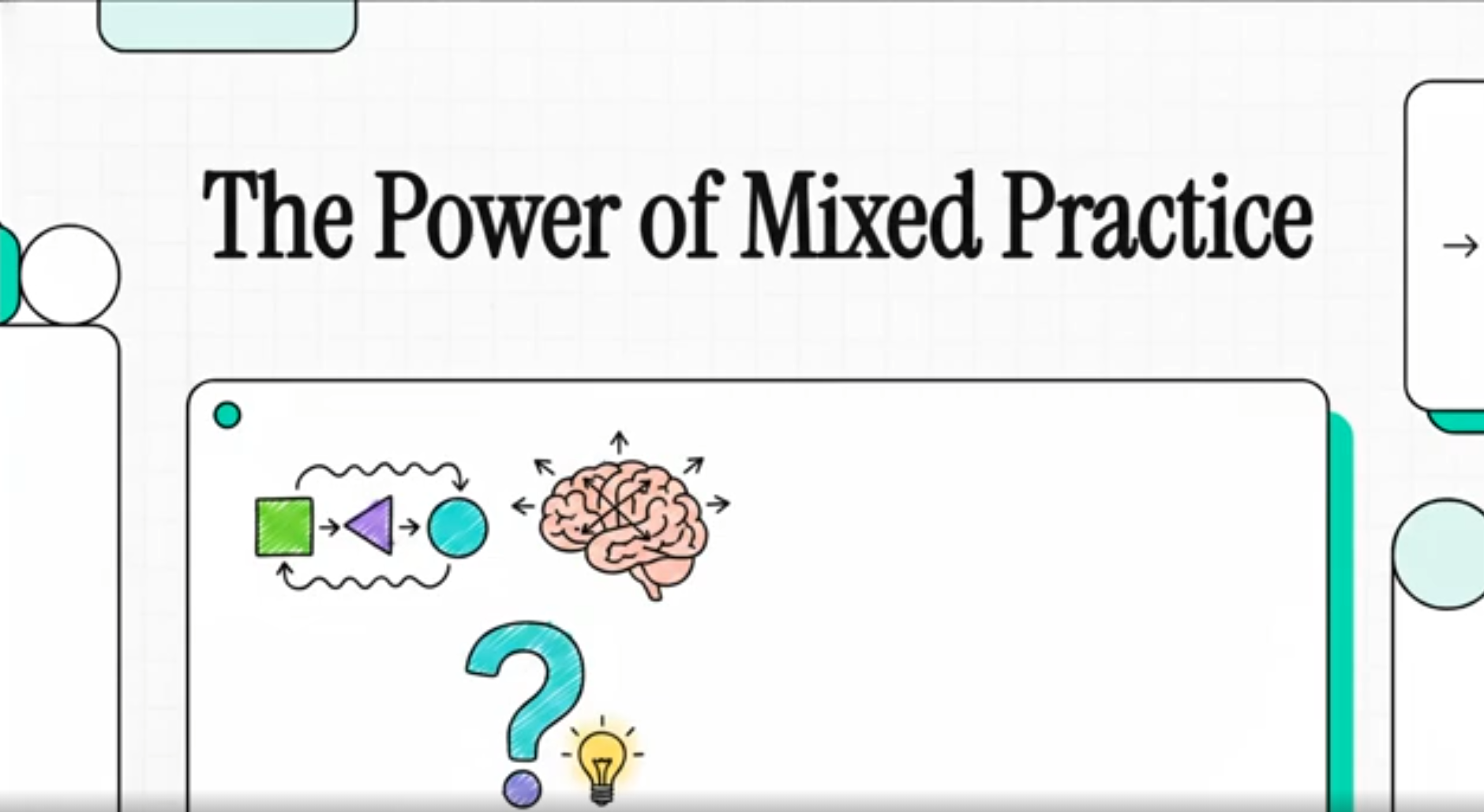
    What is interleaving? It’s simply switching between different topics. An important note, the topics need to be different but also related. This isn’t just randomized concepts. If you are learning topics A, B, and C, many people use blocked practice which is to focus on A until it is mastered, then moving on to B, and finally to C. So it looks like AAA, BBB, CCC. Interleaving has you mix these topics dynamically throughout your study session. So, it would look like ABC, BAC, CAB. You will still master the techniques, but you will do so more efficiently.

    So, how do you implement mixed practice? Your first step is to choose 3 or 4 related topics or concepts. Again, make sure that they are related and not just random topics. As an example, you can choose different types of math equations as your related concepts. You should not choose a math equation with spanish conjugation.

    Your second step is to break up your study session. Let’s say that you set aside 2 hours for studying. Instead of using all 2 hours on one topic, break it down into 15-20 minutes. Each subset will be its own concept. So, concept 1 will be the first 15 minutes, then switch to concept 2, then to concept 3. You rotate through until the 2 hours are up. Don’t be afraid to switch up the order instead of continuing 123, 123, 123.

    The third step is easier said than done. You will have an urge to master a topic before you move on. A lot of students have been trained to do this. You need to resist that urge. It’s ok to switch to the next topic before you feel completely comfortable with the topic that you are working on. Embrace the difficulty because it is where your memory will be built. 

    The final step is using something called discriminative testing. This is simply asking yourself what kind of problem you are facing. Which tool do you need and how do you use that tool correctly? So, for our example with math problems. If you are doing blocked studies of just repeated derivative problems, you never need to ask yourself what type of problem it is. Your brain knows that it’s asking for a derivative just like the previous 50 questions. With interleaving, you need to look at the problem and see if it is a derivative problem, or another type. 

    This discriminative testing is one reason why mixed practice works so well. Another reason this works is because it improves our problem categorization. In the real world, our problems don’t come labeled. By interleaving, we are training our brains to recognize patterns and selecting the right tool for the job. Think about construction. If you only face problems that require a hammer, you’ll never learn to know when a screw would work better. The last reason I’ll mention here is that interleaving gets rid of that false sense of competence. As stated at the beginning, when you do the same thing over and over again, you start to feel comfortable but you forget everything by the next week. Interleaving prevents you from getting this false sense of competence.

    One last example I’ll give is in sports. If you are playing tennis and you are working on forehands, backhands, and serves. Instead of hitting 100 forehands in a row, then 100 backhands, and then 100 serves, it would be better to mix. Have a partner send unpredictable shots your way to mimic real match play. Instead of being able to predict what is coming next, you’ll be training yourself to react in real time.


  • The Ultimate Guide to Elaborative Interrogation: The Science-Backed Way to Make Information Stick

    The Ultimate Guide to Elaborative Interrogation: The Science-Backed Way to Make Information Stick

    Have you ever heard of the power of why? Some say that it is a major factor in deciding what our brains remember and what they forget. We are wired to forget random facts. However, we love to remember stories and reasons. This is why rote memorization, which is just repeating facts over and over again, doesn’t lead to long term memory. So what can we do to remember new information? One solution is elaborative interrogation.

    Have you ever been around a younger sibling or cousin who just kept asking why? Children are naturally curious and this is how they learn. If you don’t want to be compared to a child, then think about detectives, trying to make connections and find out why something is true. Either way, you are practicing elaborative interrogation. You are taking new information and questioning why it is, how it is, or even, why it matters. You answer the question with information that you already know.

    Elaborative interrogation is easily defined by its two words. Elaborative means expanding information and you do this by connecting the new information to existing memory. Interrogation is questioning the material, the new information. This works because memory is what sticks and stays with us after a thought. A great way to remember a new fact is to think deeply about its meaning instead of focusing solely on surface-level keywords.

    There are three steps to elaborative interrogation.

    The first is obviously to identify the fact or concept that you are trying to learn. Look through chapter or lecture notes and just choose one to start with. As an example, use the fact that the human heart has four chambers.

    The second step is to ask the why question. To follow our example, why does the human heart have four chambers? You could also ask, why does the heart not just have one chamber.

    The third and final step is to answer. This step is where you can connect to existing knowledge or dig in deeper to understand the new topic. Back to our example of the heart, it can’t be a single chamber because it needs to keep oxygen-rich blood and oxygen-poor blood separate. It has four chambers so it can act as a dual pump to efficiently pump blood to the lungs at lower pressure and to the rest of the body with higher pressure.

    This works for a few reasons that are backed by cognitive science. First, similar to Feynman Technique, it removes the illusion of competence. Instead of explaining it in simple terms, elaborative interrogation forces you to answer why it is true. If you can’t explain why it is true, then you can find weak spots in your understanding. Second, by elaborating on the topic, you are increasing the encoding of the information into your memory. Think of this as your brain saving information to a hard drive. Since you connected the new information to existing memory, you’ve increased the chances that you can retrieve it later on. Third, this creates a conceptual schema in your mind. It turns an individual trivia fact into a web of logic. This makes it more difficult to forget as compared to an isolated flashcard. 

    Now that you know about elaborative interrogation, be sure to use it during your next study session. Learning new information shouldn’t be collecting facts like stamps, it should be about building a web of connections. 

  • The Feynman Technique: The Best Kept Secret for Mastering Complex Subjects 

    The Feynman Technique: The Best Kept Secret for Mastering Complex Subjects 

    Have you ever spent hours studying and not remembered a thing? It can be extremely frustrating. It feels like you’re reading the same thing over and over, putting in all your effort, and having nothing to show for it. In this post, we will go over a 4-step model based on the simple idea that if you can’t explain it, then you don’t understand it. This is based on the Great Explainer, Richard Feynman, who was able to explain complex quantum mechanics in simple ways. After mastering this technique, the Feynman Technique, you will be able to have shorter study sessions, increase retention of information, and gain real understanding of the topics you are focused on.

    The Feynman Technique is a framework that helps you identify gaps in your understanding. It does this by forcing you to explain concepts in plain, simple language. It’s ‘explain like I’m 5.’ The philosophy behind this technique is that comprehension isn’t about memorizing, but grabbing the core essence of the topic, the fundamental principles and turning that into actionable knowledge. This is another form of active learning. Compared to passive learning of rereading or highlighting, this method helps you retain information by focusing on the topic and clarifying the points that you don’t fully understand.

    Let’s move on to the 4 simple steps that you need to follow. 

    • First, you need to choose your topic. What are you studying? Write the title of the concept at the top of a sheet of paper.
    • Second, write out an explanation of the topic. Remember, use simple words and short sentences. Remove all the jargon and technical terms. This is where you explain like I’m 5.
    • Third, review the explanation and compare it to what you are studying. So, if your topic is the current chapter you are studying, you’ll compare your explanation to your text book. Look at where you got stuck in your explanation or where you accidentally used jargon. Use the book to fill in the gaps until you can explain it easily.
    • Fourth, refine your explanation. Read the definition outloud to hear if it sounds confusing and needs to be further simplified. It often helps to create an analogy. For instance, electricity flowing through a wire is like water flowing through a hose. 

    Now that we know the steps, why does it work? The Feynman Technique forces metacognition. It makes you think about your own thinking. It also shows you what you don’t understand, instead of mistaking familiarity with comprehension. Also, by removing jargon and technical terms, you force your brain to build new connections rather than just parroting a memorized phrase. Combined with spaced repetition, this technique strengthens neural pathways by engaging brain activity and converts the short-term memory into long-term knowledge.

    Learning doesn’t have to be a grueling, never-ending study session focused on memorization. Stay curious, ask how and why, and explain topics as simply as possible. 

  • Spaced-Repetition

    Spaced-Repetition

    Have you ever crammed for an exam only to forget the information the next day? Or studied a topic for hours on end, only to forget it during the exam? These are both common frustrations among students. The solution is simpler than you are probably thinking. You don’t necessarily need to study more, you just need to study smarter. This is where spaced repetition comes in. In this blog post we will cover what spaced repetition is, why it works, and how to do it. We will also cover the benefits and give an example.

    Let’s start with what spaced repetition is. It is a study technique where you review material over gradually increasing intervals of time. So, you start looking at the information every other day, then every few days, then once a week, etc. This way, as soon as you are about to forget it, your brain is forced to actively recall the information. This works with research on forgetting. Hermann Ebbinghaus discovered a now famous curve of forgetfulness. His research explains that if we periodically retrieve information, it will allow us to remember that information for longer. This repeated strengthening of memory will lead you to be more successful than an all night cram session. 

    There are a lot of benefits of using spaced repetition to study. Since it works based on the forgetfulness curve, it improves long-term memory. This is great for when you have cumulative exams and when information is built on from one semester to the next. This method also allows you to spend less time relearning material. In addition, since you are taking breaks and spreading it out, spaced repetition makes studying more effective. As an added bonus, the repeated recall will increase your confidence before an exam. This and more explains why spaced repetition is better than cramming.

    Now that we’ve covered what space repetition is and why it’s beneficial, let’s focus on how to use it. I’ve used spaced repetition for a variety of information. For instance, vocabulary and definitions, facts and concepts, and formulas. You can study these topics with spaced repetition by creating flashcards, prompts, practice quizzes, and even summary notes. As the name suggests, an important part of this method is the spacing. So, be sure to create a review schedule that works. Start off with reviewing a topic often and extend the intervals as your memory improves.

    Here are some examples for spaced-repetition. Let’s say that we are learning vocabulary. We can create flashcards. We write the word on one side and the definition on the other. Go through each card until you get the definition and the word correct. Repeat the next day, then in three days, then in 5 days. If you get a word correct each time, put it in a separate pile to review less often. This makes sure that you are reviewing all of the material and you aren’t wasting too much time on information that you have already mastered.

    As with most study methods, there are some common mistakes that you should avoid. Don’t wait too long to start. Since the intervals between sessions need to increase, you should start this method far enough in advance of the exam. For instance, if you are preparing for a final exam, you should start at least a month or two ahead of time. You will be tempted to just read the flashcard or other information. You have to ignore the temptation and truly test yourself. It’s just studying, there’s no penalty if you don’t know the information yet. So, take your time and do it properly.

    Focus on the difficult material. As mentioned above, once you get a question right repeatedly, move it to another pile so that you can focus on the topics that you are having trouble with.

    The last mistake is giving up after missing a review session. Life happens. Sometimes we will miss a day or two of studying. If that happens, just continue where you left off. Don’t stop completely and don’t just cram at the last minute.

    Just some final tips for spaced repetition. Keep review sessions short and take breaks. Use the pomodoro technique to balance time and avoid burnout. Be sure to really test yourself instead of just reading the answer. Start slow and build up as you master this study technique. Good luck on your exams!

  • Active Recall

    Active Recall

    The study tip for this week is active recall. Active recall is a study technique that forces you to pull information from your memory, rather than just reading notes off of a page.This is why it is considered active, because you are not just passively reviewing your notes. You are consciously attempting to remember all the information that you have learned. This is an excellent technique to move information into long-term memory. 

    One of the more obvious ways to do active recall is through flash cards. Most people know flashcards because of vocabulary. You write the word on one side of the card and the definition on the other side of the card. You then create a deck of cards with all of the new words that you are trying to learn and flip through the cards as you pick up new vocabulary. 

    This technique is useful for more than just vocabulary. You can use this technique for dates, people, etc. Even for philosophies. You can put the philosophy on one side of the card, and the 3 main points of that philosophy on the other. You can also start with either side of the card. So going back to the vocabulary example, you can read off the definition and then give the word. You can also read the word and give the definition. This ensures that you will be able to recall the information on the day of the test, no matter how the question is worded. 

    Another way to study with active recall is to give yourself a practice test. This allows you to practice your new knowledge but also to become more comfortable with taking tests. Before the day of the test, try to practice with not only the information but also the method of testing. To do this, you might want to ask your instructor what the test looks like. Will it be multiple choice, short answer, or an essay? It could be a mixture of these as well. Then, you create the same style of questions to be your practice test.

    This still qualifies as active recall because you are consciously grabbing the information from your memory instead of just passively reading over your notes. This also helps you write out your answers and thoughts, in a way that flashcards don’t always allow for. So, not only are you more likely to remember the information but you have practiced how best to write out the information. This can also lead to you remembering more details and can help build your confidence before the test.

    Active recall is a great way to study for a test and confirm what you know. There’s many ways of doing it, so find which way works best for you and give it a try.

  • Mastering the Pomodoro Technique

    This week, we will cover the importance of taking breaks. The best technique for this, that I’m aware of, is the Pomodoro Technique. This relatively straightforward technique requires only a timer and discipline.

    At its core, the Pomodoro Technique is breaking work down into intervals of time. The first intervals that I used were 25 minutes of work followed by 5 minutes of a break. I would complete 4 work sessions and then take a longer break of 30 minutes. I found that these were the best balance of work and rest during my study sessions.

    There are 4 steps for the Pomodoro Technique. The first step is to identify the tasks that you want to work on. For your first session, I suggest sticking to one subject or chapter. The second step is to break this task into chunks. For instance, if your task is a chapter, then break the chapter into sections. The third step is to gather everything that you need. Grab your laptop, textbook, notes, etc. The final step is to choose a reliable timer. This can be on your phone, computer, or even a kitchen timer. Once these steps are completed, you can begin your study session.

    When you are ready to begin, set your timer for the chosen interval. Once you start your timer, focus solely on the task you selected. Work without interruptions. If you are interrupted, record the interruption. This will help avoid it in the future. Then, return to your task. At the end of the interval, take a break. Good job! You have completed the first interval and can now repeat until you have finished your entire session.

    As you continue to practice studying with the Pomodoro technique, you will find ways to maximize efficiency. Use what works best for you, but I have found that these tips help me. 

    First, test a variety of lengths for your intervals and sessions. I find that a 25:5 ratio is often best for me, even now. During my undergraduate studies, I had a job. I found that 30-60 minutes was often the most time that I could easily block together in my schedule. However, for my graduate studies, I was able to create 4-hour blocks of study time. Sometimes, I even managed 8-hour blocks. The 25:5 ratio was easy to scale.

    My second tip is to remove all distractions. For  me, if I questioned if something could become a distraction, I moved it. Some days this meant that I was facing a wall and nothing was on my desk but my books and paper. A friend of mine would turn his phone and computer to grayscale so that they would be so tempting. Others just turn off notifications or set the phone as ‘Do Not Disturb.’ Sometimes you will be more easily distracted and so you should always think about what might distract you before you start each session.

    This leads to creating or choosing a conducive environment. Select a space that fits you. Some people need the ambiance of a cafe or the imposing silence of a library. Some like the quiet, private space of their bedroom while others like a park. The Pomodoro technique can be used wherever you are. The important thing is to find a place where you can focus on your task.

    It is equally important to take meaningful breaks. In order for the Pomodoro technique to prevent burnout, you need to take real breaks that pull you away from your task. These should act as a type of reset. Don’t just switch to another mentally draining task or doomscrolling. Personally, I use this time to meditate and clear my mind. I focus on my breathing, my posture, and clear away any thoughts or items that are threatening to distract me. It’s also a good pause to grab a quick cup of tea or something to drink while you work. Whatever you choose to do, the break should be a relaxing reset to prepare you for the next interval.

    There are many benefits to taking breaks and using the Pomodoro technique. It provides structure and direction. Once you set your timer, you don’t have to worry about how much longer you should study. Since you’ve already chosen your time ratio, you also don’t have to worry about taking too long of a break. By eliminating these worries, you enable yourself to maintain focus and increase productivity.

    It may seem counter-intuitive, but planned breaks help renew focus, enhance productivity, increase creativity, and reduce stress. No one can remain focused on a topic or project forever. Taking a break allows you to clear your mind and recharge. It’s like working out, you need some rest time to alleviate fatigue. In this case, it’s mental fatigue. Also similar to breaks during a workout, these breaks will help boost cognitive performance and, with persistence and consistency, they can also improve your attention span.

    Continuing with the workout analogy, breaks allow us to maintain our productivity levels. They allow us to remain energized, motivated, and in proper form. As we continue these focus times, we will become more energized and more motivated to continue focusing and improve our study routines. With increased energy and motivation, we won’t be as easily overwhelmed by the amount of studying. This will reduce stress levels and keep our mental health in check for when projects are due or when exams are on the horizon.

    Some people also say that taking breaks leads to creative thinking. Removing focus temporarily can stimulate your creativity and overcome mental blocks. Oftentimes, when you are stuck on a problem, it’s best to take a break, step back, and try a new approach. Sometimes those short breaks can improve your problem-solving skills and innovative thinking.

    Remember, taking care of yourself is an investment in your long-term academic and personal achievements.

  • Staying Calm During Midterm Exams

    After all your work and preparation, midterm exams have arrived. These exams bring a lot of stress and anxiety, especially the first year. Don’t worry, you’ve got this. You’ve been preparing for this week, so focus, review, and don’t cram.

    For this week, remove all distractions that you can. Cancel plans that aren’t necessary and make your study sessions count. Don’t overdo it. A good night’s worth of sleep beats an all-night study session in the library. Additionally, make sure you get some exercise and fresh air. This will help increase focus and relieve stress naturally. Finally, be sure to eat a balanced diet. This also helps you focus and make sure that you don’t have brain fog.

    You’ve done the studying and now you have a plan for mitigating stress. Let’s move on to some test taking strategies. 

    When you first begin the test, look it over. Read all of the questions and answer the obvious questions. After you have marked all the obvious questions, go back to the beginning. Don’t get stuck on the questions that you don’t know. Just mark the questions that you aren’t sure of and move on. When reading a question, make sure you read the entire question and the answers. On multiple choice exams, you can usually eliminate an option or two that are obviously wrong. If you must guess, this elimination will at least increase your chances of being correct.

    For essay questions, create an outline to stay organized. If there are also multiple choice questions, they may have some information you can use as ideas or reminders for the essay, so be sure to read them before writing. 

    Exam anxiety is a real thing that often occurs before or during the exam. When you notice that your anxiety is building, take a deep breath, you’ve got this under control. Take a moment to focus on your breath and settling down. When you finish the exam, spend a few minutes reviewing your answers before submitting.

    When you have finished all your midterms, go celebrate! You’ve worked hard and have earned a break. Don’t worry about the exams anymore, there is nothing you can do about them now. So, relax and enjoy a break until the second half of the term begins. And congratulations and making it through midterms!

  • Preparing for Midterms

    Preparing for Midterms

    Now that the semester is underway, it’s time to prepare for midterms. This week we will cover different techniques for taking notes in class and different ways to study. I recommend that you try each process and then think about which one worked best for you. We will first look at studying before class, the class lecture, and then studying after class.

    You should always read the chapter before you go to class. This allows you to understand more of the lecture and will also notify you of any topics that you might need to ask questions on. Most textbooks are written in a way that will guide  you in preparation. For instance, it might have a section at the beginning on how to use the book. Most chapters will start with a list of the topics covered, new vocabulary, and what objectives you should understand by the end of the chapter. Some will also include chapter outlines, or end the chapter with review questions. Use these to your advantage.

    When I would first approach a chapter, I would first look at all the section headings. This is a great way to get a quick overview of how the information is organized. I would then look at the learning objectives to see what was important in this chapter. Then I would make flashcards of all the key terms that I wasn’t familiar with.

    I would then read the introduction and conclusions, if there was one, to again, get a quick view of what would be covered. Then, I would read through the chapter. I would generally just read once and have organized notes on a separate piece of paper. I know people who read the chapter three times. The first is just a quick skim, the second highlights or questions, and the third read is a comprehensive read.

    When it came to taking notes on the chapter, I would summarize each section, in a couple of sentences or so. I would also try to connect the information to a subject I already knew. These are excellent examples of proactive reading that will help you retain the information rather than just reading on its own. When you’re done reading the chapter, complete the chapter review questions and also ask yourself if you understand the learning objectives for that chapter. Write down any questions that you have and you can ask your study group or instructor, during class, or at office hours.

    Now that you’ve read the chapter, it should be easier to follow along with the lecture. Be sure to take good notes as you listen, but don’t write everything down verbatim. Trying to copy down every signal word is stressful and then you miss one word and while you’re trying to figure it out, you’ve fallen behind. Instead, summarize key points. You can also prepare your notes a bit before class. Check if your instructor posted the presentation in the LMS. If so, you can download or print it out with note sections for each slide. If not, don’t worry. There are plenty of other techniques like outlining, mind mapping, and Cornell Notes. Also, you can pool notes together with your study group to make sure that everything is covered.

    Let’s look at these techniques one at a time. The first one is outline. This helps keep your notes organized and is sometimes more easy to focus on compared to a long block of text. This technique can also force you to be more succinct in your paraphrasing or summary. An easy example of outline would look like the following:

    1. Chapter 1: Introduction to Psychology
      1. Working in Psychology
        1. Learning Objective 1: Define Psychology
          1. Psychology is the study of behavior and mental processes
        2. Learning Objective 2: Fields of Psychology
          1. Behavioral neuroscience – examines the biological basis of behavior

    Personally, I find outlining easier with reading than with lecture, but I know a lot of people who have found success using outlines during lecture.

    The next technique is mind mapping. This tends to take up a lot of space and may be easier with a computer, but it is possible to do it by hand. Using the outline example, the mind map would look something like this:

    Mind mapping is customizable and you can base it on whatever connections you see. You also don’t need to complete it in the same block style that I used in the example. You can draw it however you find easiest to visualize the information. One of my students told me that when they draw mind maps, they picture each thing as a cloud and therefore spread them all over the page. Another student saw the main heading as a hub and all the other items as spokes, and together would create a wheel.

    My go to note-taking system was Cornell Notes. For this system, you’ll break your page into three sections. The left column will be topic cues or questions and the right column will be a bit wider and will be the bulk of your notes and key thoughts. The third section will be about the bottom quarter of the pager. This space will be for summarizing your notes for the section.

    You’ve now read the chapter and had a lecture on it. Now it’s time to fill in any missing information or answer those last few questions. Once you do, you can then start studying and find ways to make sense of and remember all of the information so that you are ready for the exam. We’ll cover 3 study techniques that I’ve had success with. First, active recall; second, mixing topics; and third, the Feynman Technique.

    Active recall is when you retrieve information instead of just reading it. For instance, after reading a section, close your book and recall what you just read. Are you able to remember all the important points? This is a good way to find out which sections you should spend more time on.

    The second technique is mixing topics. If you study topics in the same order, you start getting the right answer because you are aware of the pattern after you’ve gone through it so many times. So, once you’ve gotten them all right, shuffle the topics and see if you can still get them all right. If you can, it’s a good sign that you know the information well enough to recall it on the exam, no matter the order.

    The third study technique is the Feynman Technique. In this technique you learn by teaching. Grab a friend and teach them what you’ve learned and get feedback. Ask if there were details you got wrong or if you didn’t cover something in enough depth. Teaching not only helps us understand, but it also points out areas that we don’t confidently know. This is a great activity to complete with your study group. Divide the chapter into equal parts, assign one per person, and teach the group on your assigned section.

    None of these techniques are one and done. Choose which one, or a combination of them, that you want to utilize and repeat it over and over again in a strategic manner. This is called spaced repetition. Hermann Ebbinghaus, a psychologist, studied memory and forgetfulness. He found that after just one day, people could forget up to 70% of new information. It is a really steep drop with just the first learning. However, you can lengthen the curve by reviewing the information multiple times. So, be sure to study repeatedly, such as the day after lecture, then 2 days later, and again 3 days after that. It will become easier each time and then you’ll just need a quick review for exams.

    The last thing we’ll cover here regarding study sessions is the importance of study breaks. Taking breaks helps calm you down during frustrating situations and prevents burnout. One technique I use is the Pomodoro Technique. For this, you usually will work for 25 minutes and then break for 5 minutes. If it’s something that needs more time, you can work for 50 minutes and then take a 10-minute break, just keep that ratio the same. Also, remember that you can work for 25 minutes, break for 5 minutes, and then work for 25 minutes again. The Pomodoro technique is for this type of repeating, rather than working for 90 minutes straight and taking a 20-minute break.

  • Time Prioritization

    Time Prioritization

    Next, we turn to the Pareto Principle, Eisenhower Matrix, and other time prioritization techniques.

    The Pareto Principle, also referred to as the 80/20 rule, suggests a significant portion of results come from a small fraction of effort. Specifically, 80% of the output comes from 20% of the input. Only 20% of the input is responsible for 80% of the output. People have often used phrases like the vital few or trivial many. These phrases emphasize that when getting things done, it is quality over quantity. 

    Keep this principle in mind. This way, we ensure our 20% of ultra-productive time focuses on the correct task. For instance, if we are at our most alert in mid-morning, we shouldn’t schedule menial tasks at this time. Instead, focus on activities that require more brain power. Save the menial tasks for when you are less alert. Similarly, if your instructor has office hours, use this time for assignments that are complex and pressing. Handle simple questions at another time if they can wait.

    Eisenhower Matrix

    One technique to visualize priorities is the Eisenhower Matrix. This simple but effective chart has 4 squares total, two squares over two squares. The two columns are marked as “Urgent” and “Not Urgent.” The two rows are marked “Important” and “Not Important.” You first take all your tasks and sort them into one of the four quadrants. For the quadrant that is both “Urgent” and “Important,” you complete those tasks. Those tasks that are “Urgent” but also “Not Important,” these can be delegated. For tasks marked as “Not Urgent” but “Important,” these tasks need to be scheduled. Finally, tasks that are deemed as both “Not Urgent” and “Not Important” can be skipped altogether. 

    Rankings

    Other techniques, going by countless names, start by making a list of all activities, chores, assignments, and other tasks. Instead of putting them in quadrants, these other techniques keep all the items in a list. They either move items up and down the list based on priority or time required. They also might color code the items to visualize high importance items or things that can be done quickly. When ranking items by importance, these are some questions you can ask to help. Which task has the most impact? What would be the worst thing if this item isn’t completed?

    2 Minute Rule

    If you are ranking by time, the 2-minute rule can be useful. This simple rule recommends immediately completing every item that should take 2-minutes or less to complete. This can help motivate you to complete other tasks. You will see progress in checking tasks off of your list. One word of caution, these two-minute tasks can add up. Make sure you aren’t spending all your productive time on these items.

    The final technique to prioritize time is avoiding over-commitment. Be honest with yourself and your time restraints. Learn to say no to some events and tasks to prevent being overwhelmed by obligations. This may be one of the most important skills that you will need to learn in college. 

    By avoiding over-commitment and prioritizing your time, you can complete all of your tasks at university. When you get overwhelmed, take a deep breath. Remember these techniques to simplify your load. Use them to complete your to-do list.

  • Estimating Time

    This week, we will cover a few specific time management techniques that will further help with your schedule. We will be covering 3-point time estimations, breaking down tasks, and making task comparisons. These techniques help make scheduling more accurate.

    3-point Time Estimation

    3-point time estimation is simply creating three different time estimations for an event. The first is an optimistic estimate. This is the shortest amount of time that something will take. This estimate is the best case scenario. If everything goes right, this time estimate is good. The opposite estimate is the pessimistic estimate. This is the worst case scenario. This is the longest that something will take. This estimate assumes that everything that can go wrong, will go wrong. The third estimate falls in the middle. It is the most likely or most realistic of the three time estimations. This estimate will consider common obstacles or likely delays. It ignores extreme interruptions that probably won’t happen. You can use the difference in time estimates as part of your time buffers. By using these three estimates, you can get a more accurate idea of how your day will probably go. 

    Breaking Down Tasks

    The second technique, breaking down tasks, is also rather simple to understand. Most tasks, like writing an essay, include multiple parts or steps. Instead of scheduling a block to complete your essay, make time to write an outline. Then create a draft, complete a review, and so on. This will help motivate and guide you with the essay. It will also help you estimate time more easily and accurately. This is similar to breaking down a task into more manageable parts to help complete the tasks. Instead of requiring an estimate for the entire process, you just need estimates for the parts. This is beneficial because smaller steps are easier for us to think about. Also, by breaking the task into parts, we can make more accurate time estimations. Breaking tasks down into smaller parts makes it more manageable to schedule the tasks out.

    Time Comparisons

    The third technique is time comparisons. While it sounds easy, it can become a bit complicated in certain situations. The important thing is to make real comparisons. You have to be sure that the two tasks are similar. I find it best to use this technique on tasks that are often repeated. For instance, responding to emails and social media messages can take up similar amounts of time for me. However, this requires that the number of emails matches the number of messages. If not, the comparison is wrong. Also, this assumes that you put the same amount of thought and time into both emails and social media replies. Similarly, if you want to estimate the time to read a book, you must compare the books first. Are they written in similar styles? Are you equally interested in their topics? While you have to be careful about your comparisons, tasks that are truly alike allow you to easily make a time estimate. You don’t have to reinvent the wheel, you can trust your experiences.

    When used correctly, these three techniques will help you become better at estimating time. With practice, 3-point time estimations, breaking down tasks, and task comparisons will help you improve your scheduling.

  • Time Blocking and Theme Days

    When scheduling out your week, there are two huge techniques that you can use to simplify the task. The first was briefly mentioned in the last post and it’s time blocking. The second technique is to have theme days. I personally use both of these techniques and they have helped me immensely.

    Time blocking can be very helpful for flexibility in the overall schedule. By scheduling a 3-hour chunk of time for studying, you change your perception of the task. The schedule is no longer rigidly 2 to 5. If you start a little late, you can still accomplish the 3 hours. You just use some of your buffer time. More importantly, by seeing it as a block, you can move it around your day or even your week. The hope here is that you do not skip the task completely. Instead, you move it and complete it at a different time.

    It’s important to note that not all time blocks have to contain a task. In fact, you should have at least one daily block that is empty. You should also have one larger block for the week that is empty. These can be used for the occasions when time blocks need to be moved or unexpected tasks are added. When these things happen, adjust and make notes so that you can improve your ideal 168-hour schedule.

    The second technique is to create theme days. This lets you focus on similar topics within a day. It could make it easier to switch between tasks. For instance, you can do math and science on Mondays and Wednesdays. You can do English and History on Tuesdays and Thursdays. You can dedicate Fridays to a foreign language or administrative work.

    Another idea that is available, is to create theme days based on work load. For instance, if English and History both have long reading assignments, don’t also schedule email tasks that day. Also, think twice before you put two difficult subjects or two subjects that you dislike on the same day. You may be different. I found it hard to stay motivated all day if every task seemed daunting. It was also hard if I didn’t want to do the tasks.

    These are two really simple techniques that can be extremely useful when you are creating your weekly schedule. These time blocks and theme days can help you start a productive routine. They also can help you stay flexible which will make it easier to continue your new habit of scheduling. 

  • The 168-Hour Audit

    The 168-Hour Audit

    Managing your time when you first start university can be challenging. Without the structure of high school, many students feel overwhelmed. They think there is too much to do but not enough time to do it. At the same time, they also believe there is so much extra time. In the coming weeks, I’ll share the scheduling techniques I used. These helped me balance work and school. I also managed to include sleep and keep a social life.

    The first step we are going to take is to create an ideal week. This entails auditing all 168 hours that we have each week. This weekly schedule, while ideal, should also be realistic. This plan helps in two ways. First, it visually shows us how we spend our time. Second, it creates a gentle, non-perfectionist plant for the week.

    Before you start planning, you need to know what your time obligations are. So, for the next 7 days, track your time. You can write entries by hand or use a journal app, but make sure you keep track of every minute. This includes sleeping, getting ready, meal prep, eating, cleaning, etc. At the end of your week, you’ll have a detailed reference sheet. You can refer to this sheet when making your plans.

    Now that you have a good idea of where your time goes, it’s time to start planning your ideal week. First, look at your time anchors. These are the plans that you don’t control, such as work shifts and class times. As the name implies, these will be the anchor points that you will schedule your week around. Personally, I also put 8 hours of sleep as an anchor to make sure that I get plenty of rest. Next, add commute times for class and work. Also, add any routines before bed or that you do in the morning. Once all of your anchors are placed on your schedule, include their indirect activities. Then, you can begin to add times for eating. You can also add times for studying and other activities.

    There are three common issues that I see when people are planning their week. First, over-stuffing. Be realistic with what you can accomplish in a day. Second, forgetting buffers. Sometimes delays happen, you need to be prepared. Third, ignoring transitions. It takes time to move from one task to the next, so make sure that you make time for it.

    To avoid the pitfall of over-stuffing your schedule, look at the week you recorded. If your recorded week was very busy, don’t add to it. If, on the other hand, you had a lot of free time, over-estimate how long additional tasks will take you to complete. You can also short the time something takes you for the plan next week.

    The second common error is forgetting buffers. Add empty space at the end of activities in case they run over their allotted time. Also, remember to plan in breaks and rest periods to avoid burn-out. Taking breaks isn’t optional, they are essential to being able to get things done.

    Finally, to overcome the last error, you must be cognizant of the time spent in transition. This includes everything from switching tasks even while at the same desk to walking to your car. While this may seem petty, there are two big reasons to be aware of your time in transition. First, these moments tend to take longer than we think and they quickly add up. The second reason, and maybe more important than the first, is that transitions are when we are arguably the most likely to be distracted. Delays often happen during these times.

    Start tracking your time. Create a schedule. Tweak it as needed to improve the accuracy of your schedule. Take back control of your time and productivity!

  • Laying the Foundations for a Successful Term

    Laying the Foundations for a Successful Term

    Welcome to the first week of term! You prepared. You know where your classes are. You’ve read all your syllabi. Even so, there are still going to be some growing pains. You’re in a new environment, don’t worry if not everything is going perfectly to plan. The following will help you lay the foundations for a successful college term. Do what you can and remember to breathe. 

    This week, there are 7 things that will help set you up for success. A few of the items are just diving a little deeper into things that you worked on to prepare for this week. This things include becoming familiar with the syllabus, office-hours, and knowing where things are on campus. We also will be dipping into time management and study skills. We will even be touching a little on financial management. It is an extremely important skill for everyone. It is especially important for those of you who are living away from home.

    Let’s start in class. The first time your class meets for term, there are three things that should have your special attention. First, the LMS login, be sure you know how to login to the LMS, such as Canvas, Blackboard, or Moodle. Second, familiarize yourself with navigating the LMS. Third,  become an expert on the syllabus.

    For the LMS, familiarize yourself with the home screen. Most LMS have tabs for Dashboard, Courses, Calendar, and an Inbox. I’m going to focus on the Courses tab because this is where all of your course information will be. Generally, on each course, you’ll see Announcements, Modules, Grades, Syllabus, Assignments, and Discussions if they’ll be used in the course. Sometimes, the Grades page will allow you to enter your own scores. This way, you can see exactly what you need to pass. You can also estimate what final grade you will receive. If your instructor has mentioned that assignments must be submitted through the LMS, ensure you understand how to navigate to those pages. Also, know how to upload files and join the discussion board to provide responses.

    The LMS should also have a digital copy of the syllabus. In university the syllabus is almost a type of contract between you and the instructor. It will list policies and expectations of you but also of the instructor. For instance, in my syllabi, I always told my students that they could expect a response from me within 48 hours. Students also knew when I was going to have exams and what we were going to cover each day in lectures. The syllabus also has the grading information. This is really important. Let’s say that the total points for the course is 1000 and that the grading scale is 90-100 for an A, 80-90 for a B, 70-80 for a C, etc. That means that if you want an A in the class, you just need 900 points.

    I don’t believe it’s common, but for one of the classes I took, that meant that I didn’t need to take the final. I only needed to score high enough in the other exams, assignments, and discussion boards. Playing the point game in this way can alleviate stress. This is especially true if you’re the type of student that worries over every missed point. It’s extremely important to note that some instructors don’t count all points equally. This means that some of them will state that exams will equal 60% of your final grade, even if the points only count for 30. So, be extra careful when seeing how different things are weighed in the grading scale.

    The syllabus will also have information about office hours and best ways to contact your instructor. Go to the office hours the first week, just to drop in and introduce yourself. Start the relationship on the right footing. Also, this will make it easier to go to office hours later in the term if you have a  question or need help on a topic. Beyond just this semester, it’s beneficial for your instructors to know who you are. They can provide a reference for an application if needed.

    You’ve read the syllabus. You know all the meeting times and assignment due dates. You can start updating your calendar. Your class meeting times will be your timeblock anchors. These cannot be moved or missed. Once you have all your anchors listed on your schedule, you can start planning your work, studying, and friends around those anchors. You really start to see clearly how much time you have in your week. You can also add all the assignment and exam dates. Set reminders a week or two before exams to remember to study. I would also put a note of when office hours are. This way, you have a quick reference spot instead of having to search the syllabus each time.

    Before we leave the class, there’s one final thing we need to do. Meet classmates! I usually would talk to the people next to me, in front, and behind me. Generally, you should meet at least three people. However, I’ve had classes where I’ve just met one person before and it was manageable. It doesn’t have to be people who are sitting next to you either. I’ve created groups just from the people who always arrived at class at the same time as me. Knowing people in the class can be extremely helpful during the course.

    Exchanging contact information, even if it’s just the messaging system built into the LMS, is beneficial. Your classmates can help explain topics to you and you can explain topics that confuse them. Teaching others is a great way to learn. In addition to helping each other with studying, you can also remind each other of upcoming due dates. If one of you misses a class or zones out during a lecture, the others can fill in any missing information. 

    This leads into a study system. A lot of students find that their way of studying in high school doesn’t work well at university. Don’t be discouraged, just be willing to try something new. Use what has worked for you in the past and adapt it to university. Personally, I would always spend a little time after each class reviewing my notes. This would typically take no more than 20 minutes. I would also fill in anything from the lecture that I remember but didn’t write down. It’s good to put this information down while it is still fresh in your mind. Then, later when I was actually studying for the class, my lecture notes were more accurate.

    Also, remember the earlier schedule with the timeblock anchors? Add study time into that schedule. Don’t forget to add in study breaks, those are important. A helpful way to schedule study and breaks is the Pomodoro Technique. This will have you studying for 25 minutes. Then, take a 5-minute break. You can also choose to study for 50 minutes. After that, take a 10-minute break. Choose what works best for you. 

    While on campus, look for convenient places to study. The library is the obvious choice. The student center may also be a nice space. Depending on the weather, studying outside could work well too. The important thing is to find a place that is comfortable but also has what you need. For instance, if you have a laptop with low battery, sitting outside away from any outlets probably isn’t the best choice.

    Also while on campus, just like how you went to the first office hours, also drop by the tutoring or writing center, or any other place that is set aside for student services and academic support. It’s extremely helpful to be familiar with these places and the people before you need help. When you do need help, go to them right away. Don’t wait until you are drowning in assignments. Reach out for help early. They are there to help you year-round. You don’t need to be failing a course to get help. In fact, a lot of writing centers will proofread your essay before you submit it. They will give you ways to improve your writing.

    The final thing that you want to figure out before the end of your first week is your budget. This is mainly for students who aren’t living at home, but it’s always good to know how to budget. It’s important to be familiar with your rental agreements to see what is covered and what’s not. Generally, the university covers utilities and internet. Be sure those aren’t expenses that you’ll have to cover. You’ll also want to budget for groceries. Even if you are on a university meal plan, you may need to supplement that.

    This first week of term is a great way to test how much you’ll be spending day to day. Cutting out coffee won’t save you enough money to buy a house. However, skipping the coffee a couple of times can help you save up for a campus event. For instance, during my first week, I learned that at the end of the year, there was going to be a huge party on campus. This party was to celebrate the end of term, but it was going to be $200. So, instead of going to a coffee shop on campus everyday, I went to the student center. They had some instant coffee and tea available for free. I quickly had the money saved that I needed for the party after final exams.

  • How to Prepare for Your First Week at College

    How to Prepare for Your First Week at College

    The first week of term can be stressful. The parking lots are full, you aren’t sure where your classes are, and you may be running late.

    Luckily, there are things you can do to ensure a smooth first week. It just takes a little planning.

    Let’s first focus on the campus. Most universities have a campus map posted online. Use this map to see where your classrooms are and where the best parking lot is. You can also get directions so that you know how long your commute will be. You should also find the locations of the student services building, tutoring center, and library. Check where other useful buildings are on the map too.

    Once you know where things are on the map, it’s time for a dry run. I usually do this a week or two before term starts. I’ll use my commute estimate and leave for campus as if I have class that day. When I arrive, I buy the term parking pass if I need one, and I go to my first classroom. I take note of how long it takes to walk to class. Then, I walk around campus to find my other classrooms and department offices that I need. This is also a great time to grab your student ID card.

    Now that you are comfortable with the campus, let’s prepare for class. Most instructors will post online or email their syllabus for the course. Read through this. While the first day of class will review the syllabus, it’s nice to be prepared and have some familiarity.

    A good syllabus includes all the information that  you need to succeed in the class. It will have a calendar of lectures, assignments, and due dates. It will include contact information and office hours. Grading scales, total points, and rubrics will also be provided. Additionally, it will have the textbook information or other required materials.

    Review all of the information. Add all the scheduling information into your calendar. Then look at the textbook and lecture notes. Look when Chapter 1 will be discussed in class and make sure that you read the chapter before that lecture. Still, that doesn’t mean you should go and buy the book immediately. Compare the pricing at the bookstore and online.

    You can search by the textbook ISBN above the barcode to verify the correct edition. See if you can rent, buy used, or get a digital copy of the textbook to save some money. Better yet, see if the library has a copy that you can use. If the library doesn’t have a copy, speak to a librarian about the possibility of procuring a copy. Oftentimes class textbooks can only be read in the library and not checked out. This is fine, just be sure to find out so that you can schedule study sessions accordingly.

    Once you attend class, you can usually find out how important the textbook is for the course. Some instructors only test on material from the lectures. For classes like that, a reference copy of the textbook at the library is enough. However, if the instructor frequently references the textbook in class, the best choice is to find an inexpensive version. You will need it to study from home.

    Now, you should be ready for a smooth first week. You’ve mapped your way to campus and timed your walk to class. You know where key campus locations are. You have your student ID and parking permit. You’ve reviewed your syllabi for all your classes.

    Best of luck and have an excellent term!

  • Why Tracking Progress in Your First Year of University Is Crucial

    Why Tracking Progress in Your First Year of University Is Crucial

    Embarking on the journey of university life is an exciting and transformative experience. The first year marks a significant transition from high school to higher education, bringing with it a plethora of challenges and opportunities for personal and academic growth. Amidst the whirlwind of lectures, assignments, social events, and newfound independence, it can be easy to lose sight of one crucial aspect: tracking your progress. Here’s why keeping tabs on your development during your first year of university is essential for success:

    1. Tracking Progress: Self-Awareness and Reflection

    Tracking your progress allows you to gain insights into your strengths, weaknesses, and areas for improvement. By regularly assessing your academic performance, extracurricular involvement, and personal development, you can identify patterns, set realistic goals, and make informed decisions about your future endeavors. Moreover, reflection fosters self-awareness, helping you understand your learning style, preferences, and values, which are fundamental for navigating your academic journey effectively.

    2. Tracking Progress: Motivation and Accountability

    Setting specific, measurable goals and monitoring your progress towards them provides a sense of direction and purpose. Whether it’s aiming for a certain GPA, finishing a project, or learning a new skill, tracking your milestones enables you to stay motivated and focused on your objectives. Additionally, sharing your goals and progress with peers, mentors, or advisors creates a support system and holds you accountable for your actions, encouraging consistency and dedication in your endeavors.

    3. Tracking Progress: Adjustment and Adaptation

    The transition to university life can be challenging, with new academic expectations, social dynamics, and responsibilities to navigate. Monitoring your progress allows you to assess how well you’re adjusting to these changes and identify any areas where you may need additional support or resources. Whether it’s seeking academic assistance, refining time management skills, or finding a balance between academics and extracurricular activities, tracking your progress empowers you to adapt and thrive in your new environment.

    4. Tracking Progress: Celebrating Achievements and Milestones

    Amidst the hustle and bustle of university life, it’s easy to overlook your accomplishments and milestones. However, taking the time to acknowledge and celebrate your achievements – whether it’s acing a difficult exam, securing an internship, or making new friends – boosts your confidence, morale, and sense of fulfillment. By documenting your progress, you create a tangible record of your growth and resilience, serving as a source of inspiration and motivation during challenging times.

    5. Tracking Progress: Long-Term Planning and Development

    Your first year of university sets the foundation for your academic and professional journey. Tracking your progress enables you to make informed decisions about your future academic pursuits, career goals, and personal aspirations. Whether it’s selecting courses, declaring a major, or exploring internship opportunities, having a clear understanding of your strengths, interests, and areas for improvement empowers you to make strategic choices that align with your long-term objectives.

    In conclusion, tracking your progress during your first year of university is not just about monitoring grades; it’s about fostering self-awareness, staying motivated, adapting to change, celebrating achievements, and planning for the future. Whether you use a journal, digital planner, or goal-tracking app, finding a method that works for you is key to maximizing your growth and success throughout your academic journey. So, embrace the journey, set your sights on your goals, and keep track of your progress. You’ll be amazed at how far you’ll go!

  • Breaking Down Your Workload: How to Manage Tasks and Boost Productivity in University

    Breaking Down Your Workload: How to Manage Tasks and Boost Productivity in University

    Embarking on your first year of university is an exciting time, but it also brings with it a host of challenges. Juggling classes, assignments, and extracurricular activities can be overwhelming without a solid plan in place. One powerful strategy to enhance your productivity and managing tasks is to break tasks into manageable chunks. Here’s how you can get started:

    1. Understand the Task

    Before you can effectively break a task down, make sure you fully understand what’s required. This is the first step to manage tasks. Review any instructions or guidelines from your professors and seek clarification if needed.

    2. Identify Sub-Tasks

    Once you have a clear picture of the overall task, break it down into smaller, actionable sub-tasks. For instance, if you’re working on a research paper, you might identify sub-tasks such as conducting a literature review, outlining the paper, drafting each section, revising, and proofreading.

    3. Manage tasks by Setting Milestones

    Establishing milestones gives you interim goals to work toward, helping you track your progress effectively. These checkpoints can motivate you to stay on track and make adjustments as necessary. Assign deadlines to each milestone to create a sense of urgency and accountability.

    4. Allocate Time Blocks

    After identifying sub-tasks and setting milestones, assign dedicated time blocks in your schedule for each one. When planning these blocks, consider the complexity of the task and your other commitments. Aim to be realistic, but also challenge yourself to maintain momentum.

    5. Manage tasks with prioritization

    When organizing your time blocks, prioritize tasks based on their importance and deadlines. Focus on high-priority tasks first, particularly those with imminent deadlines. However, strive for balance so you don’t neglect less urgent but still important tasks.

    6. Maintain Focus to manage tasks

    During each time block, concentrate solely on the specific sub-task you’re working on. Avoid multitasking and resist the urge to jump between tasks, as this can hinder productivity and increase the risk of errors. Discipline yourself to stay focused and complete the designated task within the allocated time frame.

    7. Review and Adjust

    As you progress through your tasks, periodically review your approach and make any needed adjustments. If you face unexpected challenges or delays, reassess your time estimates and tweak your schedule accordingly. Staying flexible allows you to adapt to changing circumstances.

    8. Celebrate Achievements

    Acknowledge your accomplishments as you complete each sub-task and milestone. Celebrating your progress boosts motivation and reinforces positive habits. Take a moment to appreciate your hard work, and use this momentum to propel yourself forward.

    Manage tasks by breaking down your workload into manageable chunks makes tasks feel less daunting and enhances your ability to stay organized and focused. By following these steps, you can take on complex assignments and projects with confidence, knowing you have a solid strategy in place for success!

  • Trusting the Process: A Guide to Thriving in Your First Year of University

    Trusting the Process: A Guide to Thriving in Your First Year of University

    Entering university marks a significant transition in your life. It’s a time filled with excitement, nervousness, and endless possibilities. Amidst the whirlwind of new experiences and challenges, one key ingredient to success stands out: trust in the process. The journey through your first year of university can be daunting, but by embracing the process, you can navigate it with confidence and thrive both academically and personally.

    1. Embrace the Unknown, Thrive

    The first year of university is often characterized by uncertainty. You may be in a new city, surrounded by unfamiliar faces, and faced with academic expectations unlike anything you’ve encountered before. Embrace this uncertainty as part of the process. Understand that it’s okay not to have all the answers right away. Instead, view each new experience as an opportunity for growth and learning.

    2. Set Realistic Expectations

    It’s important to set realistic expectations for yourself during your first year. While it’s natural to aspire to academic excellence and a thriving social life, remember that adjustment takes time. Don’t be too hard on yourself if things don’t go exactly as planned initially. Focus on progress rather than perfection, and celebrate even the smallest victories along the way.

    3. Prioritize Self-Care

    Amidst the academic demands and social activities, don’t forget to prioritize self-care. Establishing healthy habits early on will set the foundation for your overall well-being throughout university and beyond. Make time for adequate sleep, nutritious meals, exercise, and activities that bring you joy. Remember, taking care of yourself is not selfish; it’s essential for success.

    4. Build a Support Network

    Navigating the challenges of the first year of university is much easier with a strong support network. Take advantage of the resources available to you, whether it’s academic advisors, professors, counselors, or student support services. Additionally, don’t underestimate the importance of building connections with your peers. Join clubs, participate in campus events, and foster meaningful relationships that will support you throughout your university journey.

    5. Stay Flexible and Adapt

    Flexibility is key to thriving in your first year of university. Things may not always go according to plan, and that’s okay. Be willing to adapt to new situations, learn from setbacks, and adjust your approach as needed. Remember that challenges are opportunities for growth, and each obstacle you overcome strengthens your resilience and prepares you for future success.

    6. Seek Opportunities for Growth

    University is a time of exploration and discovery. Take advantage of the countless opportunities available to you both inside and outside the classroom. Whether it’s participating in research projects, studying abroad, or taking on leadership roles in student organizations, seek out experiences that challenge you and broaden your horizons. Embrace every opportunity to learn and grow, both academically and personally.

    7. Trust Yourself and Thrive

    Above all, trust yourself and your abilities. Believe in your potential to overcome challenges and succeed in your academic and personal endeavors. Remember that you’ve already taken a significant step by embarking on this journey, and you have the strength and resilience to navigate whatever comes your way.

    Conclusion

    Trusting the process is essential for thriving in your first year of university. Embrace the unknown, set realistic expectations, prioritize self-care, build a support network, stay flexible and adapt, seek opportunities for growth, and above all, trust yourself. By embracing the journey and trusting in your ability to navigate it, you’ll not only survive your first year of university but thrive in ways you never imagined possible.

  • Exploring the Benefits of Diverse Course Selection in Your First Year of University

    Exploring the Benefits of Diverse Course Selection in Your First Year of University

    Embarking on your journey through university can be both exhilarating and overwhelming. Among the myriad of decisions you’ll make, diverse course selection is paramount. While it might be tempting to stick with familiar subjects or those directly related to your major, there are compelling reasons to diversify your course load, especially in your first year. Here’s why embracing a wide variety of classes can enrich your academic experience and set you up for success:

    1. Diverse Course Selection: Discovering New Interests:

    Your first year of university is an opportune time to explore subjects you may have never encountered before. From anthropology to astronomy, universities offer a vast array of courses across different disciplines. Taking a diverse range of classes allows you to dip your toes into various fields, potentially uncovering hidden passions or career paths you hadn’t previously considered. Who knows, maybe that elective in psychology or philosophy might spark a lifelong fascination!

    2. Diverse Course Selection: Building a Broad Foundation:

    A well-rounded education is invaluable in today’s ever-evolving job market. By enrolling in a diverse mix of courses, you lay the groundwork for a broad knowledge base that can complement your major and enhance your critical thinking skills. Exposure to different academic disciplines cultivates versatility, adaptability, and the ability to approach problems from multiple perspectives, qualities highly sought after by employers across industries.

    3. Diverse Course Selection: Fostering Intellectual Curiosity:

    University is not just about acquiring specialized knowledge; it’s also about cultivating a curious and inquisitive mind. Exploring with diverse course selection encourages intellectual curiosity and a lifelong love of learning. Engaging with diverse ideas, theories, and methodologies fosters intellectual growth and encourages you to question assumptions, think critically, and engage deeply with the world around you.

    4. Diverse Course Selection: Developing Transferable Skills:

    While the content of your courses is important, the skills you develop are equally significant. Many courses, regardless of their subject matter, emphasize skills such as research, writing, analytical thinking, and communication. These are transferable skills that are highly valued in any professional setting. By diversifying your course selection, you have the opportunity to hone a broader range of skills, making you a more well-rounded and adaptable individual.

    5. Diverse Course Selection: Expanding Your Social Circle:

    Your first year of university is a time of transition, where you’ll meet a diverse array of peers from different backgrounds and cultures. Taking a variety of classes exposes you to a broader cross-section of your fellow students, facilitating the formation of new friendships and expanding your social circle. Engaging with classmates who bring unique perspectives and life experiences can enrich your learning both inside and outside the classroom.

    6. Diverse Course Selection: Fulfilling General Education Requirements:

    Many universities have general education or distribution requirements designed to ensure that students receive a broad and balanced education. By taking a wide variety of classes, you can fulfill these requirements while simultaneously exploring different disciplines and satisfying your intellectual curiosity. This allows you to tailor your education to your interests while still meeting the academic standards set by your institution.

    In conclusion, while it may be tempting to stick with what’s familiar or closely related to your major, venturing outside your comfort zone and have diverse course selection in your first year of university can be immensely rewarding. Whether you’re discovering new interests, building a broad foundation of knowledge, or honing transferable skills, embracing diversity in your coursework sets you on a path of intellectual growth, personal development, and lifelong learning. So, don’t be afraid to step outside the box, you never know what exciting opportunities and discoveries await!

  • The Power of Reflection: How Your High School Experiences Can Propel You Through University

    The Power of Reflection: How Your High School Experiences Can Propel You Through University

    Embarking on your first year of university is a thrilling adventure filled with new experiences, challenges, and opportunities for growth. As you transition from high school to university, it’s essential to take a moment to reflect on your past experiences and the lessons you’ve learned along the way. Reflecting on your high school journey can provide valuable insights and skills that will help you thrive during your first year of university.

    Identifying Strengths and Weaknesses:

    Reflecting on your high school experiences allows you to identify your strengths and weaknesses. Did you excel in certain subjects or extracurricular activities? What study habits worked best for you? Recognizing your strengths can give you confidence as you tackle university coursework. While acknowledging your weaknesses allows you to develop strategies to overcome challenges.

    Setting Goals:

    High school was a time for setting goals and working towards them. Whether it was achieving academic excellence, mastering a new skill, or participating in community service, reflecting on the goals you set and accomplished in high school can inspire you to set new goals for university. Setting clear and achievable goals will keep you focused and motivated throughout your first year. Also, reflecting on your high school experience of goal setting can help you set and achieve new goals.

    Learning from Mistakes:

    High school was also a time for making mistakes and learning from them. Reflecting on the challenges you faced and the mistakes you made can provide valuable insights into areas where you can improve. Did procrastination hinder your academic performance? Did you struggle to balance extracurricular activities with schoolwork? Reflecting on these experiences allows you to develop effective time management and organizational skills essential for success in university.

    Building Resilience:

    Transitioning to university can be daunting, but reflecting on high school experiences can instill a sense of resilience. Whether it was overcoming academic setbacks, navigating social challenges, or dealing with personal struggles, you’ve demonstrated resilience in the face of adversity. Drawing on these experiences will help you navigate the inevitable ups and downs of university life with confidence and perseverance.

    Cultivating Self-Awareness:

    Reflecting on your high school experiences fosters self-awareness – understanding your strengths, weaknesses, values, and aspirations. Self-awareness is crucial for making informed decisions about your academic and personal life in university. It enables you to align your actions with your goals, make better choices, and stay true to yourself amidst the pressures of university life.

    Seeking Support:

    Reflecting on your high school experiences can also help you identify the support systems that were instrumental in your success. Whether it was supportive teachers, friends, or family members, recognizing the individuals who helped you along the way empowers you to seek support when needed in university. From academic advisors to peer mentors, there are numerous resources available to support your academic and personal growth in university.

    In conclusion, reflecting on your high school experiences is a valuable exercise. It that can provide a solid foundation for success in university. By identifying your strengths and weaknesses, setting goals, learning from mistakes, building resilience, cultivating self-awareness, and seeking support, you can navigate the challenges of your first year with confidence and resilience. Embrace this opportunity for introspection and growth as you embark on this exciting new chapter of your academic journey.

  • Unlocking Success: The Power of Keeping a Journal for First-Year University Students

    Unlocking Success: The Power of Keeping a Journal for First-Year University Students

    Entering university is an exhilarating yet challenging experience. Amidst the whirlwind of lectures, assignments, and newfound independence, it’s easy to feel overwhelmed. However, there’s a simple yet powerful tool that can aid in navigating this transitional period: keeping a journal. Journaling isn’t just for creative writers or introspective individuals; it’s a practice that can benefit all students, especially those embarking on their first year of university. Let’s delve into the myriad benefits of journaling and how it can specifically assist first-year students in their academic and personal journey.

    1. Clarifying Thoughts and Emotions

    Transitioning to university life can evoke a multitude of emotions, such as, excitement, nervousness, homesickness, and everything in between. Journaling provides a safe space to unpack these emotions and reflect on the experiences encountered each day. By putting pen to paper (or fingers to keyboard), students can gain clarity on their thoughts, identify recurring patterns, and articulate their feelings in a constructive manner. This process of self-reflection fosters emotional intelligence and cultivates a deeper understanding of oneself, which is invaluable during the formative years of university.

    2. Setting Goals and Tracking Progress

    Setting academic and personal goals is crucial for success in university. Whether it’s acing a particular course, joining a club, or maintaining a healthy work-life balance, journaling can serve as a tool for goal-setting and progress tracking. By jotting down aspirations and breaking them down into actionable steps, students can hold themselves accountable and stay motivated throughout the semester. Regularly revisiting journal entries allows for reflection on progress made, adjustments to strategies, and celebration of achievements, no matter how small.

    3. Managing Stress and Enhancing Well-Being

    The academic rigors of university life can sometimes lead to stress and burnout. Journaling serves as an effective stress management tool by providing an outlet for expressing worries, fears, and frustrations. By externalizing these emotions onto paper, students can alleviate mental clutter, gain perspective on challenging situations, and explore potential solutions. Additionally, incorporating gratitude journaling, where one reflects on things they’re thankful for, can foster a positive mindset. I can also enhance overall well-being, even during demanding times.

    4. Improving Critical Thinking and Creativity

    Journaling is not only about recording daily events; it’s also a space for exploration and experimentation. Engaging in freewriting exercises, brainstorming ideas, or jotting down reflections on course material can stimulate critical thinking and creativity. By allowing thoughts to flow freely without judgment, students can unlock new insights. They can also make connections between disparate concepts and cultivate a more nuanced understanding of their coursework. Over time, this practice enhances cognitive flexibility and problem-solving skills. Bot are indispensable assets in both academic and professional realms.

    5. Building a Personal Archive

    University is a time of growth, discovery, and transformation. Journaling serves as a personal archive, chronicling the journey of one’s undergraduate years. From the excitement of orientation week to the triumphs of graduation, documenting experiences allows students to capture fleeting moments, preserve memories, and reflect on their evolution over time. Years down the line, flipping through old journals serves as a poignant reminder of the challenges overcome, lessons learned, and the resilience that propelled them forward.

    In conclusion, keeping a journal is a transformative practice that offers myriad benefits for first-year university students. From fostering self-awareness and emotional resilience to enhancing academic performance and creativity, the act of journaling equips students with invaluable skills. These can be used for navigating the complexities of university life and beyond. So, grab a notebook or open a digital document, your journey to success begins with a single word.

  • Understanding the Fudge Ratio: A Sweet Guide for First-Year University Students

    Understanding the Fudge Ratio: A Sweet Guide for First-Year University Students

    Starting university is an exciting journey, full of new experiences, challenges, and academic endeavors. As a first-year student, you’ll soon discover that university life comes with its own set of academic terminologies, concepts, and challenges. One such concept you might encounter is the “fudge ratio.” But fear not, this guide is here to demystify this concept and provide you with a solid understanding of what the fudge ratio is, why it’s important, and how to navigate it successfully.

    Defining the Fudge Ratio

    The fudge ratio, often referred to as the “grade buffer,” is a term that might be unfamiliar to you as you start your university journey. It’s the balance between producing quality work and occasionally allowing yourself a bit of leeway. Imagine you’re baking a batch of delicious fudge: you want it to be just right, not too soft and not too hard. Similarly, the fudge ratio suggests that while consistently striving for excellence is important, there might be instances where a slight “fudge” in your work is acceptable, given the circumstances.

    Why Does the Fudge Ratio Matter?

    You might be wondering why understanding the fudge ratio is relevant to your academic success. Well, university life can be demanding, with multiple assignments, exams, and extracurricular activities competing for your time and energy. Striving for perfection in every single task can lead to burnout and unnecessary stress. This is where the fudge ratio comes into play, it encourages a balanced approach to your academic endeavors.

    Transitioning from high school to university brings a higher level of academic independence. While this freedom is liberating, it also requires you to manage your time and resources effectively. The fudge ratio encourages you to allocate your efforts efficiently across various tasks, prioritizing where your best work is truly needed. This doesn’t mean slacking off; rather, it suggests that, occasionally, allocating a bit less time to a task that carries less weight could be a strategic move to maintain a healthy work-life balance.

    Applying the Fudge Ratio

    Now that you understand the concept and significance of the fudge ratio, let’s delve into how you can effectively apply it to your university journey.

    1. Identify High-Stakes vs. Low-Stakes Tasks

    The first step in applying the fudge ratio is distinguishing between high-stakes and low-stakes tasks. High-stakes tasks, like major assignments and exams that significantly contribute to your final grade, deserve your maximum effort. Low-stakes tasks, on the other hand, may include smaller assignments or participation points that are important but not as critical to your overall performance.

    2. Time Allocation

    Allocate your time according to the stakes of each task. For high-stakes tasks, the fudge ratio suggests minimal fudging. Aim for your best work. For low-stakes tasks, consider using the fudge ratio to your advantage. This doesn’t mean producing subpar work, but rather allowing yourself to invest slightly less time while still meeting the necessary requirements.

    3. Prioritize Personal Well-being

    University life isn’t just about academics; it’s also about personal growth, forming friendships, and exploring new interests. Applying the fudge ratio can help you strike a balance between excelling academically and maintaining your mental and physical well-being. If you find yourself swamped with multiple high-stakes tasks simultaneously, it’s okay to adjust your approach for one of them. Allow yourself a bit more flexibility to prevent burnout.

    Success Stories: Real-Life Examples

    Transitioning theory into practice, here are a few real-life scenarios that illustrate the fudge ratio in action:

    Scenario 1: The Dual Deadlines Dilemma

    Imagine you have two major assignments due on the same day. One for your history class and another for your literature course. Both tasks are high-stakes, and you’re determined to excel in both. Instead of burning the midnight oil for both assignments, consider applying the fudge ratio strategically. Allocate more time to the assignment that you’re more confident in, allowing yourself to produce top-notch work. For the other assignment, while maintaining quality, use the fudge ratio to allocate slightly less time. Ensure you meet the requirements without sacrificing your well-being.

    Scenario 2: The Last-Minute Exam Review

    You have a crucial midterm exam approaching, and you’ve been studying diligently for weeks. However, the night before the exam, you realize that you’ve missed out on reviewing a particular topic. Rather than attempting to cram all night and exhaust yourself, consider applying the fudge ratio. Spend a reasonable amount of time reviewing the missed topic. Focus on understanding the key concepts rather than trying to master every detail. This approach allows you to balance your preparation while preventing burnout.

    As you embark on your first-year university journey, the fudge ratio is a concept that can become your ally in achieving both academic success and personal well-being. It reminds you that perfection isn’t always the goal; instead, a balanced approach that considers the stakes of each task can lead to a more fulfilling and sustainable university experience.

    By understanding the fudge ratio, you’ll be better equipped to navigate the challenges of university life, from juggling multiple assignments to maintaining your mental and physical health. Remember, the fudge ratio isn’t an excuse for subpar work; rather, it’s a strategic tool to help you allocate your efforts efficiently, ensuring that you excel where it matters most while still taking care of yourself.

    So, as you venture into the world of higher education, keep the fudge ratio in mind. It’s not just about finding the perfect recipe for academic success; it’s about baking a well-rounded university experience that’s both satisfying and sustainable.

  • Unlocking Success: The Power of Seeking Feedback in Your First Year of University

    Unlocking Success: The Power of Seeking Feedback in Your First Year of University

    Entering the world of university can be both exhilarating and daunting. It’s a time filled with new experiences, challenges, and opportunities for growth. Amidst the whirlwind of classes, assignments, and social activities, one crucial element often overlooked is seeking feedback from others. Yet, harnessing the power of feedback can be a game-changer in navigating your first year and setting the stage for academic and personal success.

    Why Seek Feedback?

    Feedback serves as a valuable tool for self-improvement. In the context of university life, seeking feedback can help you gain insights into your strengths and weaknesses, identify areas for growth, and enhance your learning experience. Here’s why it’s essential:

    1. Insightful Perspectives:

    Receiving feedback from professors, classmates, and mentors provides you with diverse perspectives on your work. These insights can offer valuable suggestions, alternative viewpoints, and constructive criticism that you might not have considered on your own. Embracing varied perspectives fosters critical thinking and encourages you to approach challenges from different angles.

    2. Continuous Improvement:

    Constructive feedback acts as a catalyst for growth. By understanding where you excel and where you can improve, you can actively work towards enhancing your skills and knowledge. Each piece of feedback becomes an opportunity for learning and development, propelling you towards academic excellence and personal fulfillment.

    3. Building Relationships:

    Seeking feedback fosters meaningful connections with peers, professors, and mentors. It demonstrates your willingness to learn and grow, fostering a supportive academic community where individuals collaborate and help each other succeed. Establishing these relationships not only enriches your university experience but also opens doors to valuable opportunities for networking and mentorship.

    Tips for Seeking Feedback:

    Now that you understand the importance of seeking feedback, here are some tips to make the most out of the process:

    1. Be Open-Minded:

    Approach feedback with an open mind and a willingness to listen. Avoid taking criticism personally and instead view it as an opportunity for improvement. Embrace different perspectives as a valuable resource on your journey towards success.

    2. Seek Feedback Early and Often:

    Don’t wait until the end of the semester to seek feedback on your assignments or projects. Engage in ongoing conversations with your professors and peers to solicit opinion regularly. The sooner you receive critiques, the more time you have to implement changes and enhance your work.

    3. Ask Specific Questions:

    When seeking feedback, be specific about what you want to improve or understand better. Ask targeted questions that prompt actionable insights. For example, instead of asking, “What do you think of my essay?” you could ask, “Can you provide feedback on how I can strengthen my thesis statement?”

    4. Reflect and Act:

    After receiving feedback, take the time to reflect on the insights provided. Identify key areas for improvement and develop a plan of action to address them. Whether it involves revising an assignment, refining your study habits, or seeking additional support, take proactive steps towards growth.

    5. Express Gratitude:

    Always express gratitude to those who provide you with feedback, whether it’s your professors, peers, or mentors. Acknowledge the time and effort they’ve invested in helping you succeed. A simple thank you can go a long way in nurturing positive relationships and fostering a supportive academic environment.

    Embrace the Feedback Loop:

    In the dynamic landscape of university life, seeking comments is not merely a one-time endeavor but rather a continuous feedback loop that fuels your growth and success. Embrace the process of seeking feedback as an integral part of your academic journey. By actively seeking critiques, reflecting on insights, and taking action to improve, you’ll not only thrive in your first year of university but also lay a solid foundation for future achievements.

    Remember, success isn’t just about reaching your destination; it’s about embracing the journey of continuous learning and self-improvement. So, seize every opportunity to seek feedback, embrace challenges, and unlock your full potential in your first year and beyond.

  • The Ultimate Guide to Automating Payments and Transfers: A Must-Have Skill for University Freshmen

    The Ultimate Guide to Automating Payments and Transfers: A Must-Have Skill for University Freshmen

    As you embark on your exciting journey into university life, there’s one skill that might not be on your radar but can greatly simplify your financial management: automating payments and transfers. While it might sound like a technical concept, it’s a valuable tool that can save you time, reduce stress, and help you stay on top of your finances effortlessly. In this comprehensive guide, we’ll delve into the hows and whys of automating payments and transfers, tailored specifically for first-year university students like you.

    Why Automate?

    Before we dive into the “how,” let’s explore the compelling “why” behind automating payments and transfers. As a university freshman, you’re stepping into a world of newfound independence and responsibilities. Juggling classes, assignments, social activities, and part-time jobs can be overwhelming, and adding financial management to the mix can make things even more complex. This is where automation comes to your rescue.

    1. Effortless Time Management

    Transitioning from the structured environment of high school to the more flexible university routine can be a challenge. By automating payments you are ensuring that bills are paid on time without requiring your constant attention. No more stressing about missing due dates amidst your busy schedule. You can channel this newfound time into pursuing hobbies, acing your academics, or simply enjoying some well-deserved relaxation.

    2. Prevents Late Fees and Penalties

    Late payment fees can be a nasty surprise that eats into your hard-earned money. Automating payments ensures that your bills are settled promptly, saving you from unnecessary expenses. This financial prudence sets the stage for responsible money management in the years to come.

    3. Builds Strong Credit Score

    Your credit score plays a crucial role in your financial future. It impacts everything from getting approved for loans to securing favorable interest rates. Timely bill payments contribute positively to your credit history. By automating payments, you’re building a foundation for a strong credit score early on.

    4. Stress Reduction

    The “broke college student” stereotype is a real concern for many freshmen. Automating payments relieves the stress of managing numerous bills and remembering due dates. Knowing that your financial obligations are being taken care of automatically will give you each of mind. This will allow you to focus on what truly matters.

    How to Automate Payments and Transfers

    Now that we’ve established the significance of automation, let’s explore the step-by-step process of setting up automated payments and transfers.

    1. Choose the Right Payment Method

    Start by evaluating the payment methods available for your bills. Many service providers offer direct debit options, allowing them to withdraw funds directly from your bank account on the due date. Alternatively, you can use your bank’s online bill pay feature to schedule automatic payments. Opt for the method that aligns with your preferences and needs.

    2. Create a Budget

    Before you automate your payments, it’s essential to have a clear understanding of your monthly expenses. Create a budget that outlines your fixed expenses, such as rent, utilities, and subscriptions. This will help you determine how much to allocate for automated payments and transfers.

    3. Set Up Alerts

    Automation doesn’t mean complete detachment. It’s wise to set up alerts to notify you when payments are made or when your account balance reaches a certain threshold. This ensures that you’re aware of your financial transactions without having to constantly check your accounts.

    4. Use a Dedicated Account

    Consider opening a separate bank account solely for automated payments and transfers. This prevents your bill payments from getting mixed up with your spending money. It also adds an extra layer of control to your financial management strategy.

    5. Regularly Review and Update

    While automation streamlines the process, it’s crucial to periodically review your automated payments. Are there any subscriptions you no longer use? Have there been changes in billing amounts? Regularly reviewing and updating your automated payments ensures that you’re in control of your financial outflows.

    Transitioning to Financial Independence

    As you wrap your head around the “how” of automating payments and transfers, remember that this skill is an invaluable asset that goes beyond your university years. By mastering this process early on, you’re setting yourself up for a smoother transition into the realms of financial independence. The benefits are manifold, from saving time and reducing stress to building a strong credit history and honing your money management skills.

    Navigating the world of university life can be exhilarating, but it comes with its fair share of responsibilities. Automating payments and transfers might seem like a small step, but it’s a significant leap towards efficient financial management. As you embrace this skill, you’ll find yourself with more time to dedicate to your studies, passions, and personal growth, all while fostering a healthy relationship with money. So, take the plunge and automate your way to financial success!

  • The Power of Individuality: Navigating the First Year of University Without Comparing Yourself to Others

    The Power of Individuality: Navigating the First Year of University Without Comparing Yourself to Others

    As you embark on your journey through the exciting realm of university life, it’s important to remember one vital lesson: the only person you should compare yourself to is the person you were yesterday. The temptation to measure your accomplishments against those of your peers can be overwhelming, especially during your first year when everything is new and unfamiliar. However, this habit of constant comparison can be detrimental to your personal growth, self-esteem, and overall well-being. In this blog post, we’ll explore the reasons why you should steer clear of the comparison trap and provide actionable strategies to embrace your individuality while thriving in your first year at university.

    Transitioning from High School to University: A Personal Odyssey

    Transitioning from high school to university is undoubtedly a monumental leap. The environment, the academic expectations, and the social dynamics all change significantly. Amidst these changes, it’s easy to fall into the trap of comparing your journey to that of your peers and forget your own individuality. This is where the journey to self-discovery begins, as you learn that every individual is on their own unique path. Active participation in clubs, societies, and classes can expose you to a diverse range of people, each with their own strengths and challenges. It’s crucial to realize that everyone has their own struggles and triumphs, making direct comparisons both unfair and counterproductive.

    The Illusion of Perfection: Breaking Down the Facade

    In the age of social media, the illusion of perfection is more pervasive than ever. Scrolling through carefully curated profiles of peers seemingly acing their studies, while effortlessly maintaining an active social life, can evoke feelings of inadequacy. However, it’s essential to remember that social media only shows a fraction of reality. Behind the polished posts lie countless untold stories of late-night struggles, insecurities, and moments of doubt. Instead of succumbing to comparison, actively remind yourself that your journey is unique and the challenges you face are an essential part of your growth.

    The Ripple Effect on Mental Health: Protecting Your Well-being

    Comparing yourself to others can have a detrimental impact on your mental health. The constant self-critique can lead to feelings of anxiety, depression, and low self-esteem. When you continuously measure your worth against external standards, you risk losing sight of your own accomplishments and qualities. The energy spent on comparing could instead be invested in cultivating your skills, honing your interests, and nurturing your passions. By focusing on your personal growth, you not only protect your mental well-being but also contribute positively to your academic and journey as an individual.

    Embracing Your Individuality: Your Journey, Your Pace

    One of the most liberating realizations is that your journey is unique, and it’s perfectly okay to progress at your own pace and show your individuality. Some students might excel academically right from the start, while others may need more time to find their rhythm. The key is to set realistic goals for yourself and celebrate every achievement, no matter how small. Transition words like “meanwhile,” “in contrast,” and “on the other hand” can help emphasize that everyone’s journey is distinct, and comparisons are futile when each individual faces their own set of circumstances.

    Turning Comparison into Inspiration: The Healthy Shift

    Rather than viewing comparison as a negative habit, try to transform it into a source of inspiration. Instead of feeling envious of someone’s achievements, ask yourself what you can learn from them. Engaging in open conversations with peers who have excelled in areas of interest can provide valuable insights and tips. This shift in perspective not only reduces the toxic effects of comparison but also fosters a collaborative and supportive environment.

    Strategies for Nurturing Self-Compassion and Growth

    Now that we’ve explored the pitfalls of comparison, let’s dive into actionable strategies to help you embrace your individuality and maximize your potential during your first year of university:

    1. Set Personal Goals: Define your own goals based on your passions and interests. Whether it’s excelling in a particular subject, engaging in extracurricular activities, or maintaining a healthy lifestyle, focus on what truly matters to you.
    2. Practice Gratitude: Regularly take stock of your accomplishments, no matter how small. Practicing gratitude can shift your focus from what you lack to what you have achieved.
    3. Limit Social Media Exposure: While social media can be a great way to stay connected, it’s important to limit your exposure to avoid falling into the comparison trap. Allocate specific times for checking social media and stick to them.
    4. Cultivate Self-Compassion: Treat yourself with the same kindness and understanding you would offer to a friend facing challenges. Remember that setbacks are an integral part of growth.
    5. Celebrate Others’ Success: Instead of feeling threatened by others’ achievements, celebrate them genuinely. Recognize that someone else’s success doesn’t diminish your own potential.
    6. Seek Support: If you find yourself struggling with comparison and its impact on your self-esteem, consider reaching out to a counselor or mental health professional. They can provide strategies tailored to your unique situation.

    Your Unique Odyssey Awaits

    As you navigate your first year of university, remember that this is your unique odyssey. The journey of self-discovery is about embracing your individuality, celebrating your accomplishments, and learning from your challenges. Instead of falling into the comparison trap, focus on nurturing your growth, setting personal goals, and cultivating self-compassion. By doing so, you’ll not only thrive academically and personally. You also contribute positively to the vibrant university community around you. Your path is your own. The world is waiting to witness the remarkable journey that only you can embark upon.

  • Mastering the MLA Citation Style: A Guide for First-Year University Students

    Mastering the MLA Citation Style: A Guide for First-Year University Students

    As you embark on your academic journey in your first year of university, you’ll quickly realize that proper citation is a fundamental aspect of scholarly writing. One of the most widely used citation styles is the Modern Language Association (MLA) style. Mastering the MLA citation style is not only a requirement for maintaining academic integrity, but it also enhances the credibility of your work. In this comprehensive guide, we will walk you through the ins and outs of the MLA citation style, providing you with essential tips and insights to succeed in your academic endeavors.

    Understanding the Basics of MLA Citation Style

    To begin our exploration of the MLA citation style, let’s delve into the basics.

    The MLA citation style, developed by the Modern Language Association, is commonly used in the humanities, including disciplines like literature, history, and art history. It offers a standardized format for acknowledging sources within your research papers, essays, and other scholarly documents.

    Now that we’ve established its significance, let’s move on to understanding the key components of an MLA citation.

    A typical MLA citation includes two main components: in-text citations and the works cited page. In-text citations are brief references within your text that point readers to the full citation in the works cited page. This enables your readers to locate the sources you’ve used in your research easily.

    With a grasp of the foundational components, let’s explore how to format in-text citations in MLA style.

    Formatting In-Text Citations

    When incorporating information from a source into your writing, whether it’s a direct quote or a paraphrase, it’s crucial to provide proper credit through in-text citations. In MLA style, this is done by including the author’s last name and the page number where the information is found.

    Moving forward, let’s discuss how to cite different types of sources within your text.

    Citing Various Sources

    MLA citation style requires slightly different approaches for different types of sources. For a book, you would include the author’s last name and the page number, like this: (Smith, 42). If the author’s name is already mentioned in your text, you can simply include the page number in parentheses.

    Now, let’s turn our attention to citing electronic sources, such as online articles.

    When citing online articles, use the author’s last name and a page number if available. If no page number is provided, you can use a section or paragraph number. If the source has no author, use a shortened version of the title in quotation marks.

    Next, we’ll explore how to construct the works cited page.

    Constructing the Works Cited Page

    The works cited page is a separate page at the end of your paper that lists all the sources you’ve referenced in your text. It provides your readers with the necessary information to locate and verify the sources you’ve used.

    Let’s delve into the specifics of how to format different types of sources on the works cited page.

    Entries on the works cited page are organized alphabetically by the author’s last name. For a book citation, include the author’s name, the title of the book in italics or underlined, the publisher’s name, the publication year, and the medium of publication.

    Now that we’ve covered the basics of formatting citations and constructing the works cited page, let’s address some common pitfalls to avoid.

    Avoiding Common Citation Mistakes

    One of the most frequent mistakes students make is not citing their sources accurately or omitting citations altogether. Remember, proper citation isn’t just about avoiding plagiarism; it’s a way to acknowledge the intellectual contributions of others and give credibility to your work.

    Another common error is failing to include all the necessary details in the works cited entry.

    Each type of source has a specific format that you need to follow diligently. Forgetting to include crucial information, such as publication dates or page numbers, can lead to inaccurate citations.

    To wrap up our guide, let’s talk about the resources available to help you navigate MLA citation style.

    Utilizing Resources for Success

    Learning a new citation style can be overwhelming, but you’re not alone in this journey. Your university’s library is an invaluable resource that can provide you with detailed guides, workshops, and one-on-one assistance for mastering the MLA citation style.

    Additionally, online citation generators can simplify the process of creating accurate citations.

    Websites and tools like Citation Machine, EasyBib, and RefWorks can generate citations for various sources once you input the necessary information. However, it’s essential to double-check the generated citations for accuracy, as errors can occur.

    Conclusion

    As you conclude your first year of university, you’ve not only gained knowledge in your field of study but also honed your skills in academic writing and proper citation.

    Remember that mastering the MLA citation style is a journey that requires practice and attention to detail. By using in-text citations correctly and constructing a well-organized works cited page, you showcase your commitment to academic integrity and strengthen the credibility of your research.

    With these newfound skills, you’re well-equipped to tackle the challenges of future research papers and essays.

    As you continue your academic voyage, never underestimate the power of accurate citations in contributing to the scholarly conversation. The MLA citation style, though intricate, empowers you to engage with the ideas of others while establishing your own voice in the academic discourse.

    So, first-year university students, embrace the MLA citation style as an essential tool in your academic toolkit. Let it guide you in acknowledging the voices that have paved the way before you and in crafting your own meaningful contributions to your chosen field of study.

  • Mastering Your Schedule: The Power of 3-Point Time Estimations for First-Year University Students

    Mastering Your Schedule: The Power of 3-Point Time Estimations for First-Year University Students

    Embarking on your journey as a first-year university student is undeniably exhilarating, brimming with new opportunities and challenges alike. Among these challenges, one that prominently surfaces is the effective management of your time. With a myriad of classes, assignments, social activities, and personal commitments demanding your attention, the mastery of time management emerges as a skill that can fundamentally shape your academic success. Within the context of this blog post, we will not only introduce you to a powerful technique known as the “3-point Time Estimations,” but also delve into how this method can intricately assist you in more astutely allocating your time. By doing so, you’ll not only alleviate the mounting stress but also strike a harmonious balance between the rigorous demands of your academic pursuits and the fulfilling aspects of your personal life.

    The Pitfalls of Poor Time Management

    Before we dive into the technique, it’s important to understand the consequences of poor time management. Procrastination, missed deadlines, and cramming for exams are all too common when time is not managed effectively. Such habits can lead to high stress levels, compromised academic performance, and even negatively impact your overall well-being. This is where the 3-Point Time Estimations technique comes into play, offering a structured approach to managing your time more efficiently.

    Understanding 3-Point Time Estimations

    So, what exactly are 3-Point Time Estimations? Imagine a spectrum where each task or activity falls into one of three categories: optimistic, realistic, and pessimistic time estimates. The optimistic estimate is the best-case scenario where everything goes smoothly, the realistic estimate accounts for potential hiccups and distractions, and the pessimistic estimate considers unexpected delays or challenges.

    Applying the Technique Step by Step

    1. Identify Your Task: Begin by breaking down your day’s tasks or activities. Whether it’s attending lectures, working on assignments, exercising, or spending time with friends, list everything you need to do.
    2. Optimistic Estimate: For each task, start by estimating how quickly you could complete it if everything goes perfectly. This is your optimistic estimate. For instance, if you think you can finish reading a chapter in your textbook in an hour without any interruptions, that’s your optimistic estimate.
    3. Realistic Estimate: Now, consider potential distractions or unforeseen circumstances that could slow you down. How long would the task take if things don’t go as smoothly as you hope? This becomes your realistic estimate. Sticking with the reading example, if you account for possible distractions and estimate it could take 1.5 hours, that’s your realistic estimate.
    4. Pessimistic Estimate: Finally, think about the worst-case scenario. What if technical issues arise, or you find the material more challenging than expected? This is your pessimistic estimate. Continuing the reading task, if you anticipate difficulties and set the time at 2 hours, that’s your pessimistic estimate.

    Benefits of 3-Point Time Estimations

    1. Accurate Time Allocation: The technique helps you allocate your time more accurately. By considering both the best-case and worst-case scenarios, you create a buffer that accounts for unexpected challenges, reducing the likelihood of rushing through tasks.
    2. Reduced Stress: Meeting your optimistic estimate might lead to a sense of accomplishment, while exceeding your pessimistic estimate could pleasantly surprise you. This balanced approach reduces stress and anxiety, as you’re prepared for variations in task completion times.
    3. Prioritization: With a clear understanding of how long tasks might take, you can prioritize effectively. Allocate more time to complex assignments and minimize multitasking, leading to improved focus and quality of work.
    4. Flexibility: Life is unpredictable, especially in a university setting. Using 3-Point Time Estimations allows you to adapt to changing circumstances without feeling overwhelmed.

    Putting It All Together: A Day in the Life

    Let’s walk through a typical day for a first-year university student, applying the 3-Point Time Estimations technique:

    1. Morning Routine
      • Optimistic: 30 minutes
      • Realistic: 45 minutes
      • Pessimistic: 1 hour
    2. Attending Lectures
      • Optimistic: 2 hours
      • Realistic: 2.5 hours
      • Pessimistic: 3 hours
    3. Study Session
      • Optimistic: 1.5 hours
      • Realistic: 2 hours
      • Pessimistic: 2.5 hours
    4. Lunch Break
      • Optimistic: 45 minutes
      • Realistic: 1 hour
      • Pessimistic: 1.5 hours
    5. Assignment Work
      • Optimistic: 2 hours
      • Realistic: 3 hours
      • Pessimistic: 4 hours
    6. Dinner and Socializing
      • Optimistic: 2 hours
      • Realistic: 2.5 hours
      • Pessimistic: 3 hours
    7. Evening Study
      • Optimistic: 1.5 hours
      • Realistic: 2 hours
      • Pessimistic: 2.5 hours

    As a first-year university student, mastering the art of time management is essential for a successful academic journey. The 3-Point Time Estimations technique empowers you to allocate your time wisely, reduce stress, and achieve a healthy balance between your studies and personal life. By considering optimistic, realistic, and pessimistic estimates for each task, you can confidently navigate the challenges that university life presents. Remember, effective time management isn’t about being rigid; it’s about finding the flexibility to adapt and excel. So, as you embark on this exciting chapter, equip yourself with this valuable technique and make the most of your time at university.

  • Mastering the Interview: Answering the Strengths and Weaknesses Question

    Mastering the Interview: Answering the Strengths and Weaknesses Question

    Entering university is an exciting journey filled with new experiences and challenges. One such challenge that many first-year students will encounter is the interview process for internships, part-time jobs, or campus leadership roles. One common question that tends to make even the most confident individuals stumble is the “What are your strengths and weaknesses?” inquiry. In this blog post, we will delve into the art of answering this question effectively, providing valuable insights and strategies to help you showcase your abilities while being honest about areas for improvement.

    The Importance of the Strengths and Weaknesses Question

    The strengths and weaknesses question is not just another interview formality. It is a chance for the interviewer to gauge your self-awareness, adaptability, and potential for growth. This question provides insight into your level of reflection and your ability to address challenges head-on. Therefore, it’s crucial to approach this question with careful consideration and preparation.

    Highlighting Your Strengths

    When discussing your strengths, it’s essential to focus on qualities that are directly relevant to the position you’re applying for. This is your opportunity to demonstrate how you can contribute positively to the role or team. Here are a few transition words to help you present your strengths confidently:

    • First and foremost, highlight strengths that align with the requirements of the role.
    • Moreover, emphasize transferable skills that you’ve acquired through coursework, extracurricular activities, or personal projects.
    • Additionally, showcase your ability to work well in a team by mentioning instances where your strengths complement those of your teammates.
    • Furthermore, provide concrete examples of how you’ve successfully applied your strengths in real-life situations.
    • In addition, emphasize qualities that set you apart and make you a valuable asset to the organization.

    Addressing Your Weaknesses

    Acknowledging your weaknesses can be challenging, but it’s a critical part of demonstrating your honesty and self-awareness. The key is to discuss weaknesses that are not detrimental to the role and to show that you’re actively working on improvement. Here’s how to tackle this aspect of the question with finesse:

    • To begin with, choose weaknesses that are not core requirements for the position.
    • However, do not attempt to disguise strengths as weaknesses; interviewers can see through insincere answers.
    • Moreover, discuss steps you’ve taken to overcome these weaknesses, such as seeking out opportunities for skill development.
    • Additionally, highlight instances where you’ve successfully managed or mitigated your weaknesses.
    • Furthermore, mention your willingness to learn from colleagues and take constructive feedback to grow professionally.
    • In addition, demonstrate your ability to adapt by explaining how you’ve turned a weakness into a learning opportunity.

    Strategies for a Stellar Response

    Crafting a well-rounded answer requires strategic thinking and a clear structure. Here’s a step-by-step approach to ace the strengths and weaknesses question:

    1. Analyze the Position: Study the job description or role requirements to identify the key strengths and skills needed. Tailor your response accordingly.
    2. Choose Wisely: Select strengths that align with the position and weaknesses that are not detrimental to success in the role.
    3. Provide Context: Share a brief context for each strength and weakness to help the interviewer understand the relevance.
    4. Offer Examples: Illustrate your strengths and weaknesses with specific examples from your academic, personal, or work experiences.
    5. Emphasize Growth: Highlight how you’ve worked on improving your weaknesses and mention any progress you’ve made.
    6. Be Concise: Keep your response concise and focused, aiming to spend about 2/3 of the time on strengths and 1/3 on weaknesses.
    7. Practice and Refine: Practice your response with a friend or in front of a mirror to ensure a confident and coherent delivery.

    Mastering the art of answering the strengths and weaknesses question is a valuable skill that will serve you not only during your university years but also throughout your career. Approaching this question with honesty, self-awareness, and a strategic mindset will leave a positive impression on interviewers. Remember, this question is an opportunity to showcase your potential for growth and your ability to contribute meaningfully to any team or organization. So, embrace the challenge, practice your response, and confidently stride into your next interview!

  • The Advantageous Choice: Why Opting for Used Over New Makes Sense for First-Year University Students

    The Advantageous Choice: Why Opting for Used Over New Makes Sense for First-Year University Students

    As first-year university students embark on their academic journey, one crucial lesson extends beyond the classroom walls: the art of making smart financial decisions. Among these, the choice between buying used or new products holds a special significance. The allure of brand-new items may be strong, but delving into the world of pre-owned goods can offer a multitude of benefits that are tailored to the unique needs and circumstances of university students. In this article, we will explore the importance of buying used over new and shed light on why this choice can be a game-changer for the frugal student.

    1. Cost-Effectiveness: Transitioning from Pocket Drain to Financial Savvy

    Undoubtedly, one of the most compelling reasons for first-year university students to opt to buy used items is the cost-effectiveness they bring to the table. College life, often accompanied by tight budgets and looming student loans, necessitates a judicious approach to spending. New products usually come with a hefty price tag, while used items offer an affordable alternative that allows students to allocate their funds elsewhere, whether it’s textbooks, course materials, or experiences that enrich their academic journey.

    2. Wider Selection: Exploring a World of Variety

    Transitioning to university life signifies a period of exploration and self-discovery. In the same vein, choosing used over new opens up a whole new realm of options. While new products often offer limited choices due to trends and marketing strategies, the pre-owned market presents a vast array of items from various eras and styles. This allows students to express their individuality and personal preferences, fostering a sense of identity that goes beyond the mainstream.

    3. Environmental Consciousness: Making a Sustainable Impact

    In an era where sustainability is at the forefront of global concerns, embracing the used-goods market aligns perfectly with environmentally conscious living. The production of new items demands valuable resources, energy, and contributes to pollution. By opting to buy used items, students reduce their carbon footprint and actively participate in the reduction of waste. This choice empowers them to become responsible consumers who are not only concerned about their immediate needs but also the well-being of the planet.

    4. Rapid Depreciation: Navigating the Value Conundrum

    For first-year university students, it’s essential to recognize the concept of depreciation, which significantly affects the value of new products over time. The moment a new product is purchased and used, its value depreciates rapidly. This can result in a substantial loss if the item is sold or traded in the future. On the other hand, used items have already undergone a significant portion of their depreciation, allowing students to recoup a larger portion of their initial investment when they choose to resell or upgrade.

    5. Quality Assurance: Unveiling the Myth of New Equals Better

    It’s a common misconception that new products inherently translate to better quality. However, the reality often contradicts this notion. Many used items have stood the test of time and have proven their durability and reliability. In contrast, some new products might come with manufacturing defects or design flaws that haven’t yet been identified. By choosing used items from reputable sources, students can benefit from a more accurate understanding of the item’s performance and longevity.

    6. Learning Financial Responsibility: Nurturing Essential Life Skills

    The university experience isn’t solely about gaining academic knowledge; it’s also about acquiring valuable life skills. Choosing used items over new teaches students a fundamental lesson in financial responsibility. It prompts them to evaluate their needs, research options, and make informed decisions based on their budget. These skills are transferrable and will prove invaluable in managing finances beyond the university years.

    7. Networking Opportunities: Building Connections through Thriftiness

    Universities are melting pots of diverse cultures, backgrounds, and experiences. Making the choice to buy used can lead to unexpected networking opportunities. Engaging in discussions about thrifty shopping and sharing tips on finding the best deals can be excellent icebreakers and conversation starters. Additionally, connecting with like-minded individuals who value financial prudence can lead to lasting friendships and potential collaborations.

    8. Practical Examples: Everyday Items Worth Considering

    To put these insights into perspective, let’s explore a few everyday items where the choice between used and new can make a significant difference for first-year university students:

    • Textbooks: Textbooks are essential for academic success, but their prices can be exorbitant when new. Opting for used textbooks can save students substantial amounts of money without compromising their learning experience.
    • Furniture and Decor: Dorm rooms and student apartments require furnishings, but investing in brand-new pieces may not be the most economical choice. Buy used, high-quality, gently used furniture and decor items can create a comfortable living space without breaking the bank.
    • Electronics: Gadgets like laptops, smartphones, and tablets are indispensable tools for students. Buying used electronics from trusted sources can provide reliable devices at a fraction of the cost of new ones.
    • Clothing and Accessories: Fashion statements can be made without draining student budgets. Thrift stores and online platforms offer a plethora of options to buy used, stylish clothing and accessories. This allows you to showcase your individuality without overspending.

    Making the Wise Choice

    As first-year university students navigate the exciting realm of higher education, you are also making their initial foray into adulthood and financial independence. The importance of buying used items over new cannot be overstated in this context. From cost-effectiveness and sustainability to quality assurance and valuable life skills, the benefits of opting for pre-owned goods are undeniable. By embracing this mindset, you can pave the way for a future marked by prudent financial decisions. Additionally, you’ll gain a heightened awareness of your impact on the world around them. So, as you step into this new chapter of your life, remember that choosing used doesn’t just make financial sense, it makes a positive difference.

  • Building Meaningful Connections in University: Embracing Zig Zagler’s Saying, “Be a Friend to Find a Friend”

    Building Meaningful Connections in University: Embracing Zig Zagler’s Saying, “Be a Friend to Find a Friend”

    Embarking on your journey as a first-year university student is an exhilarating experience marked by a mix of excitement and uncertainty. As you step onto the bustling campus grounds, you’re met with a sea of new faces, each representing a potential connection waiting to be forged. Amidst the academic challenges that lie ahead, there’s one aspect that often takes a backseat but plays a pivotal role in shaping your university experience: building meaningful connections. In this blog post, we delve into Zig Zagler’s wise adage, “Be a friend to find a friend,” and explore how it serves as a guiding principle for first-year students seeking to establish meaningful connections in the university setting.

    The Significance of Relationships in University Life

    Before we dive into the intricacies of cultivating friendships, it’s crucial to grasp the significance of relationships in the university environment. The transition from high school to university entails a shift in not only academic responsibilities but also in social dynamics. While the pursuit of knowledge remains central, the university experience is enriched when coupled with friendships that provide emotional support, intellectual stimulation, and a sense of belonging.

    Transitioning with an Open Heart and Mind

    As you step foot onto the campus, it’s imperative to approach this new chapter with an open heart and mind. Transition words like “initially” and “first and foremost” can help guide your mindset towards forming connections. While it’s natural to feel a tad overwhelmed initially, remember that everyone around you is navigating similar emotions. Therefore, it’s crucial to embrace the concept that being a friend is a two-way street; it’s about both giving and receiving.

    Initiating Conversations: A Stepping Stone

    Transitioning from being surrounded by familiar faces to encountering a diverse array of individuals can be daunting. However, it’s the perfect opportunity to step out of your comfort zone and initiate conversations to build meaningful connections. “Meanwhile,” don’t underestimate the power of small talk. A simple “Hello” or a question about a shared class can be the spark that ignites a friendship. Being proactive in initiating conversations demonstrates your approachability and genuine interest in forming connections.

    Sharing Experiences: The Glue of Friendship

    Transitioning into the university environment means that everyone is starting anew. This shared experience serves as a powerful catalyst for building meaningful connections. “Moreover,” your fellow first-year students are likely facing similar challenges, be it navigating the complex campus layout or understanding the academic rigor. Utilize these shared experiences as conversation starters, gradually paving the way for more meaningful discussions.

    Participating in Campus Activities: A Common Ground

    “Additionally,” one of the most effective ways to meet like-minded individuals is by participating in campus activities and clubs. These extracurricular opportunities offer a common ground for bonding over shared interests. Whether you’re passionate about environmental conservation, debating global affairs, or expressing yourself through the arts, there’s likely a club that aligns with your interests. By joining such groups, you’re not only enhancing your university experience but also expanding your social circle.

    Actively Listening: Nurturing Connections

    Transitioning into university is not just about finding friends; it’s about nurturing these connections as well. Active listening is an invaluable skill in this regard. Transition words like “furthermore” and “similarly” can help emphasize this point. When engaging in conversations, focus on what the other person is saying, rather than simply waiting for your turn to speak. “Similarly,” showing empathy and understanding allows the other person to feel valued and appreciated, creating a strong foundation for a lasting friendship.

    Supporting Each Other: Through Thick and Thin

    The transition to university life is riddled with ups and downs. “Consequently,” the friends you make during this phase can serve as your support system through thick and thin. From acing exams to dealing with homesickness, having a network of friends by your side makes the journey more manageable. However, it’s important to note that support is a two-way street. Just as you seek solace in your friends, be sure to offer the same level of understanding and encouragement in return.

    Embracing Diversity: A Key Ingredient

    Transitioning to university exposes you to a melting pot of cultures, backgrounds, and perspectives. “In addition,” embracing this diversity enriches your experience and broadens your horizons. Engage in conversations with individuals from different walks of life, as this can lead to enlightening discussions and foster a more inclusive and open-minded environment.

    Overcoming Social Barriers: Stepping Out of Your Comfort Zone

    Transitioning to a new social setting can sometimes entail confronting social barriers and biases that may hinder your ability to form connections. “Nonetheless,” it’s essential to step out of your comfort zone and challenge these preconceived notions. Remember, the saying “Be a friend to find a friend” doesn’t discriminate based on appearance, background, or beliefs. By actively pushing these boundaries, you not only expand your circle but also contribute to a more harmonious and accepting community.

    In the vast landscape of university life, friendships serve as the vibrant threads that weave your experience into a tapestry of memories, growth, and learning. Zig Zagler’s timeless adage, “Be a friend to find a friend,” encapsulates the essence of forming connections that transcend the superficial. As a first-year student, your journey is marked by transitions, both academically and socially. Embrace this principle, to initiate conversations, share experiences, actively listen, and support one another. By doing this, you’ll undoubtedly find yourself surrounded by a network of friends. These new friends will add depth and meaning to your university experience. So go forth with an open heart, a welcoming smile, and the intention to be a friend . Doing so, you’re sure to find friends who enrich your journey in ways you never imagined.

  • Mastering APA Citation Style: A Comprehensive Guide for First-Year University Students

    Mastering APA Citation Style: A Comprehensive Guide for First-Year University Students

    As first-year university students, you’re stepping into a world where academic writing takes center stage. One of the key elements of producing high-quality research papers and essays is accurate and consistent citation. In the realm of academic writing, the American Psychological Association (APA) citation style stands as a beacon of clarity and precision. In this comprehensive guide, we will delve into the intricacies of the APA citation style, providing you with the tools and knowledge to navigate the world of citations with confidence.

    Understanding APA Citation Style

    At its core, APA citation style is designed to ensure that your work is easily traceable and verifiable, allowing readers to follow your sources and confirm the validity of your arguments. This style is commonly used in fields such as psychology, social sciences, education, and business.

    In-text Citations: Supporting Your Claims

    In-text citations are the bread and butter of APA style, guiding readers to the exact source of your information. When integrating a source into your text, the author’s last name and the publication year are placed within parentheses. For example: (Smith, 2020). If the author’s name is mentioned in your sentence, only the publication year is enclosed in parentheses: According to Smith (2020),…

    Transitioning to the Reference List

    Your in-text citations are like stepping stones that lead readers to your comprehensive list of references at the end of your paper. This list provides full details about each source you’ve used. Each entry should follow a specific format, ensuring consistency and ease of access for anyone who wishes to delve deeper into your sources.

    Crafting the Perfect Reference Entry

    Books

    When referencing a book, the author’s last name, initials, publication year, book title (in italics or title case), and publisher’s location and name should be included. For instance:

    Smith, J. D. (2021). The Power of Imagination: Unleashing Creativity in Everyday Life. APA Publishing.

    Journal Articles

    When citing a journal article, include the author’s last name, initials, publication year, article title (in sentence case), journal name (in italics or title case), volume number (italicized), issue number (in parentheses), and page range. For example:

    Johnson, L. M. (2019). The Impact of Climate Change on Biodiversity. Environmental Studies, 25(2), 112-130.

    Websites and Online Sources

    Online sources require a slightly different approach. Include the author’s last name, initials, publication date (or n.d. if not available), page title (in sentence case), website name, URL, and the retrieval date. Here’s an example:

    Parker, S. (2022, July 15). Exploring the Wonders of Deep Sea Ecosystems. Nature Explorations. https://www.natureexplorations.com/deep-sea-ecosystems Retrieved on August 10, 2023.

    Mastering the Art of Paraphrasing and Quoting

    Paraphrasing

    Paraphrasing is the art of rephrasing a source’s ideas in your own words. This is an essential skill to master, as it showcases your understanding of the material and avoids plagiarism. When paraphrasing, ensure you maintain the original author’s meaning while using your own language and sentence structure.

    Quoting

    Direct quotes are used when you want to preserve the author’s exact words. Enclose the quote in double quotation marks and provide the page number in your in-text citation. For longer quotes (40 words or more), format them as a block quote, indented from the left margin.

    Avoiding Plagiarism and Building Credibility

    Plagiarism: A Critical Concern

    Plagiarism, the act of using someone else’s work without proper attribution, is a serious academic offense. APA citation style acts as your shield against unintentional plagiarism by making it clear which ideas are your own and which belong to others.

    Building Credibility through Citations

    Citations not only prevent plagiarism but also lend credibility to your arguments. They demonstrate that your work is rooted in established research and that you’ve engaged with scholarly conversations in your field. This strengthens your own voice as a scholar.

    Tools and Resources for Effortless Citations

    Online Citation Generators

    Numerous online tools can help you generate accurate citations effortlessly. Websites like Citation Machine and EasyBib allow you to input source details and generate citations in APA format.

    Reference Manuals and Guides

    The official APA Publication Manual is your ultimate guide to mastering APA citation style. This manual provides detailed instructions for citing various types of sources, clarifying any uncertainties you may have.

    University Writing Centers

    Most universities offer writing centers that provide guidance on academic writing, including citation styles. Seek assistance from tutors or resources available at your institution.

    Navigating the World of APA Citations with Confidence

    In your journey as a first-year university student, mastering APA citation style is a crucial step toward becoming a proficient academic writer. Clear and consistent citations not only enhance the credibility of your work but also contribute to the scholarly conversations within your chosen field. By understanding the fundamentals of in-text citations, crafting accurate reference entries, and avoiding plagiarism, you’re setting the stage for a successful academic career.

    As you embark on this new phase of your educational journey, remember that APA citation style is your ally, guiding you through the intricate labyrinth of research and academic writing. With practice and dedication, you’ll soon find that citing sources in APA style becomes second nature, empowering you to contribute your unique perspectives to the academic discourse.

    So, equip yourself with this knowledge, embrace the challenge, and let APA citation style be your beacon as you navigate the exciting world of academia. Your ability to cite with precision will not only enhance your own learning experience but will also contribute to the broader community of knowledge that you are now a part of.

  • How to Navigate and Conquer Delays: A Guide for First-Year University Students

    How to Navigate and Conquer Delays: A Guide for First-Year University Students

    Transitioning to university life can be an exhilarating experience filled with newfound independence and exciting academic challenges. However, it’s essential to recognize that with this newfound freedom comes the responsibility of managing your time effectively, especially when dealing with unexpected delays. Delays can disrupt your plans and cause stress, but fear not! In this comprehensive guide, we will walk you through the art of planning for delays and provide you with actionable strategies to ensure your academic success.

    Understanding Delays and Their Impact

    Delays are an inevitable part of life, and understanding their potential impact is crucial. Whether it’s a public transportation hiccup, a last-minute assignment extension, or unexpected personal circumstances, delays can throw your schedule off balance. This can result in missed deadlines, compromised study time, and increased stress levels. However, by acknowledging their existence and preparing for them in advance, you can minimize their impact on your academic journey.

    1. Cultivate a Flexible Mindset

    The first step in planning for delays is to adopt a flexible mindset. Instead of rigidly adhering to a fixed schedule, consider building some buffer time into your plans. This will allow you to accommodate unexpected delays without feeling overwhelmed. For instance, when setting study schedules or planning project timelines, add an extra day or two to account for unforeseen interruptions. By doing so, you’ll be better equipped to manage your commitments without sacrificing your academic performance.

    2. Prioritize and Organize Tasks

    Effective time management is the cornerstone of successful delay planning. Begin by identifying your most important tasks and assignments. Prioritize them based on deadlines and significance. This proactive approach ensures that even if a delay occurs, you’ve already completed or made substantial progress on high-priority tasks. Use tools such as to-do lists, digital calendars, or time management apps to keep track of your tasks and deadlines.

    3. Break Down Complex Tasks

    Large projects and assignments can be particularly susceptible to delays, leading to a last-minute rush that impacts the quality of your work. To combat this, break down complex tasks into smaller, manageable chunks. This not only makes the workload seem less daunting but also allows you to work on different sections over time. By doing so, you’ll be better prepared to handle any delays that might arise during the process.

    4. Build in Contingency Time

    Building contingency time into your schedule is an effective way to prepare for delays. Just as you might allocate time for studying, allocate a portion of your schedule as “contingency time.” This serves as a safety net, providing you with extra hours to address unforeseen delays. Whether it’s a sudden illness, technical difficulties, or transportation issues, having this buffer time can make a significant difference in your stress levels and overall productivity.

    5. Effective Communication

    When delays are beyond your control, communication becomes vital. If you anticipate a delay that could affect a group project, assignment submission, or class attendance, reach out to relevant parties as soon as possible. Professors and peers appreciate proactive communication and may offer assistance or accommodations. This not only reflects your responsibility but also demonstrates your commitment to your studies.

    6. Learn from Past Experiences

    Reflecting on past experiences can provide valuable insights into planning for delays. Analyze instances where delays affected your schedule and consider what could have been done differently. Did you underestimate the time required for a particular task? Were there external factors that you didn’t account for? By learning from these experiences, you can refine your approach to planning and be better prepared for future delays.

    7. Embrace Time Management Techniques

    Various time management techniques can empower you to stay on track, even in the face of delays. The Pomodoro Technique, for example, involves working in focused, 25-minute intervals followed by short breaks. This approach not only enhances your productivity but also allows you to adjust your schedule when unexpected delays arise. Other techniques, such as the Eisenhower Matrix for task prioritization, can also help you allocate time more efficiently.

    As a first-year university student, mastering the art of planning for delays is a skill that will serve you well throughout your academic journey and beyond. By cultivating a flexible mindset, organizing tasks, building in contingency time, and embracing effective time management techniques, you can navigate unexpected delays with confidence. Remember that delays are not insurmountable obstacles but opportunities to showcase your adaptability and resourcefulness. By incorporating these strategies into your routine, you’ll be well-prepared to conquer challenges, meet your goals, and excel academically.

  • Crafting an Irresistible Elevator Pitch: Your Ultimate Guide for First-Year University Students

    Crafting an Irresistible Elevator Pitch: Your Ultimate Guide for First-Year University Students

    Picture this: you step into an elevator, and as the doors close, you find yourself face-to-face with the CEO of a company you’ve been dreaming of working for. You have just a few moments to capture their attention and make a lasting impression. This scenario perfectly encapsulates the essence of an elevator pitch, a concise and compelling introduction that succinctly outlines who you are and what you have to offer. As a first-year university student, mastering the art of creating an effective elevator pitch can open doors to countless opportunities. In this guide, we’ll take you through the step-by-step process of crafting an irresistible elevator pitch that will set you apart from the crowd.

    Understanding the Power of the Elevator Pitch

    Before delving into the nitty-gritty of crafting your elevator pitch, let’s understand why it’s such a crucial skill to possess. Whether you’re networking at a career fair, introducing yourself to a potential mentor, or simply striking up a conversation with a new acquaintance, your elevator pitch can make or break that crucial first impression. Its concise nature, typically lasting no longer than 30 to 60 seconds, makes it the perfect tool to capture attention and convey your value proposition succinctly.

    Step 1: Define Your Unique Selling Proposition

    Every successful elevator pitch starts with a clear understanding of your unique selling proposition. This is the core element that sets you apart from others and makes you memorable. Think of it as the answer to the question, “Why should someone choose you over others?” Reflect on your strengths, skills, experiences, and passions to identify your unique selling proposition. Are you an aspiring engineer with a knack for creative problem-solving? A future marketer with a passion for storytelling? Identify your niche and make it the foundation of your pitch.

    Step 2: Know Your Audience

    Transitioning seamlessly from your unique selling proposition to your audience’s needs requires a deep understanding of who you’re speaking to. Tailoring your elevator pitch to resonate with your listener’s interests and goals is crucial. If you’re at a technology-focused event, emphasize your technical skills. If you’re connecting with someone in the arts, highlight your creative talents. This alignment demonstrates that you’ve taken the time to research and understand their world. Therefore, making your pitch all the more compelling.

    Step 3: Craft a Captivating Hook

    Just as a captivating opening sentence draws readers into a novel, a compelling hook reels in your audience during your elevator pitch. Whether it’s a thought-provoking question, a surprising fact, or a bold statement, your hook should pique curiosity and create an emotional connection. For instance, if you’re a budding environmental scientist, you could start with, “Did you know that our planet loses X acres of forest every minute? As a passionate environmental science student, I’m on a mission to change that.”

    Step 4: Develop a Concise Message

    Now that you’ve grabbed your listener’s attention, it’s time to deliver your message concisely and clearly. Avoid jargon or technical terms that might confuse your audience. Use simple, everyday language that communicates your value without overwhelming them. Keep your sentences direct and to the point, ensuring that each word serves a purpose. For example, instead of saying, “I possess proficient skills in utilizing a variety of programming languages,” you could say, “I excel at programming in languages like Python, Java, and C++.”

    Step 5: Highlight Achievements and Proof of Concept

    Backing up your claims with tangible evidence is a powerful way to add credibility to your elevator pitch. Share specific accomplishments, projects, or experiences that showcase your skills in action. If you’ve developed an app, mention how many downloads it received. If you’ve led a team project, highlight the successful outcome. Demonstrating your abilities in real-world scenarios helps your listener visualize the value you can bring.

    Step 6: Express Enthusiasm and Confidence

    Transitioning from the content of your pitch to its delivery, enthusiasm and confidence play a pivotal role. Maintain an upbeat tone, use dynamic body language, and make eye contact to convey your genuine passion for what you’re discussing. Confidence is contagious, and when you believe in yourself and your message, your audience is more likely to believe in it too.

    Step 7: End with a Clear Call to Action

    A strong elevator pitch leaves your listener wanting more. So, give them a clear call to action. Whether it’s exchanging business cards, setting up a coffee meeting, or directing them to your online portfolio, guide the conversation towards a next step. This not only shows your initiative but also ensures that the connection you’ve established doesn’t fizzle out.

    Step 8: Practice, Refine, Repeat

    Crafting a compelling elevator pitch isn’t a one-and-done task. Like any skill, practice makes perfect. Rehearse your pitch in front of a mirror, with friends, or even record yourself to identify areas for improvement. Pay attention to your pacing, intonation, and body language. Refine your pitch based on feedback and experiences, and don’t hesitate to tailor it slightly depending on the context.

    In the competitive landscape of academia and career-building, having a well-crafted elevator pitch in your arsenal can be a game-changer. It’s your opportunity to introduce yourself confidently, make an impact, and leave a lasting impression on anyone you meet. By defining your unique selling proposition, understanding your audience, crafting an attention-grabbing hook, and delivering your message with enthusiasm, you’re well on your way to mastering the art of the elevator pitch. So, whether you’re entering an elevator or moving through your university’s halls, you’ll be ready to seize any opportunity. Remember, crafting an irresistible elevator pitch is not just about words. It’s about the connections and opportunities those words can create.

  • Building a Strong Credit Score in College: Your Path to Financial Success

    Building a Strong Credit Score in College: Your Path to Financial Success

    As you embark on your exciting journey through college, you’ll encounter numerous opportunities to learn and grow. One often overlooked aspect of this journey is building a solid credit score. A credit score might seem like a far-off concern, but establishing good credit habits early on can pave the way for your financial success in the future. In this comprehensive guide, aimed specifically at first-year university students, we’ll explore the step-by-step process of building and maintaining a healthy credit score.

    Why Should You Care About Your Credit Score?

    Before diving into the nitty-gritty of credit-building, it’s essential to understand why your credit score matters. A credit score is a numerical representation of your creditworthiness, which lenders use to assess your ability to repay loans and manage credit responsibly. A higher credit score opens doors to better interest rates on loans, credit cards with favorable terms, and even rental opportunities. In essence, a strong credit score is your financial passport to flexibility and opportunity.

    Step 1: Educate Yourself about Credit

    Knowledge is power, and when it comes to credit, this phrase holds true. As a college student, it’s time to arm yourself with the fundamental concepts of credit. Start by understanding key terms such as “credit utilization,” “credit history,” and “credit report.” Transitioning from high school to college involves many life changes, including newfound financial responsibilities. Therefore, take the initiative to educate yourself about the world of credit.

    Step 2: Open a Student Credit Card

    One effective way to start building credit in college is by opening a student credit card. These cards are specifically designed for students with limited credit histories, making them a viable starting point. When selecting a student credit card, look for options with no annual fees and manageable credit limits. As you use the card for small purchases, ensure that you pay off the balance in full each month. This responsible credit usage lays the foundation for a positive credit history.

    Step 3: Make On-Time Payments a Priority

    In the journey of credit-building, punctuality is a virtue. Timely payments are the backbone of a healthy credit score. Whether it’s your student credit card, utilities, or any other bills, make it a non-negotiable rule to pay on time, every time. Set reminders or automate payments to avoid any slips. Consistency in on-time payments demonstrates your reliability and responsibility to potential lenders.

    Step 4: Keep Credit Utilization in Check

    Credit utilization refers to the ratio of your credit card balance to your credit limit. It’s advisable to keep this ratio below 30%. For instance, if your credit limit is $1,000, try not to carry a balance of more than $300. High credit utilization can negatively impact your credit score, so it’s crucial to manage your spending and payments wisely.

    Step 5: Diversify Your Credit Mix

    In the world of credit, having a diverse mix of credit types can work in your favor. Besides a credit card, consider other forms of credit such as installment loans or a student loan. Diversity in your credit portfolio showcases your ability to handle different types of credit responsibly, boosting your creditworthiness in the eyes of lenders.

    Step 6: Regularly Monitor Your Credit Report

    Your credit report is a comprehensive summary of your credit history. Regularly monitoring your credit report allows you to catch any inaccuracies or fraudulent activities early on. You’re entitled to one free credit report per year from each of the major credit bureaus. Take advantage of this opportunity to stay informed about your credit standing and address any discrepancies promptly.

    Step 7: Avoid Excessive Credit Applications

    Each time you apply for credit, a hard inquiry is conducted on your credit report. Too many hard inquiries within a short period can raise red flags for lenders, as it might signal financial instability or desperation. Therefore, be selective about the credit applications you submit and avoid the temptation of signing up for multiple credit cards or loans in a short span.

    Step 8: Build a Positive Credit History Over Time

    Building a solid credit history is a gradual process that requires consistent effort and patience. Demonstrating responsible credit habits over an extended period enhances your creditworthiness and boosts your credit score. As you progress through your college years and beyond, continue to prioritize financial responsibility and prudent credit management.

    Your Financial Journey Starts Now

    Your first year of university is a time of new experiences and personal growth, and it’s also the perfect time to start building a strong credit score. By educating yourself, opening a student credit card, making on-time payments, managing credit utilization, diversifying your credit mix, monitoring your credit report, and avoiding excessive credit applications, you’re setting the stage for a financially secure future. Remember, the habits you cultivate today will have a lasting impact on your financial well-being tomorrow. So, take the reins of your financial journey and start building a strong credit foundation that will serve you well for years to come.

  • Conquering Exam Stress: A Comprehensive Guide for University Freshmen

    Conquering Exam Stress: A Comprehensive Guide for University Freshmen

    Starting university is an exhilarating experience filled with new friendships, academic challenges, and personal growth. However, it also brings along a significant amount of stress, particularly when it comes to exams. Exam stress can affect your well-being, academic performance, and overall university experience. This article aims to provide a comprehensive guide for university freshmen to help them understand and effectively manage exam stress. By implementing these strategies, you can navigate the exam season with confidence and achieve your full potential.

    Understanding Exam Stress:

    Exam stress is a common phenomenon experienced by students at all academic levels. It arises from the pressure to perform well, fear of failure, and the anticipation of upcoming exams. The symptoms of exam stress can vary from person to person, but they often include anxiety, restlessness, difficulty concentrating, sleep disturbances, and even physical symptoms like headaches or stomachaches. It is important to recognize these signs to address them proactively.

    Developing Effective Study Habits:

    One of the primary causes of exam stress is inadequate preparation. By cultivating effective study habits, you can minimize stress levels and increase your chances of success. Start by creating a study schedule that allows for regular breaks and ensures adequate time for each subject. Break down your study material into smaller, manageable chunks and employ active learning techniques such as summarizing, teaching others, or creating flashcards. Find a study environment that suits your preferences, whether it’s a quiet library or a bustling coffee shop. Experiment with different techniques to discover what works best for you.

    Managing Time Wisely:

    Time management plays a crucial role in reducing exam stress. Plan ahead and allocate time for studying, relaxation, and leisure activities. Prioritize your tasks based on urgency and importance. Avoid procrastination, as it only amplifies stress levels. Break down larger tasks into smaller, achievable goals and reward yourself upon completion. Additionally, practice self-discipline by avoiding distractions, such as excessive use of social media or spending excessive time on non-academic activities.

    Maintaining Physical and Mental Well-being:

    Exam stress can take a toll on both your physical and mental health. It is essential to prioritize self-care during the exam period. Engage in regular physical exercise to relieve stress and improve concentration. Get enough sleep to rejuvenate your mind and body. Maintain a healthy diet, ensuring you eat nutritious meals that provide sustained energy. Practice relaxation techniques, such as deep breathing exercises or meditation, to calm your mind and reduce anxiety. Reach out to university resources, such as counseling services, if you feel overwhelmed and in need of professional support.

    Building a Support Network:

    Sharing your exam stress with peers who are experiencing similar challenges can be immensely helpful. Build a support network of friends and classmates with whom you can discuss your concerns and share study strategies. Organize group study sessions or form study groups to enhance collaboration and exchange knowledge. Moreover, don’t hesitate to seek guidance from professors, teaching assistants, or academic advisors who can provide valuable insights and resources to aid your exam preparation.

    Cultivating a Positive Mindset:

    Your mindset plays a crucial role in managing exam stress. Instead of focusing solely on the outcome, shift your perspective to view exams as an opportunity for growth and learning. Embrace a positive mindset by setting realistic expectations, acknowledging your efforts, and celebrating small victories along the way. Practice positive self-talk, replacing negative thoughts with affirmations and confidence-boosting statements. Visualize success and envision yourself performing well during exams. Remember that your worth as an individual extends beyond your academic achievements.

    Exam stress is an inevitable part of university life, but with the right strategies, it can be effectively managed. By understanding the causes of exam stress, developing effective study habits, managing time wisely, maintaining physical and mental well-being, building a support network, and cultivating a positive mindset, university freshmen can navigate the exam season with resilience and achieve their academic goals. Remember, exams are just one aspect of your university journey, and taking care of your overall well-being is equally important. Best of luck in conquering your exam stress!

  • How to Be Approachable: A Guide for First-Year University Students

    How to Be Approachable: A Guide for First-Year University Students

    Starting university is an exciting journey filled with new experiences, challenges, and opportunities for personal growth. One essential skill that can greatly enhance your university experience is being approachable. Being approachable not only helps you make friends but also fosters positive relationships with professors, peers, and even potential employers. In this guide, we’ll delve into the art of being approachable and provide actionable tips for first-year university students to master this skill.

    Why Approachability Matters

    Approachability is the cornerstone of effective communication. When you’re approachable, you invite others to interact with you, share their thoughts, and collaborate on projects. This is crucial in a university setting where networking, group projects, and socializing play a significant role. Approachability also promotes a positive and welcoming atmosphere, contributing to a supportive and inclusive campus community.

    1. Maintain Open Body Language

    Body language speaks volumes before words are even uttered. Maintaining open and inviting body language is key to being approachable. When engaged in conversations, face the person you’re talking to and make eye contact. Avoid crossing your arms, as this can signal defensiveness. Instead, keep your arms relaxed and gestures natural. This not only makes you appear more approachable but also indicates that you’re attentive and interested in the conversation.

    2. Smile and Greet

    A simple smile can work wonders in breaking the ice. When you smile, you radiate warmth and positivity, making others feel comfortable around you. Don’t underestimate the power of a friendly greeting, either. A warm “hello” or “hi” can instantly put someone at ease and create an open space for conversation.

    3. Actively Listen

    Listening is an active skill that involves giving your full attention to the speaker. When someone is talking to you, focus on their words, and avoid interrupting. Nodding and providing verbal cues like “I understand” or “That’s interesting” show that you’re engaged and receptive. Active listening not only makes the speaker feel valued but also encourages them to share more.

    4. Show Empathy

    Empathy is the ability to understand and share the feelings of others. Demonstrating empathy can greatly enhance your approachability. When someone shares their concerns or experiences, acknowledge their feelings and show genuine understanding. Phrases like “I can see why that’s important to you” or “I’m here for you” convey empathy and create a safe space for meaningful conversations.

    5. Be Mindful of Your Tone

    Your tone of voice can greatly affect how approachable you come across. Aim for a warm and friendly tone that matches the context of the conversation. Avoid sounding dismissive or overly formal, as this might discourage others from approaching you. Practice speaking in a way that makes others feel comfortable sharing their thoughts.

    6. Approach Others First

    Taking the initiative to approach others is a proactive way to show your approachability. Join clubs, attend campus events, and participate in group activities. Initiating conversations and introductions not only helps you expand your social circle but also positions you as someone who is open to meeting new people.

    7. Be Respectful and Non-Judgmental

    Respect and non-judgment are fundamental to being approachable. Everyone has their unique perspectives and experiences, and it’s important to honor those differences. Avoid making assumptions or passing judgment based on appearances or backgrounds. Treat every interaction as an opportunity to learn from others and broaden your horizons.

    8. Offer Help and Support

    Being approachable also means being willing to offer help and support. If you notice someone struggling with coursework or adjusting to university life, extend a helping hand. This not only demonstrates your approachability but also fosters a sense of camaraderie within the university community.

    9. Remember Names and Details

    A person’s name is, to that person, the sweetest sound in any language. Remembering names and details about others shows that you value your interactions and are genuinely interested in getting to know them. Use memory techniques like repetition and association to help retain names and information.

    10. Embrace Diversity

    Universities are melting pots of diversity, bringing together people from various cultures, backgrounds, and experiences. Embrace this diversity and seek to learn from it. Engaging in conversations with people who have different viewpoints enriches your own understanding and makes you more approachable to a wider range of individuals.

    In conclusion, being approachable is a skill that can greatly enhance your university journey. By maintaining open body language, offering a warm smile, actively listening, showing empathy, and embracing diversity, you can create a welcoming environment that encourages meaningful connections. Approachability not only benefits your social life but also enriches your educational experience and prepares you for success in your future endeavors. So, as you embark on your first year of university, remember that a friendly demeanor and an open heart can pave the way for a fulfilling and enriching journey.

  • Boost Your Productivity: Crafting the Ultimate Study Playlist for First-Year University Students

    Boost Your Productivity: Crafting the Ultimate Study Playlist for First-Year University Students

    As first-year university students, embarking on the exciting journey of higher education brings forth a multitude of challenges and responsibilities. Among these, the art of effective studying is a crucial skill to master. With the advent of technology and a plethora of distractions at our fingertips, cultivating an environment conducive to focused learning is paramount. One powerful tool in this pursuit is the creation of a well-curated study playlist. In this blog post, we’ll delve into the science behind study playlists, explore the ideal elements to include, and provide you with a step-by-step guide to craft your personalized auditory motivation, all aimed at enhancing your productivity.

    Understanding the Science Behind Study Playlists

    Before diving into the intricacies of crafting your ideal study playlist, it’s important to understand the science that supports the use of music as a study aid. Research has shown that music can have a profound impact on concentration, mood, and cognitive function. The Mozart Effect, for instance, suggests that listening to certain types of music can enhance spatial-temporal reasoning, a skill crucial for subjects like mathematics and physics. Moreover, familiar and instrumental music with a steady tempo can create a rhythm that helps to synchronize your cognitive processes, fostering a sense of focus.

    Choosing the Right Genre: Finding Your Groove

    When it comes to selecting the genre for your study playlist, the options are vast. From classical compositions to ambient electronic beats, each genre offers unique benefits. Classical music, for instance, is often favored for its soothing and non-intrusive nature. Pieces by renowned composers like Beethoven and Chopin provide a serene backdrop for intense study sessions. Alternatively, instrumental and electronic genres such as lo-fi hip-hop or ambient music can create a calming atmosphere that bolsters concentration.

    Crafting the Perfect Playlist: Key Elements to Include

    Creating an effective study playlist involves more than just randomly selecting tracks. The arrangement and variety of music are vital to maintaining your engagement and focus. Incorporating these key elements will optimize your playlist for productive study sessions:

    1. Variety in Tempo and Energy Levels: Transitioning between tracks with varying tempos and energy levels prevents monotony and helps sustain your focus. Start with slower, calming tracks to ease into your study session, gradually moving into more upbeat tunes during breaks to rejuvenate your mind.
    2. Instrumental and Vocals Balance: While lyrics in songs can sometimes be distracting, instrumental tracks are excellent choices for studying. However, if you find instrumental tracks too monotonous, opt for songs with minimal vocals or lyrics in a language you don’t understand, reducing the risk of your mind wandering.
    3. Familiarity and New Discoveries: Strike a balance between including familiar tunes that offer comfort and new discoveries that keep your interest piqued. Familiar tracks can create a sense of security, while new ones introduce novelty and excitement.
    4. Personal Connection: Infuse your playlist with tracks that hold personal significance. Whether it’s a song that reminds you of an inspiring moment or a track associated with achievement, these connections can motivate and uplift your spirits during intense study sessions.

    Step-by-Step Guide: Crafting Your Ultimate Study Playlist

    Define Your Study Goals:

    Consider the subjects you’re tackling and the specific goals you want to achieve during your study session. Are you aiming to grasp complex concepts, complete assignments, or review for exams? Your goals will influence the type of music you choose.

    Genre Selection:

    Identify the genre that resonates most with you and aligns with your study goals. Classical, instrumental, ambient, or even video game soundtracks can be excellent starting points.

    Curate a Pool of Tracks:

    Create a preliminary list of tracks that match your chosen genre. Don’t worry about order at this stage; focus on building a pool of options.

    Organize for Flow:

    Listen to your chosen tracks and arrange them in a sequence that transitions smoothly from one to the next. Group slower, calming tracks together for focused study periods, and intersperse them with slightly more energetic tracks for breaks.

    Experiment and Adjust:

    Your study playlist is not set in stone. As you use it during your study sessions, take note of how different tracks affect your focus and mood. Remove any tracks that consistently prove distracting and add new ones that enhance your concentration.

    Duration Consideration:

    Depending on your study session’s length, ensure your playlist is appropriately sized. A playlist that’s too short may lead to repetition-induced distraction, while one that’s excessively long might become tiresome.

    Regular Updates:

    Just as your academic journey evolves, so should your study playlist. Regularly refresh your playlist by adding new tracks or making adjustments to keep it engaging.

    As you embark on your first year of university, the creation of a purposeful study playlist can be a game-changing asset in your academic arsenal. The combination of science-backed principles, genre selection, and personalized curation can transform your study sessions from mundane to motivational. Remember that the effectiveness of your playlist lies not only in the music itself but also in your engagement and focus. Experiment, refine, and tailor your study playlist to your unique preferences, and watch as it becomes an invaluable tool in your pursuit of excellence. With the right tunes accompanying your journey, you’ll find yourself navigating the academic landscape with newfound confidence and productivity.

  • The Planning Fallacy: Navigating Time Management in Your First Year of University

    The Planning Fallacy: Navigating Time Management in Your First Year of University

    Starting your journey as a first-year university student is both exciting and challenging. You’re entering a new phase of life, full of opportunities to learn, grow, and make lasting memories. However, amidst all the excitement, there’s one common pitfall that many students, especially freshmen, tend to fall into: the planning fallacy. This cognitive bias can wreak havoc on your time management skills and hinder your academic success. In this blog post, we’ll delve into what the planning fallacy is, why it affects university students, and most importantly, how you can overcome it using effective strategies.

    Understanding the Planning Fallacy

    The planning fallacy is a cognitive bias that leads individuals to consistently underestimate the time, costs, and risks associated with future actions, while overestimating the benefits. It’s a phenomenon that affects not only students but people across all walks of life. When it comes to university life, the planning fallacy often surfaces in the form of overly optimistic estimates for completing assignments, studying for exams, and even managing extracurricular commitments.

    Why Does the Planning Fallacy Affect University Students?

    Transitioning from high school to university brings about a host of changes. The increased freedom, new social dynamics, and a more flexible schedule can make it challenging to accurately estimate the time required for various tasks. As a result, students often find themselves caught in the trap of the planning fallacy. This can lead to last-minute rushes, all-nighters, and undue stress—hardly the ideal conditions for thriving academically and enjoying the university experience to the fullest.

    The Perils of Underestimating Time

    Underestimating the time needed to complete tasks is a major consequence of the planning fallacy. Assignments that seem manageable at first glance can quickly snowball into stressful endeavors when you realize you’ve underestimated the time required. This not only affects the quality of your work but also impacts your overall well-being. Chronic sleep deprivation, increased stress levels, and a diminished ability to engage in other important activities can all result from failing to accurately plan your time.

    Overcoming the Planning Fallacy: Strategies for Success

    Fortunately, there are several effective strategies you can employ to overcome the planning fallacy and make the most of your time at university:

    1. Break Tasks Into Smaller Steps

    When faced with a large assignment or project, break it down into smaller, more manageable tasks. This not only makes the workload seem less daunting but also helps you allocate time more accurately to each component. By tackling tasks incrementally, you’re less likely to fall into the trap of underestimating the time required.

    2. Use the “Outside View”

    The “outside view” involves looking at similar tasks or projects that you or others have undertaken in the past. This perspective can provide a more realistic estimation of the time needed. Instead of just being optimistic, think about past durations of similar tasks, considering unexpected difficulties too.

    3. Consider Buffer Time

    Integrate buffer time into your schedule to account for unexpected delays or complications. Buffer time serves as a safety net, letting you handle unexpected situations without harming work quality or causing stress.

    4. Prioritize and Plan Ahead

    Effective prioritization is key to successful time management. Identify tasks that have impending deadlines and allocate sufficient time for them. Don’t wait until the last minute for tasks, as it worsens planning mistakes and yields poor outcomes.

    5. Learn from Experience

    Reflect on past instances where the planning fallacy led to unfavorable outcomes. By acknowledging your tendency to underestimate time, you can proactively adjust your planning to avoid repeating the same mistakes.

    6. Seek External Input

    Don’t hesitate to seek input from peers, professors, or mentors. Talking about your plans with others can offer helpful insights and give you a more realistic view of task timeframes.

    As you embark on your first year of university, embracing effective time management is essential for a successful academic journey. The planning fallacy is a cognitive bias that can hinder your ability to accurately estimate the time required for tasks, leading to stress and subpar results. By employing strategies such as breaking tasks into smaller steps, using the “outside view,” incorporating buffer time, prioritizing, learning from experience, and seeking external input, you can overcome the planning fallacy and make the most of your university experience.

    Remember, your time is a valuable resource, and learning to manage it effectively will not only enhance your academic performance but also contribute to your personal growth and well-being. By acknowledging the planning fallacy and actively working to counteract it, you’ll be well on your way to thriving in your first year and beyond. So, go ahead and take charge of your time, your future self will thank you for it!

  • Mastering the Art of Interviews: Essential Tips for First-Year University Students

    Mastering the Art of Interviews: Essential Tips for First-Year University Students

    Interviews can be a nerve-wracking experience, especially if you’re a first-year university student stepping into the professional world for the first time. But fear not! With the right preparation and mindset, you can confidently navigate any interview and leave a lasting impression. In this blog post, we will guide you through a comprehensive set of interview tips, designed to help you shine and secure your dream opportunities.

    1. Research, Research, Research

    The first interview tip starts at the beginning of the process. Before you even step foot into the interview room, make sure you’ve done your homework. Research the company or organization thoroughly. What is their mission? What are their recent achievements? Who are their key personnel? Having this knowledge not only demonstrates your genuine interest, but it also helps you tailor your responses to the company’s values and needs.

    2. Practice Makes Perfect

    Practice is the key to conquering nerves. Recruit a friend, family member, or even a mirror to simulate an interview scenario. Practice your answers to common questions such as “Tell me about yourself,” “What are your strengths and weaknesses?” and “Why do you want to work here?” The more you practice, the more confident and articulate you’ll become.

    3. Dress the Part

    Your appearance is your first opportunity to make an impression. Dress appropriately for the industry you’re interviewing in. Whether it’s business casual or professional attire, ensure your clothes are clean, well-fitted, and in line with the company culture. Remember, confidence often starts with how you feel in what you’re wearing.

    4. Craft Your Elevator Pitch

    An elevator pitch is a succinct summary of who you are and what you bring to the table. Craft a compelling pitch that highlights your skills, experiences, and aspirations. This can be a great way to start the interview, setting a positive tone and giving the interviewer a clear idea of what you’re all about.

    5. Showcase Your Soft Skills

    While technical knowledge is important, don’t underestimate the power of soft skills. Communication, teamwork, problem-solving – these abilities are highly valued by employers. Use examples from your academic and extracurricular activities to showcase how you’ve developed and applied these skills.

    6. Tell Stories

    Humans are wired to respond to stories. Instead of just listing your accomplishments, frame them within a narrative. Describe a challenge you faced, the actions you took, and the positive outcome. This not only engages the interviewer but also makes your experiences more memorable.

    7. Be Specific

    When answering questions, provide concrete examples to back up your claims. Instead of saying, “I’m a good team player,” share a situation where you collaborated effectively within a team to achieve a common goal. Specificity adds credibility to your responses.

    8. Ask Thoughtful Questions

    At the end of the interview, you’ll likely be asked if you have any questions. This is your chance to show your genuine interest and curiosity. Ask about the company’s future projects, the team dynamics, or how success is measured in the role. Avoid questions that can be easily answered through a quick Google search.

    9. Address Weaknesses Positively

    When asked about your weaknesses, be honest but also demonstrate your willingness to learn and improve. Highlight a weakness you’ve actively worked on and mention steps you’ve taken to overcome it. This showcases your self-awareness and commitment to growth.

    10. Follow Up

    The final interview tip is the follow-up. After the interview, send a thank-you email to the interviewer. Express your gratitude for the opportunity to interview and reiterate your interest in the position. This small gesture can leave a lasting positive impression.

    In conclusion, interviews are an opportunity to showcase your skills, personality, and potential to future employers. By researching the company, practicing your responses, dressing appropriately, crafting your elevator pitch, highlighting your soft skills, telling engaging stories, being specific, asking thoughtful questions, addressing weaknesses positively, and following up, you can increase your chances of making a strong impression and landing the job you desire.

    Remember, every interview is a learning experience. Even if you don’t get the first job you interview for, the skills you develop through the process will undoubtedly serve you well in your future endeavors. So, go ahead and conquer those interviews with confidence and poise! Your future self will thank you for it.

  • Mastering the Art of Writing Scholarship Essays: A Guide for First-Year University Students

    Mastering the Art of Writing Scholarship Essays: A Guide for First-Year University Students

    Scholarship opportunities hold a significant place in the academic journey of every student. They not only provide financial relief but also recognize and reward exceptional achievements and potential. One of the most crucial aspects of applying for scholarships is crafting persuasive and impactful essays. As a first-year university student, delving into the world of scholarship essay writing might seem daunting, but fear not! This comprehensive guide will walk you through the process, offering valuable insights, actionable tips, and an arsenal of transition words to enhance your essay-writing prowess.

    Understanding the Importance of Scholarship Essays

    Before we dive into the nitty-gritty of crafting a compelling scholarship essay, let’s take a moment to understand why these essays hold such paramount importance. Scholarship committees utilize these essays as a window into your personality, accomplishments, aspirations, and how you align with the values of the awarding institution. It’s your opportunity to stand out from the crowd and leave a lasting impression.

    Selecting the Right Scholarship and Analyzing the Prompt

    The first step towards writing an effective scholarship essay is to carefully select scholarships that resonate with your goals, background, and accomplishments. Once you’ve identified the scholarships you want to apply for, thoroughly analyze the essay prompts. Each prompt offers valuable insights into what the committee is looking for in a candidate. Be sure to underline key phrases or instructions and have a clear understanding of what’s expected.

    Brainstorming and Outlining: Setting the Foundation

    Effective scholarship essays are built upon a solid foundation of ideas. Transition words like “firstly,” “next,” and “furthermore” can guide your reader through your thought process. Start by brainstorming ideas related to your accomplishments, experiences, goals, and how they relate to the scholarship’s mission. Then, create an outline that organizes your thoughts logically. This will serve as your roadmap, ensuring a smooth flow of ideas throughout the essay.

    Captivating Introductions and Compelling Hooks

    Just as the introduction of a book determines whether a reader will continue, the opening of your scholarship essay sets the tone for the entire piece. Begin with a compelling hook or an anecdote that draws the reader in. Transition words like “in particular,” “to illustrate,” and “for example” can help you seamlessly weave in a relevant story or fact. Introduce yourself and provide a glimpse of what the essay will entail, leaving the reader intrigued and eager to delve further.

    Showcasing Achievements and Experiences

    This is where you highlight your accomplishments, experiences, and qualifications that make you an ideal candidate for the scholarship. Avoid mere listing and instead, delve into the stories behind your achievements. Use transition words like “additionally,” “moreover,” and “in addition” to smoothly add layers to your narrative. Provide concrete examples to substantiate your claims, demonstrating how your experiences align with the scholarship’s criteria.

    Conveying Passion and Purpose

    Scholarship committees are not only interested in what you’ve achieved, but also in understanding your passion and purpose. Use active verbs and transition words like “passionately,” “wholeheartedly,” and “driven by” to convey your enthusiasm. Explain why you’re deeply invested in your chosen field of study and how the scholarship will enable you to contribute positively to your community or the world at large.

    Overcoming Challenges and Adversities

    Often, scholarship essays provide an opportunity to share how you’ve overcome challenges or adversities. These personal stories can be incredibly impactful. Utilize transition words like “despite,” “nevertheless,” and “however” to show resilience and determination. Discuss how these challenges have shaped your character and influenced your ambitions.

    Aligning with the Scholarship’s Values

    Scholarship organizations are keen to identify candidates who align with their core values. Thoroughly research the scholarship’s mission, values, and objectives. Use transition words like “in alignment with,” “correspondingly,” and “similarly” to link your own values with those of the scholarship. Explain how your personal beliefs and goals resonate with the organization’s ideals.

    Crafting a Memorable Conclusion

    The conclusion is your final opportunity to leave a lasting impression. Summarize the key points you’ve discussed throughout the essay. Use transition words like “in summary,” “to conclude,” and “overall” to guide the reader through your final thoughts. Reinforce your enthusiasm for the scholarship, express gratitude for the opportunity to apply, and leave the reader with a sense of closure.

    Polishing and Proofreading

    A well-crafted essay is only as strong as its presentation. Transition words like “additionally,” “moreover,” and “furthermore” can guide your reader through your final thoughts. Carefully proofread your essay for grammar, spelling, and punctuation errors. Consider seeking feedback from peers, teachers, or mentors. Their insights can be invaluable in refining your essay to perfection.

    Reflecting on Your Journey

    As you conclude your scholarship essay, reflect on the journey you’ve undertaken to complete it. Transition words like “in retrospect,” “looking back,” and “in conclusion” can aid in summing up your experience. Consider the growth you’ve experienced throughout the writing process and how the act of articulating your goals and aspirations has enhanced your self-awareness.

    In conclusion, writing scholarship essays is not merely a task; it’s an opportunity to showcase your uniqueness, determination, and aspirations. With the right approach and the use of impactful transition words, you can craft an essay that resonates with scholarship committees and stands out in the competitive landscape. Remember, scholarship essays are not just about winning financial support; they’re about sharing your story and vision with the world. Embrace the process, invest time and effort, and you’ll find that the rewards go far beyond the monetary value of the scholarship.

  • Psychology Tips on How to Start a Conversation: A Guide for First-Year University Students

    Psychology Tips on How to Start a Conversation: A Guide for First-Year University Students

    Starting a conversation, especially in a new environment like university, can be both exciting and nerve-wracking. As a first-year university student, you’re likely to encounter a multitude of new people and opportunities to connect with fellow students, professors, and other individuals. Mastering the art of initiating a conversation is not only a crucial social skill but also a key to building meaningful relationships and expanding your network. In this blog post, we’ll delve into the psychology behind effective conversation starters and provide you with valuable tips to kickstart your social interactions with confidence.

    1. Understand the Importance of First Impressions:

    The first step in starting a conversation is recognizing the significance of the initial impression you make. As humans, we tend to form opinions about others within seconds of meeting them. Therefore, approach each interaction with an open and positive mindset, as this will significantly impact the outcome of the conversation.

    2. Use Non-Verbal Cues to Your Advantage:

    Non-verbal cues, such as body language and facial expressions, play a vital role in the success of your conversation starters. Maintaining eye contact, offering a warm smile, and having an open posture can signal your approachability and eagerness to engage in a dialogue.

    3. Find Common Ground:

    Discovering common interests or shared experiences can serve as an excellent conversation starter. Whether it’s a class you both attend, a hobby you enjoy, or even the university campus itself, identifying common ground creates an immediate bond that encourages meaningful conversations.

    4. Practice Active Listening:

    Active listening involves giving your full attention to the person you’re speaking to. By showing genuine interest in their words and responding thoughtfully, you convey that you value their input and are invested in the conversation.

    5. Start with a Friendly Greeting:

    A simple “Hello” or “Hi, how’s it going?” can go a long way in breaking the ice. Pair your greeting with a smile to make it more inviting and warm. This easy opening line can lead to more extended conversations naturally.

    6. Compliments and Observations:

    Compliments and observations can serve as fantastic conversation starters. If you notice something unique about the person, such as a distinctive accessory or an intriguing notebook, use that as a launching pad for your conversation. A genuine compliment can put the other person at ease and make them more receptive to engaging with you.

    7. Ask Open-Ended Questions:

    Engage the other person by asking open-ended questions that encourage them to share more about themselves. Questions like “What do you think about the professor’s lecture?” or “How do you feel about the campus environment?” invite more elaborate responses and foster deeper connections.

    8. Share a Personal Anecdote:

    Opening up about yourself can help create a sense of relatability and vulnerability. Sharing a brief personal story or experience can prompt the other person to share their own stories, leading to a more genuine and enjoyable conversation.

    9. Be Mindful of Timing and Context:

    The timing and context of your conversation starter can significantly impact its success. Choose moments when the other person is not preoccupied or in a hurry, as this will increase the chances of having an uninterrupted and meaningful conversation.

    10. Embrace Rejections Gracefully:

    Not every conversation starter will result in a lengthy dialogue, and that’s okay. People have different moods and comfort levels, and some may not be receptive to conversation at certain times. If your initial attempt doesn’t lead to a conversation, simply smile and respect their boundaries.

    11. Utilize Humor Wisely:

    Humor is a universal icebreaker that can instantly lighten the mood and create a comfortable atmosphere. However, be mindful of the type of humor you use, as different individuals have varying sensitivities. A light, friendly joke can be a great way to initiate a conversation.

    12. Be Authentic and Genuine:

    Authenticity is key to establishing meaningful connections. While it’s natural to feel nervous, strive to be yourself during conversations. People are more likely to respond positively to someone who is genuine and sincere.

    13. Practice, Practice, Practice:

    Just like any skill, the art of starting conversations becomes more natural with practice. Challenge yourself to initiate conversations regularly, whether it’s with classmates, professors, or even strangers you encounter on campus. The more you practice, the more confident you’ll become.

    14. Use Technology to Your Advantage:

    In today’s digital age, technology can also aid in the art of starting conversations. Connect with classmates through social media platforms or university forums, and use these platforms to introduce yourself or initiate discussions about class topics or events.

    15. Follow Up and Maintain Connections:

    Starting a conversation is only the first step. To build lasting relationships, follow up with the people you’ve spoken to. Send a quick message after class, expressing your enjoyment of the conversation and your interest in future interactions.

    In conclusion, the art of starting a conversation is not limited to a select few individuals. With the right mindset, strategies, and a dash of practice, any first-year university student can become a proficient conversationalist. Remember, each interaction is an opportunity for growth and connection. Embrace the excitement of meeting new people, and use these psychology-based tips to confidently embark on countless conversations throughout your university journey.

  • Navigating the Seas of Scholarship: Demystifying Citation Styles for First-Year University Students

    Navigating the Seas of Scholarship: Demystifying Citation Styles for First-Year University Students

    As you embark on your academic journey as a first-year university student, one of the critical skills you’ll need to master is citing sources properly. The world of academia is built upon the foundation of intellectual integrity and the free exchange of ideas, which is why citing sources accurately is of paramount importance. In this blog post, we’ll delve into the realm of citation styles, exploring what they are, why they matter, and how you can navigate them with finesse. So, let’s set sail on this voyage of understanding!

    Understanding Citation Styles: What and Why

    Before diving into the intricacies of various citation styles, it’s crucial to grasp the fundamental concept of what citations are and why they matter. In scholarly writing, citations serve several purposes. First and foremost, they give credit to the original authors and thinkers whose work has influenced your own ideas and arguments. Secondly, citations allow readers to trace back and verify the information you’ve presented, thus enhancing the credibility of your work. Lastly, citations foster a spirit of scholarly dialogue by acknowledging the ongoing conversations within the academic community.

    Common Citation Styles: Navigating the Landscape

    The academic world features several citation styles, each tailored to suit different disciplines and publishing outlets. Three of the most widely used styles are the Modern Language Association (MLA), the American Psychological Association (APA), and the Chicago Manual of Style. Let’s set sail into the specifics of each style, guiding you through the nuances of their usage.

    Modern Language Association (MLA)

    MLA is frequently employed in humanities disciplines such as literature, philosophy, and the arts. It emphasizes simplicity and straightforwardness. When citing sources within your text, use the author’s last name and the page number in parentheses. For example, (Smith 45). In your Works Cited page, list all the sources alphabetically by the author’s last name. Remember, consistency is key – ensure that your in-text citations correspond precisely with your Works Cited entries.

    American Psychological Association (APA)

    In the realm of social sciences, psychology, and education, the APA citation style reigns supreme. APA has a more structured approach, utilizing the author’s last name and the year of publication for in-text citations: (Smith, 2023). Your reference list should provide a detailed account of each source, including publication dates, titles, and other essential information. Pay close attention to capitalization, italics, and punctuation – these details can make or break the accuracy of your citations.

    Chicago Manual of Style

    The Chicago Manual of Style offers two primary citation systems: notes and bibliography (used in humanities) and author-date (used in social sciences). In the notes and bibliography system, you use footnotes or endnotes to cite sources within the text and provide full citations in your bibliography. In the author-date system, in-text citations include the author’s last name, publication year, and sometimes page numbers, like this: (Smith 2023, 56). Whichever system you use, maintain consistency throughout your work.

    Navigating the Seas of Style: Tips and Best Practices

    Citing sources accurately might initially feel like charting uncharted waters, but fear not! Here are some tips and best practices to steer you in the right direction:

    1. Start Early: Don’t wait until the last minute to tackle your citations. As you research and gather sources, jot down the necessary information to create accurate citations later.
    2. Consult Style Guides: Each citation style has a comprehensive style guide that serves as your North Star. These guides provide detailed instructions on how to format citations for different types of sources, from books and articles to websites and interviews.
    3. Use Citation Generators Sparingly: While online citation generators can be handy, they’re not infallible. It’s crucial to understand the principles behind citations so that you can correct errors generated by these tools.
    4. Be Mindful of Plagiarism: Plagiarism, intentionally or unintentionally presenting someone else’s work as your own, is a serious offense in academia. Proper citations are your armor against this academic misconduct.
    5. Proofread Diligently: Accurate citations are a mark of your attention to detail and commitment to your academic work. After completing your citations, proofread them meticulously to catch any errors.
    6. Ask for Help: If you’re uncertain about a particular citation, don’t hesitate to ask your professors or university writing center for guidance. They’re there to support your academic growth.

    Sailing Towards Scholarly Excellence

    As you embark on your university journey, mastering citation styles might feel like navigating through uncharted waters. However, armed with the knowledge of various citation styles and their nuances, you’re well-equipped to steer your academic ship towards scholarly excellence. Whether you’re in the humanities, social sciences, or any other discipline, accurate citations are your compass, ensuring that you contribute ethically to the ongoing conversations within your field. So, hoist your citation sails high and set forth on your academic adventure with confidence!

  • Time Management 101: Mastering Time Boxing and Time Blocking for University Success

    Time Management 101: Mastering Time Boxing and Time Blocking for University Success

    Welcome, first-year university students, to the exciting journey of higher education! As you embark on this new chapter, it is essential to recognize that one crucial skill that will pave the way to your success is effective time management. In this blog post, we’ll explore two powerful time management techniques: time boxing and time blocking. By the end of this read, you’ll feel confident and empowered to take control of your time, boost productivity, and find that perfect balance between academic pursuits and personal endeavors.

    1. Understanding Time Boxing:

    Time boxing is a revolutionary time management technique that will revolutionize how you approach your tasks. It involves allocating a specific amount of time to work on a task, focusing solely on it during that period. This approach helps you stay on track, avoid distractions, and complete your tasks efficiently. Imagine achieving your goals one step at a time, knowing you have dedicated time for each task.

    2. Exploring Time Blocking:

    Time blocking takes organization to a whole new level. This technique requires you to divide your day into blocks of time, assigning each block to a particular activity or subject. By creating a structured schedule, you can manage your time effectively, ensuring each aspect of your life receives the attention it deserves. Say goodbye to cramming and last-minute stress; with time blocking, you’ll be in full control of your daily routine.

    3. Key Differences Between Time Boxing and Time Blocking:

    While time boxing and time blocking share the goal of improving time management, they approach it differently. Time boxing focuses on setting specific time limits for tasks, while time blocking emphasizes creating a daily schedule with designated time slots for different activities. As a first-year university student, you’ll have the flexibility to choose the technique that suits your personality and lifestyle best.

    4. Advantages of Time Management for First-Year University Students:

    Let’s be honest; university life can get overwhelming. But fear not! With effective time management, you can unlock a world of advantages, such as improved productivity, reduced stress, enhanced focus, and a healthy work-life balance. Embracing time boxing and time blocking will provide you with a sense of control, allowing you to tackle your studies and enjoy your social life with equal enthusiasm.

    5. Overcoming Common Challenges:

    We understand that adjusting to university life might present challenges in sticking to your schedule. Procrastination, unexpected events, and distractions are common roadblocks. Fear not; we’ll share invaluable tips and strategies to overcome these obstacles and stay on track. Remember, it’s normal to encounter hurdles, but your time management skills will help you face them head-on.

    6. Time Management Tools and Apps:

    In today’s digital age, there is an abundance of time management tools and apps at your fingertips. From simple to-do list apps to sophisticated time tracking tools, we’ll introduce you to some popular and user-friendly options. Moreover, these tools will enhance your time management experience and keep you motivated to reach your goals.

    7. Personalizing Time Management Techniques:

    The beauty of time boxing and time blocking lies in their adaptability. As first-year university students, you have the freedom to personalize these techniques to suit your unique needs and preferences. Furthermore, don’t be afraid to experiment and find what works best for you. In fact, flexibility is the key to mastering time management.

    8. Success Stories and Testimonials:

    Throughout your university journey, you’ll encounter peers who have already conquered the art of time management. Additionally, we’ll share inspiring success stories and testimonials from fellow students who have used time boxing and time blocking to excel academically and make the most of their university experience. Notably, their stories will serve as motivation on your own time management journey.

    Congratulations, first-year university students, for taking the initiative to enhance your time management skills! By adopting time boxing and time blocking techniques, you’ll embark on a journey of self-improvement, productivity, and success. Embrace the challenges with confidence, and remember that every small step counts towards your larger goals. As you master the art of time management, you’ll discover that the university life you’ve dreamed of is well within your reach. Best of luck on your journey, and let time management be your guiding star!

  • The Fundamental Guide to Professional Networking for First-Year University Students

    The Fundamental Guide to Professional Networking for First-Year University Students

    As you embark on your journey through university life, one crucial aspect that often gets overlooked amidst academic pursuits is the art of professional networking. While it might seem like a distant concept, building a strong network early on can significantly impact your future career prospects. In this comprehensive guide, we’ll walk you through the basics of professional networking, offering insights and tips to help you navigate this essential skill with confidence.

    Why Networking Matters

    Before delving into the specifics, let’s first understand why networking matters in the realm of career development. Networking is not just about swapping business cards at events; it’s about cultivating meaningful relationships that can open doors to opportunities you might never have encountered otherwise. Think of it as an investment in your future; by connecting with peers, professors, and professionals in your field, you’re creating a support system that can guide you towards your goals.

    Start with Your University Community

    As a first-year university student, you have a goldmine of networking opportunities right at your fingertips. Begin by immersing yourself in campus life. Attend orientation events, join clubs and organizations related to your interests, and actively participate in class discussions. These activities provide a natural environment for meeting people who share your passions.

    Engage with Professors

    Transitioning from high school to university can be daunting, but your professors are there to support you academically and beyond. Don’t hesitate to engage with them during office hours or after class. Ask questions, seek advice, and express your genuine interest in the subject matter. Building a rapport with your professors not only enhances your learning experience but can also lead to valuable recommendations and insights into your chosen field.

    Leverage Peer Relationships

    Your fellow students are a valuable resource for networking too. Collaborate on projects, participate in study groups, and engage in extracurricular activities together. These interactions can lead to lasting friendships while also providing you with a network of like-minded individuals who may one day become colleagues or collaborators.

    Utilize Career Services

    Most universities offer career services that provide guidance on resumes, internships, and job searches. Make the most of these resources by attending workshops, career fairs, and networking events organized by your university. These events bring together employers, alumni, and industry professionals who are eager to share their insights and potentially offer opportunities.

    Attend Industry Events and Conferences

    Transitioning from the academic environment to the professional world is made smoother by attending industry events and conferences. These gatherings provide you with exposure to real-world trends, emerging technologies, and key players in your field. Don’t be shy, approach speakers, exhibitors, and fellow attendees to exchange ideas and contact information. This proactive approach demonstrates your initiative and eagerness to learn.

    Harness the Power of Social Media

    In the digital age, social media platforms serve as powerful tools for networking. LinkedIn, in particular, is a professional networking platform designed for connecting with peers, professionals, and potential employers. Craft a compelling LinkedIn profile that highlights your skills, experiences, and ambitions. Join relevant groups, share insightful content, and connect with individuals you meet at networking events to expand your online presence.

    Informational Interviews

    Informational interviews are a valuable strategy for gaining insights into your chosen field. Reach out to professionals in your industry and ask if they would be willing to spare some time for an informational interview. Prepare thoughtful questions that showcase your interest and curiosity. These conversations can provide you with insider knowledge, advice, and potential referrals.

    Give as Much as You Get

    Networking isn’t a one-way street. Just as you seek advice and connections, be willing to offer your assistance in return. If you come across an opportunity that aligns with a connection’s interests, share it with them. Providing value to your network demonstrates your commitment to building genuine relationships and can lead to reciprocity in the future.

    Follow Up and Stay Connected

    Building a network isn’t a one-time endeavor; it requires consistent effort. After attending an event or meeting someone new, follow up with a personalized message expressing your gratitude for the interaction. Maintain these connections by occasionally reaching out to share updates on your academic and professional journey. Remember, relationships flourish when nurtured.

    Overcoming Networking Anxiety

    It’s natural to feel anxious about networking, especially as a first-year student. Remember that everyone starts somewhere, and networking is a skill that improves with practice. Push yourself out of your comfort zone, and focus on the value you bring to the table. Be an active listener, ask open-ended questions, and be genuinely curious about others. The more you engage, the more confident you’ll become.

    As you embark on your university journey, embracing the art of professional networking can set you on a path to success that extends beyond your academic achievements. Building connections within your university community, engaging with professors and peers, utilizing career services, attending industry events, and leveraging social media are all steps towards creating a robust network that can shape your future. Remember, networking is about building authentic relationships, so be yourself, stay curious, and be open to the possibilities that await. Your first year is just the beginning of a lifelong journey of connecting and growing within your chosen field.

  • Budget-Friendly Meal Planning for University Students: Your Comprehensive Guide to Confidently Balance Nutrition and Finances

    Budget-Friendly Meal Planning for University Students: Your Comprehensive Guide to Confidently Balance Nutrition and Finances

    Welcome, first-year university students, to the exciting world of higher education! As you embark on this new chapter in your life, it’s essential to equip yourself with the right tools for success. One of the most crucial skills you’ll need is budgeting, especially when it comes to meals. Balancing the need for nutritious food with limited resources may seem daunting, but fear not! In this comprehensive guide, we’ll show you how to find budget-friendly meals with confidence, so you can focus on what truly matters – your academic journey and personal growth.

    Understanding the Importance of Budgeting:

    We get it; university life can be overwhelming, both academically and financially. However, effective budgeting is the foundation of financial freedom and success. By taking control of your meal expenses, you’ll not only save money but also develop essential life skills in money management. Think of it as an investment in your future!

    Assessing Your Resources:

    Before diving into meal budgeting, it’s essential to understand your financial resources. Take a close look at any scholarships, allowances, or part-time income you may have. With a clear understanding of your finances, you can set a realistic weekly food budget that aligns with your resources, ensuring you won’t overspend.

    Creating a Weekly Meal Budget:

    Now that you know your financial boundaries, it’s time to set up a weekly meal budget. Don’t worry; this doesn’t mean surviving on instant noodles alone! By determining a reasonable amount to allocate for food each week, you’ll be able to strike a perfect balance between healthy and cost-effective choices.

    Smart Grocery Shopping Tips:

    One of the most significant aspects of budgeting meals is grocery shopping. Before hitting the store, make sure you have a well-thought-out shopping list. This will help you avoid impulsive purchases and stay within your budget. Additionally, don’t shy away from buying in bulk, taking advantage of discounts, or exploring local markets for great deals.

    Meal Planning Strategies:

    Meal planning is a game-changer when it comes to budgeting. By setting aside some time each week to plan your meals, you can significantly reduce food waste and save money. Need inspiration? We’ve got you covered! We’ve prepared sample meal plans for breakfast, lunch, and dinner that are both nutritious and budget-friendly.

    Cooking on a Budget:

    Cooking at home is not only cost-effective but also allows you to experiment with delicious and affordable ingredients. From hearty soups to creative stir-fries, we have a collection of wallet-friendly recipes that will satisfy your taste buds without breaking the bank. Plus, we’ll show you how to maximize leftovers and minimize waste!

    Eating Out Wisely:

    As much as we enjoy the occasional restaurant experience, eating out can quickly add up. But don’t worry, you don’t have to give up dining out entirely. We’ll share tips on finding affordable dining options near your university, allowing you to indulge on special occasions without guilt.

    Importance of Self-Care and Health:

    Remember, first-year students, it’s not just about the money, your well-being matters too! Nourishing your body with nutritious food has a direct impact on your academic performance and mental well-being. We’ll explore the relationship between diet, stress management, and your overall university experience, encouraging you to prioritize self-care along your journey.

    Congratulations, first-year university students, you’re now equipped with the tools to budget meals with confidence! By understanding the importance of budgeting, assessing your resources, and implementing smart shopping and meal planning strategies, you can conquer any financial challenge that comes your way. Remember, this journey is not just about saving money; it’s about developing essential life skills and cultivating a balanced and fulfilling university experience. So go forth with confidence, explore new flavors, and embrace the joy of budget-friendly meal planning! Bon appétit!

  • Discovering You: Unveiling Self-Realizations in Your College Journey

    Discovering You: Unveiling Self-Realizations in Your College Journey

    Embarking on the exhilarating journey of college life is akin to stepping into a new realm of self-discovery. As a first-year university student, you’re about to experience a transformational period that will not only shape your academic and professional path but also unveil a myriad of insights about who you are as an individual. The transition from high school to college opens the door to a world of opportunities, challenges, and self-realizations. In this blog post, we’ll delve into the captivating journey of self-discovery that awaits you, shedding light on the multitude of things you’re bound to learn about yourself during your college years.

    Embracing Independence

    The moment you set foot on campus, a sense of independence envelops you. You’re no longer under the constant watch of parents and teachers. From choosing your courses to managing your schedule, you’re in charge. This newfound autonomy not only empowers you but also encourages you to make decisions that align with your interests and aspirations. As you navigate this independence, you’ll discover your decision-making abilities, preferences, and personal strengths that guide you on your academic journey.

    Navigating Time Management

    Transitioning into college requires mastering the art of time management. Balancing classes, assignments, social activities, and perhaps even part-time jobs can be overwhelming initially. However, this challenge presents an invaluable opportunity to understand your own rhythms and preferences. You’ll uncover when you’re most productive, how to effectively allocate your time, and the significance of prioritization. Learning to manage time efficiently not only ensures academic success but also provides insights into your own work style and productivity patterns.

    Unearthing Passions and Interests

    College serves as a breeding ground for exploring new subjects and hobbies. From electives outside your major to clubs and extracurricular activities, you’ll be exposed to a variety of opportunities that you may not have encountered before. Whether it’s joining a debate club, experimenting with photography, or learning a new language, these experiences will help you uncover hidden passions and interests that contribute to a deeper understanding of your identity and aspirations.

    Cultivating Resilience in the Face of Challenges

    The college journey is not without its fair share of challenges. From demanding coursework to adapting to a new social environment, you’ll encounter obstacles that test your resilience. These challenges are fertile ground for discovering your inner strength and determination. Overcoming academic setbacks, managing conflicts, and pushing through tough times will reveal your capacity to persevere and adapt. This is a valuable lesson that extends far beyond the classroom.

    Forming and Nurturing Relationships

    College is a melting pot of diverse individuals, and forming connections with peers from different backgrounds fosters personal growth and self-discovery. As you interact with classmates, roommates, professors, and club members, you’ll identify the types of people you naturally gravitate toward. You’ll also learn how to build and sustain relationships, navigating the complexities of communication, empathy, and cooperation. These interactions will illuminate aspects of your personality that are drawn to camaraderie, leadership, or collaboration.

    Embracing Multiculturalism and Diversity

    Exposure to a diverse campus community introduces you to a world of different cultures, perspectives, and beliefs. Engaging with this diversity encourages you to reevaluate your own beliefs and broaden your horizons. You’ll learn to appreciate cultural differences, challenge stereotypes, and develop a more open-minded worldview. This process of understanding and adapting to diverse viewpoints contributes to your self-discovery, personal growth, and global awareness.

    Discovering Strengths Through Leadership

    Joining clubs, student organizations, or taking on leadership roles provides a platform to discover and harness your strengths. Whether you’re coordinating events, leading team projects, or spearheading initiatives, you’ll gain insight into your leadership style, communication skills, and problem-solving abilities. These experiences offer a unique opportunity to realize your potential as a leader and team player.

    Navigating Personal Limits and Comfort Zones

    College encourages you to step outside your comfort zone and explore your limits. Whether it’s giving a presentation in front of a large audience, taking on a challenging research project, or participating in a debate, each experience reveals your capacity for growth. Pushing these boundaries leads to newfound confidence and an understanding of your own resilience in the face of uncertainty.

    Gaining Clarity on Career Goals

    While you might enter college with a clear career path in mind, it’s not uncommon for this to evolve over time. As you engage in coursework, internships, and networking events, you’ll refine your understanding of your strengths and passions. You might find that your initial career choice aligns perfectly or discover a completely unexpected path that resonates with you. This journey of exploration ultimately helps you make more informed decisions about your future.

    Cultivating Self-Care and Well-being

    The demanding nature of college life underscores the importance of self-care. Juggling academics, social life, and personal responsibilities emphasizes the need for balance. You’ll learn the significance of prioritizing your well-being, whether through exercise, mindfulness, or seeking support when needed. Understanding your triggers for stress and how you best manage is important. It empowers you to maintain a healthy lifestyle beyond your college years.

    In the pursuit of higher education, you’re not just acquiring knowledge; you’re also on a transformative journey of self-discovery. College provides an environment that fosters personal growth, resilience, and an understanding of your own capabilities. Embracing independence, honing time management skills, unearthing passions, forming meaningful relationships, and navigating challenges are just a few of the invaluable lessons awaiting you. As you embark on this adventure, remember that each experience, success, setback, and realization contributes to the mosaic of who you are becoming. Embrace the journey, for the lessons you learn about yourself in college will be among the most profound and enduring gifts of this chapter in your life.

  • Unlocking Academic Triumph: Decoding the University Syllabus for Success

    Unlocking Academic Triumph: Decoding the University Syllabus for Success

    Embarking on an Academic Odyssey: Understanding the University Syllabus as Your Guiding Map. Serving as a comprehensive document delineating course objectives, content, assignments, assessments, and expectations, the university syllabus plays a vital role in guiding students through their academic journey. However, the true significance of comprehending this crucial roadmap is often underestimated, resulting in confusion and missed opportunities. In the following blog post, we will delve into the essential steps to skillfully decode a university syllabus, empowering students to traverse their courses with confidence and unlock the path to academic excellence.

    Read the Syllabus Carefully

    The first step in comprehending a university syllabus is to read it thoroughly. Skimming through it may lead to important details being overlooked. Pay close attention to the course title, instructor’s name, office hours, and contact information. Familiarize yourself with the course description, learning objectives, and any prerequisites required.

    Understand the Course Structure

    Syllabi generally provide an outline of the course structure. Look for information about the number of lectures, tutorials, or labs per week, and the distribution of credits. This will give you an idea of how much time you should dedicate to the course and its overall workload.

    Identify Learning Objectives

    Learning objectives articulate what you should achieve by the end of the course. These objectives set the foundation for what you will be learning, and they can guide your study efforts. Make sure you understand the knowledge and skills you are expected to acquire.

    Grasp the Assessment Criteria

    Knowing how you’ll be evaluated is essential for successful performance in a course. Pay close attention to the grading system, including the weightage of assignments, exams, and participation. Additionally, familiarize yourself with the criteria for each assessment to understand what the instructor expects from you.

    Be Aware of Important Dates

    Syllabi often contain crucial dates such as exam schedules, assignment due dates, and special events. Transfer these dates to your planner or digital calendar to stay organized and avoid missing deadlines.

    Recognize Required Readings and Resources

    Most syllabi list required textbooks, supplementary readings, or online resources. Acquire the necessary materials early to ensure you have ample time to study and prepare for assignments.

    Identify Course Policies

    Course policies address matters like attendance, late submissions, academic integrity, and accommodations for students with disabilities. Familiarize yourself with these policies to ensure you adhere to the instructor’s guidelines.

    Communicate with the Instructor

    If you have any doubts or concerns about the syllabus, don’t hesitate to seek clarification from your instructor. They are there to help you understand the course better and succeed academically. Engaging in proactive communication can also leave a positive impression on the instructor.

    Plan Your Study Strategy

    Once you understand the syllabus and its components, devise a study plan. Break down the material into manageable chunks and create a schedule to cover all topics systematically. Staying organized and disciplined in your approach will greatly contribute to your academic success.

    Understanding a university syllabus is a crucial skill that all students should master. By carefully reading and comprehending the syllabus, you gain valuable insights into the course’s expectations, structure, and content. This knowledge empowers you to plan effectively, manage your time efficiently, and excel in your studies. Remember, the syllabus is not just a piece of paper; it is a valuable resource that can pave the way to a successful academic journey. So, embrace it, decode it, and let it be your guiding light towards a fulfilling university experience.

  • Academic Excellence Unlocked: The Ultimate Guide to ABC Method for First-Year University Students

    Academic Excellence Unlocked: The Ultimate Guide to ABC Method for First-Year University Students

    Welcome to your exciting journey through university life! As first-year university students, you’ll encounter new challenges, opportunities, and responsibilities. To thrive in this new environment, one of the keys is mastering effective study techniques. In this blog post, we’ll explore the ABC Method, a powerful study approach that will equip you with the skills and confidence to excel in your academic endeavors. Additionally, with the ABC Method, you’ll be better prepared to face the academic rigors ahead and make the most out of your university experience. So, let’s dive into the details of this valuable method and discover how it can significantly impact your academic success.

    1. Understanding the ABC Method

    The ABC Method is a structured study technique designed to enhance learning and improve academic performance. Moreover, its roots can be traced back to renowned scholars and educationists who recognized the value of a systematic approach to studying. By adopting the ABC Method, you can effectively organize your study sessions, allowing for better retention of information and a deeper understanding of the material. Additionally, this method has proven to be particularly beneficial for students facing complex subjects or demanding coursework. So, let’s delve into the principles of the ABC Method and explore how it can revolutionize your approach to learning.

    The core principles of the ABC Method are:

    1. Active Learning: Engage with the study material actively rather than passively consuming it. Take notes, ask questions, and participate in discussions to reinforce understanding.
    2. Breaks and Time Management: Divide your study sessions into manageable chunks, interspersed with short breaks, to maintain focus and prevent burnout.
    3. Consistent Review: Regularly revisit and review your notes and materials to strengthen your retention and recall abilities.

    2. Analyzing the Top 10 Search Results for “ABC Method”

    Let’s explore the top 10 search results for the ABC Method:

    1. Search Result 1: Provides a comprehensive overview of the ABC Method with practical tips for implementation.
    2. Search Result 2: Focuses on success stories from students who have used the ABC Method to improve their grades and overall learning experience.
    3. Search Result 3: Offers a step-by-step guide to effectively apply the ABC Method for various subjects and assignments.
    4. Search Result 4: Debunks common myths and misconceptions surrounding the ABC Method, clearing up any doubts.
    5. Search Result 5: Provides expert insights from educators and academic advisors on the impact of the ABC Method on academic success.

    3. Identifying Common Themes Among the Top Results

    As we delve deeper into the search results, we notice common themes emerging:

    1. The ABC Method is highly regarded for its effectiveness in boosting students’ confidence and motivation.
    2. Many successful students attribute their academic achievements to the ABC Method’s structured approach.
    3. The method is adaptable and can be tailored to individual learning styles and preferences.

    4. Practical Application of the ABC Method for First-Year University Students

    Now, let’s discuss how you can apply the ABC Method to your university studies:

    1. Active Learning Techniques: Attend lectures attentively, take concise and organized notes, and participate in group discussions to reinforce your understanding.
    2. Effective Time Management: Break down your study sessions into focused intervals, incorporating short breaks to maintain productivity and prevent burnout.
    3. Consistent Review and Revision: Regularly review your class notes, textbooks, and supplementary materials to consolidate your knowledge and enhance long-term retention.

    5. Addressing Misconceptions about the ABC Method

    Let’s debunk some myths surrounding the ABC Method:

    1. Myth: The ABC Method requires excessive study hours. Reality: The method aims to enhance efficiency, enabling you to achieve more in less time.
    2. Myth: The ABC Method is only suitable for certain subjects. Reality: You can adapt the ABC Method to any subject or course of study.

    6. Comparing this method with Other Study Techniques

    While various study techniques exist, the ABC Method stands out for its holistic approach:

    1. Comparison with Rote Memorization: Unlike rote memorization, the ABC Method encourages active learning and deep understanding.
    2. Comparison with Cramming: The ABC Method promotes consistent review, ensuring better retention of information compared to last-minute cramming.

    Congratulations! By acquiring the ABC Method, you now possess a powerful tool to excel in your academic journey. Additionally, embrace active learning, effective time management, and consistent review to build a solid foundation for academic success. Moreover, always remember that confidence comes from preparation and practice. As you implement the ABC Method, you’ll find yourself feeling more self-assured in your abilities, fully prepared to conquer any academic challenge that comes your way.

    So, go forth with enthusiasm and dedication, knowing that the ABC Method is your key to unlocking the doors of success in your first year at university and beyond. Happy studying!

  • Unlocking Your Future: The Ultimate Guide to Choosing the Perfect Major for Your Career

    Unlocking Your Future: The Ultimate Guide to Choosing the Perfect Major for Your Career

    Welcome, first-year university students, to an exciting journey of self-discovery and academic exploration! The choice of your major is a pivotal decision that will shape your future career path. But fear not, as we embark on this informative guide, we’ll help you navigate through the process and leave you feeling confident about choosing the perfect major for your career success.

    I. Self-Exploration and Reflection

    The first step in finding the ideal major is understanding yourself. Take a moment to reflect on your interests, passions, and values. What do you genuinely enjoy doing? What motivates and excites you? These reflections will serve as your compass, guiding you toward a major that aligns with your inner calling.

    Remember, you possess unique strengths and talents. Assess them objectively to identify the subjects you excel in and the skills you naturally possess. Combining your interests and strengths will lead you closer to your dream career.

    2. Researching Career Options

    Once you have an understanding of your interests and strengths, it’s time to explore various career paths. Look into industries and professions that resonate with your passions. Investigate job market trends and employment opportunities in those fields. By researching thoroughly, you’ll gain insights into the job prospects and growth potential for each major.

    Additionally, reach out to your university’s career services for guidance. They have a wealth of resources, including workshops, career fairs, and alumni networks, that can provide valuable career-related information.

    3. Understanding College Major Requirements and Curriculums

    Having a clear picture of your dream career and the majors that can lead you there is vital. Investigate the requirements and curriculum of each major you’re considering. Understanding the coursework, core classes, and electives will help you determine if it aligns with your academic and career goals.

    Keep in mind that some majors you can choose might demand more time and effort than others. Ensure you’re comfortable with the workload and can balance your academic and personal life effectively.

    4. Seeking Guidance from Academic Advisors

    Your academic advisors are your allies in this journey. Schedule appointments to discuss your career goals and interests. Their experience and expertise will provide valuable insights and recommendations. They can also help you explore specialized programs or unique major opportunities that align with your aspirations.

    5. Connecting with Alumni and Industry Professionals

    Networking is a powerful tool to gain real-world perspectives on potential majors. Engage with alumni and industry professionals through informational interviews or networking events. Listen to their stories, challenges, and achievements. These connections will inspire you and provide a glimpse into the possibilities your chosen major can offer.

    6. Exploring Extracurricular Activities and Internships

    Beyond classroom learning, extracurricular activities and internships offer hands-on experiences. Join clubs and organizations related to your interests and potential major. Participate in internships to gain practical knowledge and skills. Such experiences will strengthen your resume and confirm whether your chosen major is the right fit for you.

    7. Considering Minor or Double Major Options

    You may find yourself drawn to multiple fields of study. Don’t worry, you can choose to pursue a minor or double major to explore these interests further. A minor can complement your chosen major and broaden your skill set, while a double major demonstrates your versatility and dedication.

    8. Embracing Flexibility and Growth Mindset

    Remember, the major you choose now is not a lifelong commitment. Be open to exploration and growth. Embrace the journey of learning and allow yourself the flexibility to change your major if your interests evolve.

    9. Making the Decision and Moving Forward

    Armed with self-awareness, research, and advice, you’re now ready to make an informed decision. Trust your instincts and believe in yourself. Your chosen major should reflect your passions and aspirations, setting you on the path to a fulfilling career.

    Congratulations, first-year university students, for taking the first step towards an exciting future! Armed with self-discovery, thorough research, and the support of advisors and professionals, you are well-equipped to confidently choose the perfect major for your career. Embrace this transformative journey, and remember that your time at university is about more than just academics; it’s about personal growth, exploration, and finding your true calling. As you embark on this adventure, stay true to yourself and remain open to the limitless possibilities that await you. The world is yours to conquer!

  • Top 10 Best Part-Time Jobs for College Students: The Ultimate Guide for First-Year University Success

    Top 10 Best Part-Time Jobs for College Students: The Ultimate Guide for First-Year University Success

    Welcome, first-year university students! As you embark on this exciting academic journey, you may find yourself seeking opportunities to enhance your university experience. Moreover, one great way to do this is by finding the perfect part-time job that aligns with your interests, schedule, and future goals. In this blog post, we’ll explore the top 10 best jobs for college students, providing you with valuable insights and tips to help you feel confident in your job search.

    I. Key Considerations When Choosing a Job:

    Before diving into our top 10 list, let’s first consider some essential factors to keep in mind when selecting a job. Balancing work and study is crucial during your university years, so here are some key considerations:

    1. Flexibility of schedule: Prioritize jobs that offer flexible hours, allowing you to attend classes and study without overwhelming yourself.
    2. Proximity to campus: Opt for jobs that are conveniently located near your campus. As a result, this will reduce commuting time and stress.
    3. Relevance to your field of study: Look for job opportunities that align with your major or future career path, as they can provide valuable experience and networking opportunities.
    4. Skill development and career advancement: Seek jobs that offer opportunities for skill development and potential for advancement, helping you grow both personally and professionally.
    5. Job requirements and qualifications: Be mindful of the job requirements and qualifications to ensure you can meet them effectively.

    II. Top 10 Best Jobs for College Students:

    1. On-Campus Jobs:

    On-campus jobs are a fantastic option for college students as they offer convenience and familiarity. Positions like library assistant, campus tour guide, or administrative roles provide valuable experience while keeping you close to your academic environment.

    1. Internships and Co-op Programs:

    Internships and co-op programs provide real-world experience in your field of study. Additionally, they allow you to apply classroom knowledge to practical situations, giving you a competitive edge in the job market.

    1. Tutoring or Teaching Assistant Roles:

    If you excel in a particular subject, consider becoming a tutor or a teaching assistant. These roles not only reinforce your knowledge but also help you improve communication and leadership skills.

    1. Freelancing or Gig Economy Jobs:

    Embrace the gig economy with freelance jobs like writing, graphic design, or web development. These jobs offer flexibility and the chance to showcase your creative talents.

    1. Retail or Customer Service Jobs:

    Working in retail or customer service builds essential interpersonal skills and helps you develop patience and problem-solving abilities.

    1. Online Content Creation and Social Media Management:

    If you have a flair for content creation, consider exploring opportunities in blogging, vlogging, or social media management. Furthermore, these roles allow you to express yourself creatively and potentially build a personal brand.

    1. Research Assistant Positions:

    Becoming a research assistant enables you to work closely with professors on cutting-edge research, enhancing your analytical and critical thinking abilities.

    1. Fitness Instructor or Personal Trainer:

    For those passionate about fitness, becoming a fitness instructor or personal trainer offers a fulfilling way to stay active while earning money.

    1. Delivery or Ride-Share Jobs:

    The gig economy provides excellent opportunities for earning through delivery or ride-share services, giving you flexibility and independence.

    1. Campus Event Coordinator or Campus Ambassador:

    Get involved in campus life by becoming an event coordinator or campus ambassador. Particularly, these roles allow you to engage with fellow students and build a strong network within your university.

    III. Tips for Balancing Work and Study:

    As you venture into part-time work, here are some tips to help you strike the right balance between work and study:

    1. Create a well-organized schedule: Develop a weekly schedule that allocates sufficient time for both work and study, ensuring you have time for social activities and rest.
    2. Utilize time management techniques: Employ effective time management techniques such as the Pomodoro Technique to maintain focus and productivity during study sessions.
    3. Communicate with employers and professors: Be open with your employer and professors about your commitments, and don’t hesitate to seek support or adjustments when needed.

    First-year university students, finding the best job for your college experience is an exciting opportunity to grow, learn, and build valuable skills. Remember to consider your interests, schedule, and future goals when making your decision. Whether it’s on-campus jobs, internships, or freelancing gigs, each job has something unique to offer. Embrace the challenge, stay confident, and know that your part-time job can be a stepping stone to a bright future. University jobs can complement your academic journey in the most rewarding way possible. Happy job hunting!

  • Conquering First-Year University Fear: The Ultimate Guide to Thriving in College

    Conquering First-Year University Fear: The Ultimate Guide to Thriving in College

    Welcome, first-year university students! Embarking on this new chapter of your life can be both exciting and nerve-wracking. It’s normal to feel fear and uncertainty as you step into the unknown. But fear doesn’t have to hold you back; in fact, it can be a powerful catalyst for growth and personal development. In this blog post, we’ll explore practical strategies to help you overcome fear and thrive during your first year at university, leaving you feeling confident and ready to embrace the challenges that lie ahead.

    Understanding Fear and Its Impact on First-Year Students

    Fear is a natural emotion that has evolved to protect us from potential threats. As first-year students, you may encounter various fears, such as fear of failure, social anxiety, and the unknown aspects of university life. These fears can sometimes hinder your academic performance and overall well-being, but they can also serve as opportunities for growth and learning.

    Analyzing the Top 10 Search Results on “How to Overcome Fear”

    To provide you with the most effective strategies, we’ve analyzed the top 10 search results on “how to overcome fear.” By sifting through these resources, we’ve identified recurring themes that resonate with first-year students like you. The following strategies have proven to be both practical and reliable in conquering fear:

    The Mindset Shift: Embracing Fear as an Opportunity

    The first step to overcoming fear is to shift your mindset. Embrace fear as a natural part of your journey and view it as an opportunity for growth. Cultivate a growth mindset, which means recognizing that your abilities and intelligence can be developed through dedication and hard work. Understand that setbacks and challenges are stepping stones to success.

    Building Resilience: Strategies for Overcoming Fear

    1. Gradual Exposure: Face your fears step-by-step. Break down daunting tasks into smaller, manageable actions, and gradually increase your exposure to them. This approach allows you to build confidence as you make progress.
    2. Mindfulness and Meditation: Practice mindfulness to stay present in the moment and manage anxiety. Meditation can help quiet your mind and reduce stress, making it easier to face your fears with a clear perspective.
    3. Positive Visualization: Visualize yourself successfully overcoming your fears. When you can see yourself succeeding, your mind becomes more receptive to the possibility of achievement.
    4. Goal Setting: Set specific, measurable, achievable, relevant, and time-bound (SMART) goals to address your fears. Having clear objectives will give you a sense of direction and purpose.
    5. Seeking Support: Don’t be afraid to seek support from friends, family, or campus resources. Surrounding yourself with a supportive network can provide comfort and encouragement during challenging times.
    1. Fear of Academic Failure: Adopt effective study strategies and time management techniques to ease academic stress. Seek guidance from professors or academic advisors if you encounter difficulties.
    2. Social Anxiety: Take small steps to engage in social situations and build connections with fellow students. Join clubs or organizations that align with your interests to meet like-minded individuals.
    3. Fear of Independence: Embrace your newfound independence by setting personal boundaries and responsibilities. Be open to new experiences and opportunities to grow as an individual.

    The Power of Self-Compassion

    Remember to be kind to yourself throughout this journey. Self-compassion involves treating yourself with the same care and understanding that you would offer to a friend facing similar challenges. Embrace your imperfections and learn from mistakes without harsh self-criticism.

    Case Studies and Success Stories

    To inspire you, we’ve gathered real-life stories of first-year university students who overcame their fears and thrived. These students used the strategies discussed in this blog post to turn their fear into a driving force for success.

    As you embark on your first year at university, remember that it’s perfectly normal to feel fear; it’s a natural part of the process. However, by embracing fear as an opportunity for growth and implementing the strategies we’ve discussed, you can confidently navigate your first year and beyond. Additionally, embrace the unknown with courage, resilience, and self-compassion, and watch yourself flourish in this exciting new chapter of your life. Ultimately, remember, you’ve got this!

  • Note-Taking Techniques for First-Year University Students: Master Your Studies with these 10 Proven Methods!

    Note-Taking Techniques for First-Year University Students: Master Your Studies with these 10 Proven Methods!

    Welcome, first-year university students, to the beginning of an exciting academic adventure! As you embark on this new chapter, note-taking will become an invaluable skill that will pave the way for your success. In this blog post, we’ll explore the top 10 note-taking techniques to equip you with the tools you need to conquer your studies with confidence.

    1. The Cornell Method: Organize and Conquer

    The Cornell Method is a game-changer for effective note-taking. By dividing your page into distinct sections for cues, notes, and summaries, you’ll create a structure that enhances comprehension and recall. Learn how to apply this method across various subjects, and you’ll soon see how organized notes lead to a deeper understanding of your course material.

    2. Mind Mapping: Unlock Your Creativity

    Immerse yourself in the world of Mind Mapping, a visual technique that stimulates your creative thinking. By using diagrams and connecting ideas with colors and images, you’ll unleash your brain’s full potential. This technique is especially useful for subjects that involve complex relationships and interconnected concepts.

    3. The Feynman Technique: Master the Art of Simplification

    The Feynman Technique encourages you to teach yourself as if you were explaining the subject to someone else. Embrace this method to break down complex topics into simple, easy-to-understand explanations. You’ll discover that simplifying information leads to a deeper grasp of the subject matter.

    4. Outline Method: Structure Your Learning

    If you prefer a more structured approach to taking notes, the Outline Method is your ally. Learn how to create clear hierarchies and organized lists to capture essential information. This technique works wonders for courses that present information in a logical order.

    5. Charting Method: Visualize Data for Mastery

    For those studying scientific or mathematical subjects, the Charting Method is a treasure trove. Transform your notes into charts and tables to gain a clear overview of data-driven concepts. This method helps you spot patterns and correlations more effectively.

    6. Flow-Based Note-Taking: Stay in the Zone

    Capture ideas as they flow with the Flow-Based Note-Taking technique. Embrace spontaneity and keep your notes open to interpretations, making them a perfect companion during discussions and brainstorming sessions. Stay engaged with the material and experience a surge in creativity.

    7. Mapping Method (Concept Mapping): Make Connections

    Unleash the power of connections with Concept Mapping. By creating a visual representation of related ideas, you’ll reinforce your understanding of complex topics. Embrace this technique to delve deeper into the intricacies of your coursework.

    8. Sentence Method: Traditional and Trustworthy

    The Sentence Method is a classic note-taking technique for a reason. Learn how to craft concise yet comprehensive sentences that capture the essence of your lectures. This method offers a reliable and time-tested way to maintain organized notes.

    9. Revision and Review Strategies: Sharpen Your Memory

    Taking effective notes isn’t complete without a solid revision and review strategy. Discover the art of active recall and spaced repetition to reinforce your learning and cement essential concepts in your long-term memory. Embrace these techniques to boost your confidence during exams.

    10. Note-Taking Tools and Technology: Embrace the Digital Age

    Embrace the digital revolution and explore various note-taking tools and apps that cater to different learning styles. From traditional digital notes to interactive multimedia platforms, discover the technology that suits your preferences and enhances your note-taking experience.

    Congratulations, students! Armed with these 10 note-taking techniques, you are now equipped to navigate your academic journey with confidence and success. Embrace experimentation, find what works best for you, and remember that effective note-taking is a skill that grows with practice. As you embrace these techniques, your academic endeavors will become more enjoyable, and your understanding of complex subjects will deepen. Embrace the power of note-taking and get ready to excel in your studies!

  • Boosting University Success: The Two-Minute Rule for First-Year Students

    Boosting University Success: The Two-Minute Rule for First-Year Students

    Welcome to the world of academia! As you embark on your exciting journey as a first-year university student, mastering productivity and time management becomes crucial for your success. One powerful technique that can significantly boost your confidence and productivity is the Two-Minute Rule. In this blog post, we will delve into the concept of the technique, explore its effectiveness backed by scientific insights, and provide practical tips on how to apply it to your university life. By the end, you’ll be equipped with a powerful tool to conquer your tasks with confidence and excel in your academic pursuits.

    Understanding the Two-Minute Rule

    At its core, the Two-Minute Rule is simple yet profound: if a task takes less than two minutes to complete, do it immediately. This rule is based on the idea that tackling quick tasks immediately saves time in the long run and prevents procrastination from derailing your progress. By taking care of small tasks promptly, you create momentum and gain a sense of accomplishment, fueling your confidence to handle more significant challenges.

    The Science Behind the Two-Minute Rule

    Research in psychology supports the effectiveness of the Two-Minute Rule. One psychological phenomenon known as the Zeigarnik effect explains why unfinished tasks tend to linger in our minds, leading to distractions and decreased focus. This rule addresses this effect by encouraging you to finish small tasks quickly, freeing your mind to focus on more critical academic pursuits. Additionally, the rule combats procrastination by breaking the cycle of avoidance, instilling a positive habit of immediate action.

    Applying the Two-Minute Rule to University Life

    1. Managing Assignments and Study Tasks

    The university journey is often filled with numerous assignments and study tasks. Break down larger tasks into smaller, manageable chunks. Whenever you come across a quick task that aligns with the Two-Minute Rule, seize the opportunity to complete it. This approach not only lightens your workload but also enhances your self-assurance in handling academic responsibilities.

    2. Organizing University Schedule and Time

    Utilize this rule to handle administrative tasks like replying to emails, organizing study materials, or updating your calendar. These seemingly insignificant tasks, when left unattended, can pile up and become overwhelming. By addressing them promptly, you’ll maintain an organized schedule, freeing up valuable time for focused studying and relaxation.

    Overcoming Challenges with the Two-Minute Rule

    While the Two-Minute Rule is a powerful technique, some tasks might take longer than two minutes but are essential for your academic success. To tackle such tasks with confidence, divide them into smaller segments and allocate focused time slots to complete them gradually. Remember, progress is progress, no matter how small the steps are.

    Real-Life Success Stories and Testimonials

    To further inspire your confidence in the Two-Minute Rule, let’s explore the experiences of other university students who have applied this technique. Many have reported increased productivity, reduced stress, and improved academic performance. Their stories serve as a testament to the transformative potential of the Two-Minute Rule.

    Expert Opinions on the Two-Minute Rule

    Renowned productivity experts endorse this technique as an effective strategy for conquering procrastination and managing time efficiently. However, it’s essential to recognize that each individual’s approach to productivity may vary. By seeking diverse perspectives, you can tailor the rule to fit your unique needs and preferences.

    Common Misconceptions about the Two-Minute Rule

    Clearing up misconceptions about the Two-Minute Rule is vital for confident application. Remember, this technique isn’t about rushing through tasks or sacrificing quality for speed. Instead, it empowers you to prioritize and efficiently handle tasks that can be completed swiftly, allowing you to focus on more demanding endeavors with a calm and collected mindset.

    Tools and Apps to Facilitate the Two-Minute Rule

    In the digital age, numerous productivity tools and apps can support your implementation of the Two-Minute Rule. From task managers to timers and habit trackers, these tools streamline your workflow. They also ensure you stay on top of your academic responsibilities.

    As a first-year university student, the Two-Minute Rule is your secret weapon to confidence and productivity. Embrace the power of immediate action, and watch as your self-assurance grows alongside your accomplishments. By applying this simple yet effective rule to your daily life, you’ll find yourself navigating university with ease and achieving academic excellence. Furthermore, you’ll be making the most of this exciting chapter in your life. Stay focused, stay confident, and conquer the university experience with the Two-Minute Rule!

  • Career Networking Success for First-Year University Students: A Step-by-Step Guide to Building a Powerful Career Network

    Career Networking Success for First-Year University Students: A Step-by-Step Guide to Building a Powerful Career Network

    Welcome to the exciting world of university life! As a first-year student, you have just embarked on a journey filled with endless possibilities and opportunities. One essential aspect of your university experience is building a career network. This blog post aims to equip you with the knowledge and tools to confidently start building your professional connections, paving the way for a successful future.

    1. Understanding the Basics of Networking

    Networking is more than just exchanging business cards at events. It’s about establishing meaningful relationships with others, learning from their experiences, and discovering potential career paths. Remember, networking is not just for extroverts; it’s a skill that anyone can develop with practice and genuine interest in connecting with others.

    2. Identifying Your Goals and Interests

    Start by exploring your career aspirations and passions. Take some time to reflect on your interests, skills, and strengths. By understanding what excites you, you can narrow down industries and professions that align with your ambitions.

    3. Utilizing University Resources

    Your university is a treasure trove of resources for building your career network. Make the most of your university’s career services, attend career fairs and networking events, and engage with alumni networks. These resources can provide valuable insights and connections that can jumpstart your career.

    4. Leveraging Online Platforms

    LinkedIn is a powerful platform for students to showcase their talents and connect with professionals. Create an impressive LinkedIn profile highlighting your skills, experiences, and aspirations. Remember, networking etiquette online is crucial, so be respectful and professional in your interactions.

    5. Building Relationships with Professors and Peers

    Your professors and peers are valuable assets in your network. Don’t hesitate to connect with your professors during office hours, and actively participate in class discussions. Engaging with your peers in clubs and organizations can lead to lasting friendships and professional collaborations.

    6. Informational Interviews and Job Shadowing

    Informational interviews are an excellent way to learn more about your desired industries and roles. Don’t be afraid to reach out to professionals and request an informal chat. Additionally, explore job shadowing opportunities to get a glimpse of what a typical day in your dream career entails.

    7. Building Your Elevator Pitch

    Crafting an elevator pitch is a valuable skill for any student. It’s a concise and compelling summary of who you are, what you do, and what you aspire to achieve. Practice your elevator pitch until you feel confident and natural delivering it.

    8. Career Networking Beyond Your Campus

    Expand your network by connecting with professionals in your community. Seek out internships and part-time jobs related to your field of interest. Consider attending industry conferences and seminars to meet like-minded individuals and industry leaders.

    9. Nurturing and Maintaining Your Career Network

    Networking is an ongoing process, and it’s essential to nurture your connections. Send follow-up emails after networking events, express gratitude for any assistance received, and offer your help to others whenever possible. Building meaningful relationships takes time, so be patient and stay committed.

    10. Overcoming Career Networking Challenges for First-Year Students

    As a first-year student, networking may seem intimidating, especially if you’re shy or introverted. Remember that many students feel the same way, and it’s okay to step outside your comfort zone. In a virtual environment, make use of online networking events and reach out to professionals through LinkedIn or email.

    11. Tracking Your Progress and Success Stories for Career Networking

    Set specific networking goals and measure your success. Celebrate your achievements, no matter how small they may seem. Look for success stories of other first-year students who built strong career networks to inspire and motivate yourself.

    Building a career network as a first-year university student is an invaluable investment in your future. By understanding the basics of networking, identifying your goals, and utilizing university resources, you can start building connections with confidence. Leverage online platforms, nurture relationships, and overcome networking challenges to thrive in your journey. Remember, networking is a lifelong skill, and the connections you make today can shape your professional path for years to come. Embrace the adventure, stay positive, and go forth with confidence as you embark on this exciting networking journey!

  • Budget Travel and Entertainment: The Ultimate Guide for First-Year University Students

    Budget Travel and Entertainment: The Ultimate Guide for First-Year University Students

    Welcome, first-year university students, to a new and exciting chapter in your life! As you embark on this journey of higher education, you may be eager to explore the world beyond your campus and enjoy various entertainment options. However, being a student often comes with limited finances, making budgeting a crucial aspect of your college experience. But fear not, for this blog post is designed to equip you with practical and empowering tips on budget travel and entertainment, leaving you feeling confident about making the most of your college years without overspending.

    Understanding the Importance of Budgeting for Students:

    The first step to gaining financial confidence is understanding the significance of budgeting. As a university student, you’ll face unique financial challenges, such as tuition fees, textbooks, and daily expenses. By creating a budget, you’ll have a clear overview of your income and expenses, enabling you to manage your money effectively.

    Budget Travel Tips:

    a. Researching Affordable Travel Destinations:

    One of the joys of college life is exploring new places during breaks. Researching affordable travel destinations can help you plan memorable trips without burning a hole in your wallet. Websites and resources like budget travel blogs, student travel forums, and travel deal websites can be invaluable in finding hidden gems and cost-effective options.

    b. Transportation on a Budget:

    Opting for budget-friendly transportation is key to saving money during your travels. Utilize buses, trains, and rideshares, which are often more affordable than other alternatives. When flying, keep an eye out for student discounts and discounted flight deals, ensuring you make the most of your student status.

    c. Accommodation on a Budget:

    Choosing economical accommodation doesn’t mean sacrificing comfort. Hostels, Airbnb, and even staying with relatives or friends can be fantastic money-saving options. Additionally, consider splitting accommodation costs with your travel companions for added savings.

    d. Saving on Food and Dining:

    Experiencing local cuisine is a highlight of travel, but it doesn’t have to be expensive. Purchase groceries and cook simple meals to save on dining costs. Exploring local eateries and street food can offer delicious experiences at affordable prices.

    Entertainment on a Budget:

    a. Exploring Free and Low-Cost Activities:

    The college experience isn’t just about travel; it’s also about discovering local entertainment options. Embrace free or low-cost activities like attending community events, exploring nature in nearby parks, or taking advantage of your campus’s recreational facilities.

    b. Student Discounts and Deals:

    Being a student comes with perks, and one of them is access to student discounts. Many attractions, cinemas, theaters, and restaurants offer discounted rates to students. Always carry your student ID with you and inquire about available discounts wherever you go.

    c. Taking Advantage of University Resources:

    Universities provide a wealth of opportunities for entertainment right on campus. Join student clubs and organizations that align with your interests, attend campus events, and engage in extracurricular activities, all of which often come at little to no cost.

    Managing Finances and Saving Money:

    a. Opening a Student Bank Account:

    Having a student bank account with low fees can make managing your finances much easier. Take advantage of online banking tools and mobile apps to track your spending and savings effectively.

    b. Creating a Savings Plan:

    By setting financial goals and creating a savings plan, you can work towards affording future travel and entertainment experiences. Consider setting up automatic transfers to a savings account to save consistently.

    Congratulations, first-year university students! Armed with these budget travel and entertainment tips, you can confidently navigate the world of college while enjoying amazing experiences without breaking the bank. Remember that being financially responsible doesn’t mean sacrificing fun; it means making informed choices that align with your goals. Embrace the adventure, savor the memories, and make the most of your college years, one budget-friendly step at a time!

  • Finding Volunteering Opportunities: The Ultimate Guide for First-Year University Students

    Finding Volunteering Opportunities: The Ultimate Guide for First-Year University Students

    Welcome, first-year university students! Congratulations on embarking on this exciting new chapter in your life. As you navigate the world of academia, you’ll discover numerous opportunities for growth and enrichment, and one such opportunity is volunteering. Volunteering not only allows you to give back to the community but also offers a chance to develop essential skills, build lasting connections, and create cherished memories. In this blog post, we will explore the top 10 ways to find volunteering opportunities, empowering you to make a positive impact during your university journey.

    1. Utilizing University Resources

    Your university is a treasure trove of resources, including various avenues to find volunteering opportunities right on campus. Many universities host a multitude of clubs, organizations, and community engagement centers dedicated to volunteering and community service. Reach out to them, and you’ll discover a world of possibilities to get involved.

    2. Online Platforms for Volunteering Opportunities

    In this digital age, the internet can be your best friend in finding volunteering opportunities. We’ll introduce you to the top five online platforms that connect volunteers with meaningful causes. Each platform offers unique features and focuses on diverse areas of interest, giving you plenty of choices to align your passion with a cause you care about.

    3. Engaging with Local Nonprofit Organizations

    Making a difference in your immediate community can be incredibly rewarding. We’ll show you how to identify local nonprofit organizations near your university, approach them with confidence, and showcase your skills and enthusiasm to become a valued volunteer.

    4. Leveraging Social Media for Volunteering

    Social media is more than just a platform for sharing memes and selfies. Discover how you can harness the power of social media to find and participate in volunteering campaigns, connect with like-minded individuals, and make your voice heard in the causes you’re passionate about.

    5. Volunteering Abroad and Alternative Spring Breaks

    If you have a sense of adventure and a desire to experience new cultures while making a difference, volunteering abroad or participating in alternative spring breaks might be the perfect fit. We’ll guide you through the steps to find reputable international volunteer organizations and make your dream of giving back on a global scale a reality.

    6. Incorporating Volunteering into Academics

    Juggling academics and volunteering may seem daunting, but we’ll show you how to seamlessly integrate both aspects. Learn about service-learning courses, getting academic credit for volunteering, and the art of showcasing your volunteering experiences in essays and applications.

    7. Overcoming Challenges and Time Constraints

    As a first-year university student, you may encounter challenges and time constraints, but don’t worry! We’ll address common obstacles and provide you with effective time management strategies, empowering you to navigate through them confidently.

    8. Making the Most of Volunteering Experiences

    Volunteering is not just about the impact you make on others but also the transformative effect it has on you. Discover how to develop vital skills, embrace personal growth, and build a strong professional network through your volunteering experiences.

    9. Recognizing the Impact on Personal Well-being

    Beyond the positive impact on the community, volunteering can enhance your personal well-being. Learn about the mental and emotional benefits of volunteering, as well as the joy and fulfillment that come with giving back.

    10. Conclusion

    As a university student, you have the power to create a lasting impact through volunteering. By leveraging university resources, online platforms, and social media, you can find the perfect volunteering opportunity that aligns with your passions and goals. Whether you choose to engage with local nonprofits or embark on an international adventure, volunteering will enrich your university experience and leave a lasting impression on your life.

    Confidently step into the world of volunteering, and embrace the incredible journey ahead of you. The skills, connections, and experiences you gain will not only complement your academic journey but also shape you into a compassionate and empowered individual. Remember, making a difference starts with a single step. Your willingness to contribute already makes you a hero in the making. So, let’s embark on this volunteering journey together and create a positive impact that will last a lifetime!

  • Ultimate Guide for First-Year University Students: How to Catch Up on Work and Excel Academically

    Ultimate Guide for First-Year University Students: How to Catch Up on Work and Excel Academically

    Welcome, first-year university students, to an exhilarating journey of academic growth and self-discovery! As you embark on this new chapter of your life, we understand that managing coursework and assignments might seem overwhelming. Fear not! In this comprehensive guide, we will equip you with effective strategies to catch up on work and navigate university life with confidence.

    Understanding the Importance of Catching Up:

    As you settle into your university routine, it’s crucial to grasp the significance of staying on top of your workload. Firstly, falling behind can lead to unnecessary stress and hinder your academic progress. Consequently, keeping up with assignments and deadlines is of utmost importance. Additionally, it’s essential to keep in mind the stories of successful students who mastered the art of catching up. By learning from their experiences, you can gain valuable insights into effective strategies and time management techniques. Ultimately, their dedication yielded outstanding results, showcasing the positive impact of staying ahead.

    Assessing the Current Workload:

    To begin your catch-up journey, firstly, take a moment to evaluate your current workload. Subsequently, organize assignments and prioritize tasks based on their deadlines and complexity. Moreover, utilize helpful productivity tools and apps to stay organized and manage your time efficiently. By doing so, you can streamline your efforts and make the most of your study sessions.

    Creating a Catch-Up Plan:

    Catching up on work requires a well-thought-out plan. Set realistic goals and break down larger tasks into manageable milestones. Embrace time-blocking techniques to allocate focused study sessions. Remember, small, consistent efforts yield remarkable outcomes.

    Utilizing Campus Resources:

    Universities offer an array of valuable resources to support your academic journey. Reach out to tutoring centers, writing labs, and professors for guidance and clarification. Study groups and peer collaboration can foster a dynamic learning environment, enhancing your understanding of the coursework.

    Effective Study Techniques:

    Discover study techniques that complement your unique learning style. Engage in active learning methods, such as note-taking and summarizing, to reinforce your understanding. Embrace mnemonic devices and visual aids to enhance memory retention and recall.

    Time Management and Avoiding Procrastination:

    Time management is the key to maintaining balance in university life. Overcome procrastination by breaking tasks into smaller, less daunting chunks. Learn to focus on the present moment and resist distractions to make the most of your study time.

    Maintaining Mental and Physical Well-Being while Catching Up on Work:

    Remember, your mental and physical well-being play a crucial role in your academic success. Take care of yourself by managing stress, practicing mindfulness, and engaging in regular physical activity. A healthy mind and body will fuel your productivity and motivation.

    Overcoming Setbacks and Celebrating Progress:

    Facing setbacks is a natural part of the learning process. Instead of being discouraged, view them as opportunities for growth. Persevere with determination and celebrate each milestone you achieve. You are on a journey of continuous improvement, and every step counts.

    Congratulations, first-year university students, on taking the initiative to master the art of catching up on work! With practical strategies and a resilient mindset at your disposal, you are well-prepared to conquer any academic challenge that comes your way. Embrace this exciting phase of your life with confidence, for your commitment to catching up will undoubtedly lead you to academic excellence and personal growth. Moreover, remember that you have the power to shape your own success, and undoubtedly, you will make the most of it!

  • Mastering the Pareto Principle: How 20% Effort Yields 80% Results | A Guide for First-Year University Students

    Mastering the Pareto Principle: How 20% Effort Yields 80% Results | A Guide for First-Year University Students

    Welcome, first-year university students, to a transformative concept that will significantly impact your academic journey and beyond: the Pareto Principle, also known as the 80/20 rule. This powerful principle states that 20% of your efforts lead to 80% of your results, and by understanding and leveraging this rule, you can enhance your productivity, time management, and overall success. In this blog post, we will explore how you can confidently apply the Pareto Principle to various aspects of your life to achieve extraordinary outcomes.

    Understanding the Pareto Principle

    The origins of the Pareto Principle can be traced back to Italian economist Vilfredo Pareto, who observed that 80% of Italy’s wealth was owned by 20% of the population. Since then, this rule has been found applicable in numerous contexts, including academics, time management, personal finance, and social life. Simply put, it emphasizes that a small portion of your efforts generates the majority of your desired outcomes.

    Applying the 80/20 to Academics

    In the realm of academia, the Pareto Principle becomes a game-changer. Identifying the “vital few” subjects and assignments that have the most significant impact on your grades allows you to prioritize and allocate your time more effectively. Rather than spreading yourself thin across all subjects, focus your energy on the critical areas that yield the most rewards. This approach not only saves time but also boosts your overall academic performance.

    Maximizing Productivity with the Pareto Principle

    For first-year university students facing a myriad of commitments, time management is essential. By embracing the Pareto Principle, you can identify the most important tasks in your life and eliminate time-wasting activities. Allocate your efforts to the tasks that truly matter, ensuring you make the most of your limited time and energy. This way, you’ll find yourself achieving more with less stress and effort.

    The 80/20 Principle in Personal Finance

    As you embark on your university journey, mastering personal finance is vital. The 80/20 rule can be applied to your finances by recognizing that a significant portion of your expenses is discretionary spending. By focusing on reducing unnecessary expenditures and saving more strategically, you can build a solid financial foundation for your future. The principle also emphasizes the importance of investing your money wisely to generate long-term wealth.

    Applying the Principle to Social Life

    Balancing academics and social life can be a challenge, but the Pareto Principle can provide valuable guidance. Identify the friendships and social activities that truly enrich your life and contribute positively to your growth. By investing your time in meaningful relationships and pursuits, you’ll foster a supportive social circle while maintaining focus on your academic pursuits.

    Overcoming Challenges and Pitfalls

    While the Pareto Principle offers immense benefits, it’s essential to address potential challenges and misconceptions. Sometimes, people interpret the principle as an excuse to avoid investing effort in areas that seem less impactful. However, it’s crucial to remember that the principle is a guide for optimizing your efforts, not an excuse for laziness. Stay motivated and committed to your goals, even if they require more than 20% effort, as persistence and dedication are key components of success.

    Success Stories: How the Pareto Principle Transformed Lives

    To truly feel confident in applying the Pareto Principle, take inspiration from those who have achieved success through its application. Numerous individuals, including successful entrepreneurs and high-achieving students, have utilized this principle to propel their journeys toward greatness. Their stories showcase how the 80/20 rule can lead to remarkable accomplishments and motivate you to embrace the principle wholeheartedly.

    Tips for Implementing the Pareto Principle Effectively

    As you begin your journey with the Pareto Principle, start small and gradually expand its application. Keep track of your progress and be open to making adjustments along the way. Seek support from mentors, friends, or study groups, as accountability partners can help you stay on track and motivated.

    First-year university students, armed with the knowledge of the Pareto Principle, you now have the tools to navigate your academic and personal life with confidence and purpose. By applying the 80/20 rule to your studies, time management, finances, and social life, you can achieve remarkable results while maintaining a balanced lifestyle. Embrace the Pareto Principle as a powerful ally on your journey to success, and you’ll soon witness the incredible impact of 20% effort in yielding 80% of your desired outcomes. Remember, you have the potential to achieve greatness so, go forth and conquer!

  • Crafting an Outstanding CV: A Step-by-Step Guide for First-Year University Students

    Crafting an Outstanding CV: A Step-by-Step Guide for First-Year University Students

    Welcome, first-year university students, to the exciting journey of shaping your future career! One of the essential tools you’ll need on this path is a well-crafted Curriculum Vitae (CV) or resume. This informative blog post aims to guide you in identifying the key highlights that will make your CV shine, leaving you feeling confident and ready to conquer the job market.

    Understanding the Purpose of a CV:

    Before we delve into the nitty-gritty, let’s understand what a CV is and why it matters. A Curriculum Vitae is more than just a document listing your academic achievements; it is your professional story. It showcases your skills, experiences, and accomplishments, presenting you as the perfect fit for your dream job. Remember, it’s not just about quantity but quality.

    Identifying Personal Strengths and Key Skills:

    Confidence begins with knowing your strengths. Take some time for self-assessment exercises to recognize what you excel in, both academically and personally. Consider your accomplishments, hobbies, and passions to identify the skills you’ve honed. Whether it’s leadership, problem-solving, or adaptability, these skills will be your secret weapon in building a powerful CV for students.

    Researching the Target Industry or Field:

    Confidence blooms when you are well-prepared. Before crafting your CV, research the industry or field you wish to enter. Understand the demands and preferences of potential employers, and tailor your CV to meet their needs. By demonstrating your knowledge of their requirements, you’ll show that you are a candidate who is well-informed and serious about pursuing a career in that field.

    Showcasing Academic Excellence:

    Your academic achievements deserve to be in the spotlight. Highlight relevant coursework, projects, and research endeavors to showcase your intellectual prowess. Don’t forget to include any scholarships or awards you’ve received. Demonstrating your commitment to academic excellence will instill confidence in potential employers about your dedication to success.

    Highlighting Extracurricular Activities and Leadership Roles:

    Confidence comes from knowing you are more than just a student. Extracurricular activities and leadership roles demonstrate your ability to manage time, work in teams, and take initiative. Choose impactful involvements and describe your responsibilities concisely. Let your enthusiasm and passion for these activities shine through, as they showcase your multifaceted personality.

    Demonstrating Work Experience (if applicable):

    Even if you’re a first-year student, you might have some work experience under your belt. Internships, part-time jobs, or volunteer work can reveal valuable skills and insights. Highlight your accomplishments and contributions in each role, and align them with the skills required for your desired career path. Every bit of experience counts, so be proud of what you’ve achieved so far.

    Incorporating Projects and Personal Initiatives into your CV as a Student:

    Confidence flourishes when you show initiative. Personal projects and initiatives are a testament to your creativity and drive. Whether it’s a blog, a coding project, or a community service endeavor, be sure to include these in your CV. Describe the outcomes and impact of your efforts; potential employers will be impressed by your go-getter attitude.

    Tailoring the Student CV for Different Job Applications:

    One size does not fit all when it comes to CVs. Customize your CV for different job opportunities based on the specific requirements of each position. Create a master CV that includes all your highlights, and then tailor it to emphasize the most relevant aspects for each application. A targeted CV demonstrates your dedication to securing the right job for yourself.

    Formatting and Design Tips for an Effective CV for Students:

    A well-formatted and visually appealing CV can leave a lasting impression. Keep your CV concise, ensuring it is easy to read and understand. Choose an appropriate template that suits your style and profession. Avoid clutter and use bullet points to make information easily scannable. A visually organized CV reflects your attention to detail and professionalism.

    Dos and Don’ts of CV Highlighting:

    Confidence is knowing what works and what doesn’t. Do highlight your achievements, use action-oriented language, and provide evidence of your impact. Don’t include irrelevant information, use cliches, or exaggerate your accomplishments. Stay truthful and authentic; potential employers value honesty above all else.

    Congratulations, first-year university students, for taking the initiative to create a powerful CV! By understanding the purpose of a CV, recognizing your strengths, and tailoring it to your target industry, you are well on your way to success. Showcase your academic excellence, extracurricular passions, and work experiences with confidence. Remember, your CV is a reflection of your unique journey, and each highlight tells a part of your story. With this comprehensive guide, you can approach the job market with newfound confidence and enthusiasm, ready to take on the world!

  • Mastering Scholarship Essays: Your Ultimate Guide to Writing Winning Applications for First-Year University Students

    Mastering Scholarship Essays: Your Ultimate Guide to Writing Winning Applications for First-Year University Students

    Welcome, first-year university students, to an exciting journey towards securing scholarships! As you embark on this adventure, scholarship essays will play a crucial role in the application process, offering a platform to showcase your achievements, aspirations, and uniqueness. Throughout this comprehensive guide, we will carefully guide you through the steps to write compelling scholarship essays with confidence. By following these steps, you can significantly enhance your chances of standing out from the crowd and obtaining the much-needed financial aid for your education.

    Understanding Scholarship Essays

    Before we delve into the writing process, let’s understand the significance of scholarship essays. These essays give scholarship committees a glimpse into your personality, ambitions, and potential contributions to the community. By knowing the different types of essays and what committees seek, you can tailor your responses more effectively.

    Preparing for the Scholarship Essay

    Firstly, research available scholarships and ensure you meet the eligibility criteria. Secondly, carefully read and analyze the essay prompts or topics to understand what the committee wants to learn about you. These initial steps set the foundation for crafting a powerful essay.

    Brainstorming and Planning

    Embrace the power of brainstorming! Firstly, reflect on your life experiences, accomplishments, and dreams. Next, create a mind map or outline to organize your thoughts and structure your essay coherently. By doing this preparation, you will gain a clear focus and direction, ultimately making the writing process smoother.

    Crafting a Compelling Introduction

    The introduction is your chance to captivate the reader’s attention from the start. Consider starting with a thought-provoking question, a vivid anecdote, or a meaningful quote. Your introduction should lead smoothly into your thesis statement, the main idea you want to convey in your essay.

    Developing the Body of the Essay

    The body of your essay is where you shine. Utilize the STAR method (Situation, Task, Action, Result) to showcase your achievements and experiences. Back up your claims with specific examples and evidence to demonstrate your suitability for the scholarship. Align your goals with the scholarship’s values to reinforce your commitment.

    Showcasing Your Achievements and Extracurricular Activities

    Highlight your accomplishments and extracurricular activities to illustrate your diverse skills and interests. Emphasize leadership roles, community service, and any initiatives you’ve taken. Demonstrate how these experiences have shaped your character and influenced your academic pursuits.

    Addressing Weaknesses or Challenges

    Be honest and transparent about any weaknesses or challenges you’ve faced. Instead of shying away from them, explain how you’ve grown and overcome adversity. Demonstrating resilience and a growth mindset can impress scholarship committees.

    Writing Style and Tone

    Adopt a formal and appropriate writing style, but let your authentic voice shine through. Avoid using jargon and slang, ensuring clarity in your communication. After completing your first draft, ask for feedback from peers or mentors and proofread diligently.

    In the conclusion, summarize your key points and restate your main message. Leave a lasting impression on the reader by reaffirming your dedication to your academic and personal goals. Express your gratitude for the opportunity to apply for the scholarship.

    Final Tips for Success

    Starting early and avoiding procrastination is crucial. Tailor each essay to the specific scholarship you are applying for, highlighting the aspects that align with the scholarship’s mission. Apply for multiple scholarships to maximize your chances of success.

    Additional Resources and Tools

    Make use of scholarship search engines, campus writing centers, and other support services. Consider exploring books or online courses that focus on essay writing and scholarship applications.

    With this comprehensive guide, you are well-equipped to tackle scholarship essays with confidence. Remember, your experiences and aspirations make you unique, so embrace your individuality. Craft your essay with passion and authenticity, and you will undoubtedly leave a lasting impression on scholarship committees. Wishing you the best of luck in your scholarship journey!

  • Top 10 Dorm Room Setup Tips for First-Year University Students: Your Ultimate Guide to Dormitory Success

    Top 10 Dorm Room Setup Tips for First-Year University Students: Your Ultimate Guide to Dormitory Success

    Welcome to the exciting world of university life! As you embark on this new chapter, one of the most significant steps is setting up your dorm room. Creating a space that is comfortable, organized, and reflects your unique personality can make a world of difference in boosting your confidence during your first year. In this comprehensive guide, we’ll walk you through the essential steps and creative ideas to transform your dorm room into a cozy sanctuary where you can thrive and make lasting memories.

    Preparing for the Move:

    Before you start packing, have a helpful checklist of essential items you’ll need in your dorm room. From bedding and linens to study essentials and kitchen supplies, being well-prepared ensures a smooth transition to university life.

    Setting Up Your Sleeping Area:

    Your bed will be your haven during your university journey, so we’ll guide you in choosing the right bedding and mattress topper for maximum comfort. Additionally, we’ll share some nifty storage solutions to help you organize your sleeping area efficiently, while also personalizing it with decor that reflects your style.

    Creating a Study Zone:

    A dedicated study area is crucial for academic success. We’ll help you select a suitable desk and chair for ergonomic support, organize study materials and stationery, and introduce you to tech tools that enhance productivity and efficiency.

    Organizing Your Closet and Clothing:

    Maintaining a tidy closet will save you time and ensure your wardrobe stays organized. We’ll share some clever storage ideas to maximize your closet space, along with tips for seasonal clothing rotation. Embrace your unique style by mixing and matching your limited wardrobe choices.

    Designing a Relaxation Corner:

    University life can get overwhelming, so it’s essential to have a relaxation corner where you can unwind. We’ll explore various cozy seating options, entertainment setups, and the therapeutic benefits of adding plants to create a calming atmosphere.

    Setting Up a Mini Kitchenette:

    While dorm kitchens may have limitations, you can still set up a mini kitchenette for quick and easy meals. Discover essential kitchen tools and appliances, and we’ll even throw in some simple and healthy dorm-friendly recipes to keep you energized.

    Managing Clutter and Keeping it Clean:

    Maintaining a clean and organized dorm room contributes to a positive mindset. Learn how to implement daily cleaning habits and apply smart storage hacks to keep clutter at bay and your room tidy and inviting.

    Safety and Security:

    Feeling safe and secure in your dorm room is essential for overall well-being. We’ll share tips on safeguarding your belongings, understanding dormitory rules and regulations, and utilizing campus resources to prioritize personal safety.

    Decorating on a Budget:

    You don’t need to break the bank to create a visually appealing dorm room. Explore a plethora of budget-friendly DIY dorm decor ideas and discover where to find affordable decorations and furnishings. Thrifting and upcycling can add a unique touch to your space without spending a fortune.

    Thriving in Dorm Life:

    Making Friends and Building Community: Confidence isn’t just about your physical space but also about connecting with others. Embrace dormitory events and activities, communicate openly with roommates, and consider joining clubs and organizations on campus to create a supportive community.

    Congratulations on taking the first step toward an incredible university experience! By following our confidence-boosting guide, you’ll set up a dorm room that truly feels like home and reflects the amazing individual you are. Embrace the journey ahead, welcome new experiences, and remember that your dorm room will be the backdrop of unforgettable memories and personal growth. Best of luck, and may you thrive during your first year!

  • Stress Management 101: 10 Healthy Ways to Handle Stress for First-Year University Students

    Stress Management 101: 10 Healthy Ways to Handle Stress for First-Year University Students

    Welcome, first-year university students! Congratulations on embarking on this exciting journey filled with new experiences and opportunities for growth. As you navigate through this transformative phase of life, it’s essential to equip yourselves with healthy coping strategies to maintain balance and confidence. In this blog post, we’ll explore ten healthy ways to handle stress that will leave you feeling empowered and ready to conquer any challenge that comes your way.

    Understanding Stress and Its Sources

    Stress is a natural response to various demands and changes, and as first-year university students, you might encounter stressors related to academics, social life, and personal development. Understanding the impact of stress on your mental and physical well-being is the first step toward taking charge of your stress levels.

    The Benefits of Managing Stress

    Before diving into the strategies, let’s take a moment to highlight the incredible benefits of managing stress effectively. By adopting healthy coping mechanisms, you’ll experience improved mental health, enhanced academic performance, and stronger personal relationships, all of which will contribute to your overall well-being and success in university.

    Top 10 Healthy Ways to Handle Stress

    1. Practice Mindfulness and Meditation

    Mindfulness and meditation are powerful practices that can help you stay present, focused, and calm amidst the chaos of university life. Embrace mindfulness exercises and meditation routines to cultivate a sense of inner peace and reduce stress.

    2. Engage in Regular Physical Activity

    Physical activity isn’t just essential for your physical health; it also works wonders for your mental well-being. Incorporate exercise into your routine to release endorphins, boost your mood, and reduce stress levels.

    3. Develop Effective Time Management Skills

    Balancing academics, extracurriculars, and social life can be overwhelming, but mastering time management will help you stay organized and in control. Prioritize your tasks and set realistic goals to manage stress efficiently.

    4. Foster a Supportive Social Network

    Surrounding yourself with a positive and supportive social network is crucial during your university years. Lean on your friends and loved ones during challenging times, and be there for them as well. Together, you’ll navigate the ups and downs of university life with confidence.

    5. Practice Deep Breathing Techniques

    When stress starts to build up, take a moment to practice deep breathing exercises. Deep breaths can instantly calm your nervous system, providing clarity and relaxation when you need it most.

    6. Get Sufficient Sleep

    Adequate sleep is the cornerstone of good physical and mental health. Prioritize your sleep schedule to improve focus, memory, and overall well-being. Quality rest ensures you’re ready to face each day with renewed energy.

    7. Adopt a Balanced and Healthy Diet

    Nourishing your body with wholesome, nutritious food is essential for managing stress effectively. Opt for a balanced diet that includes fruits, vegetables, whole grains, and lean proteins to fuel your mind and body.

    8. Engage in Creative Outlets and Hobbies

    Explore your creative side and indulge in hobbies that bring you joy and relaxation. Whether it’s painting, writing, dancing, or playing a musical instrument, creative outlets provide a valuable escape from stress.

    9. Seek Professional Help and Counseling

    Remember, it’s okay to seek professional help if stress becomes overwhelming. University campuses offer counseling services to support students, so don’t hesitate to reach out for guidance when you need it.

    10. Practice Positive Self-Talk and Cognitive Restructuring

    Your thoughts can greatly influence how you perceive and handle stress. Embrace positive self-talk and cognitive restructuring to develop a resilient mindset that helps you face challenges with confidence and optimism.

    Integrating Healthy Coping Strategies into University Life

    Now that you’re aware of these stress-busting techniques, it’s time to create your personalized stress management plan. Embrace these strategies and adapt them to fit your unique journey in university. Emphasize self-compassion, and don’t be too hard on yourself if you encounter setbacks along the way. Remember, you’re learning and growing every step of the way.

    As you embark on your first year of university, know that you have the power to manage stress effectively and thrive in this new environment with healthy coping strategies. By incorporating these ten healthy coping strategies into your life, you’ll build a strong foundation for personal growth, academic success, and overall well-being. Believe in yourself, be kind to yourself, and face every challenge with the confidence of knowing you have the tools to handle stress in a healthy and positive way. Your university journey is yours to embrace, and with these strategies at your disposal, you’re ready to conquer the world! Best of luck, and may this chapter of your life be filled with growth, joy, and success. You’ve got this!

  • The Ultimate Guide to Mastering Time Management with the Eisenhower Matrix for First-Year University Students

    The Ultimate Guide to Mastering Time Management with the Eisenhower Matrix for First-Year University Students

    Welcome, first-year university students, to a new phase of your life! As you embark on this exciting journey filled with academic challenges, social experiences, and personal growth, it’s essential to recognize that mastering time management is key to success and confidence. In this blog post, we’ll first introduce you to the powerful tool of the Eisenhower Matrix. Additionally, we’ll provide you with practical strategies to excel in your studies and personal life. By the end of this post, you’ll undoubtedly feel equipped to conquer university life with confidence!

    Understanding the Eisenhower Matrix

    The Eisenhower Matrix, named after former US President Dwight D. Eisenhower, is a time management tool that categorizes tasks into four quadrants based on their urgency and importance. This matrix serves as your personal guide to making wise decisions about how to prioritize your responsibilities and optimize your time.

    Imagine four quadrants:

    • Quadrant 1: Urgent & Important – High-priority tasks demanding immediate attention, like deadlines or exams.
    • Quadrant 2: Not Urgent & Important – Vital tasks that contribute to long-term success, such as studying, skill development, and goal-setting.
    • Quadrant 3: Urgent & Not Important – Time-sensitive distractions that should be minimized, like interruptions and unnecessary meetings.
    • Quadrant 4: Not Urgent & Not Important – Activities that provide relaxation and leisure but can lead to procrastination if overindulged.

    Time Management Challenges for First-Year University Students

    We understand that transitioning to university life can be overwhelming. Firstly, with a plethora of academic commitments, social activities, and newfound personal freedom, managing your time becomes crucial. Additionally, some common challenges you may face include a lack of structure, ineffective planning, and difficulty juggling various responsibilities.

    Fear not! Embracing the Eisenhower Matrix will help you overcome these challenges and lead to a more balanced and successful university experience.

    Applying the Eisenhower Matrix to University Life

    Let’s dive into the practical application of the Eisenhower Matrix:

    1. List and Categorize Tasks: Start by listing all your tasks and responsibilities. Categorize them into the four quadrants based on their urgency and importance.
    2. Prioritize with Purpose: Now that you have your tasks sorted, prioritize them based on their significance. Focus on Quadrant 2 tasks as they contribute to long-term success and should not be overshadowed by urgent tasks.

    Strategies for Each Quadrant

    1. Quadrant 1: Urgent & Important
      • Create a sense of urgency: Break down tasks into smaller chunks and set mini-deadlines to stay on track.
      • Seek support: Don’t hesitate to ask for help or collaborate with peers when tackling challenging assignments.
    2. Quadrant 2: Not Urgent & Important
      • Proactive planning: Schedule dedicated study and goal-setting sessions to foster personal growth.
      • Reward yourself: Celebrate achievements to stay motivated in the journey of self-improvement.
    3. Quadrant 3: Urgent & Not Important
      • Minimize distractions: Identify time-wasting activities and limit their impact on your schedule.
      • Delegate when possible: Pass on tasks that do not require your immediate attention to others.
    4. Quadrant 4: Not Urgent & Not Important
      • Enjoy leisure mindfully: Embrace leisure activities in moderation to recharge without losing focus.
      • Reflect and reassess: Evaluate your habits to ensure they align with your long-term goals.

    Overcoming Time Management Obstacles

    We know it’s not always easy to stay on track, but remember, confidence comes from overcoming obstacles:

    1. Beat Procrastination: Break tasks into smaller, manageable parts, and tackle them one step at a time.
    2. Set Realistic Goals: Be kind to yourself by setting achievable objectives, and don’t forget to celebrate progress.
    3. Seek Support: Reach out to academic advisors, mentors, or classmates for guidance and encouragement.

    Implementing Digital Tools for Time Management

    In the digital age, various apps and tools can complement your time management efforts:

    • Task tracking apps like Trello and Todoist help you stay organized.
    • Time blocking tools like Google Calendar assist in scheduling your daily activities.

    Time Management and Academic Success

    Effective time management not only boosts academic performance but also enhances overall well-being:

    • Achieving a balanced study-life routine fosters a positive mindset and reduces stress.
    • Properly managed time allows for personal growth and exploration of diverse interests.

    Case Studies and Success Stories

    You are not alone in this journey! Many students have mastered time management with the Eisenhower Matrix and reaped the rewards:

    • “I transformed my study routine and improved my grades significantly.”
    • “Balancing academics and extracurriculars has never been easier.”

    Congratulations! Now that you are equipped with the Eisenhower Matrix and valuable time management strategies, you can confidently navigate university life. Embrace the challenges ahead and prioritize wisely. Remember that every step forward is a victory. With dedication and mindful time management, you’ll undoubtedly achieve academic success and personal growth, ultimately making your first year at university an unforgettable experience. Good luck, and always remember: you’ve got this!

  • Unleashing Your Potential: A First-Year University Student’s Guide to Career Center Success

    Unleashing Your Potential: A First-Year University Student’s Guide to Career Center Success

    Congratulations on embarking on your exciting journey as a first-year university student! As you navigate through your academic endeavors, it’s crucial to keep an eye on your future career. Moreover, one valuable resource that will empower you on this path is the university career center. In this blog post, we will explore what to expect from your university’s career center. Additionally, we will discuss how you can confidently leverage its services to shape your future success.

    I. Unveiling the Career Center’s Services:

    At the heart of every university, there’s a bustling career center eager to guide and support students like you. For example, here are some of the key services you can expect to find:

    1. Career Counseling and Guidance: Discover your passions, interests, and strengths with the help of career counselors. They’ll assist you in aligning your academic pursuits with potential career paths.
    2. Resume and Cover Letter Assistance: Crafting an impressive resume and captivating cover letter is essential. Career advisors will help you showcase your achievements and experiences effectively.
    3. Job Search Strategies and Resources: Navigating the job market can be overwhelming, but the career center equips you with job search strategies, valuable databases, and job boards to ease your search process.
    4. Internship and Co-op Opportunities: Gain real-world experience through internships and co-op programs, facilitated by the career center. These opportunities can be instrumental in building your professional network.
    5. Mock Interviews and Interview Preparation: Boost your interview skills with mock interviews and personalized feedback from career experts. This practice will make you feel more confident during actual job interviews.
    6. Skill Development Workshops: The career center offers workshops to enhance your soft skills, such as communication, teamwork, and leadership, which are crucial in any career path.
    7. Networking Events and Career Fairs: Connect with potential employers, industry professionals, and alumni through networking events and career fairs organized by the career center.
    8. Alumni Networking and Mentoring: Tap into the power of alumni networks, where experienced graduates offer insights and mentorship to guide you on your journey.

    II. The Importance of Engaging with the Career Center:

    Early engagement with the career center is a game-changer. Here’s why it matters:

    1. Charting a Clear Path: By accessing the career center’s resources from the beginning, you can proactively plan your academic and career goals, giving you a sense of direction and purpose.
    2. Building Confidence: The career center’s guidance and support can boost your confidence, making you feel more prepared to tackle the professional world.
    3. Gaining Competitive Edge: In today’s competitive job market, leveraging the career center’s services will give you a competitive edge when applying for internships and jobs.

    III. How to Get Started:

    Feeling excited to embark on your career journey with the career center? Here’s how you can get started:

    1. Registering with the Career Center: Head over to your university’s career center website and register for their services. Remember, it’s never too early to begin!
    2. Take Initiative: Initiate your first meeting with a career counselor to discuss your interests, skills, and aspirations. They’ll help you identify potential career paths and suggest appropriate resources.

    IV. Overcoming Common Challenges:

    At times, you may feel uncertain or overwhelmed. Don’t worry; you’re not alone! Here’s how to tackle common challenges:

    1. Seek Support: Don’t hesitate to reach out to career advisors or peers for support. They’ll offer valuable insights and encouragement.
    2. Embrace Growth Mindset: See career setbacks as learning opportunities, therefore, staying determined to improve and grow.

    V. Success Strategies for Using the Career Center:

    To make the most of the career center’s resources, consider these strategies:

    1. Time Management and Early Planning: Allocate time regularly to explore career opportunities, attend workshops, and build connections.
    2. Networking Tips and Building Professional Relationships: Approach networking with enthusiasm and genuine interest in others. Consequently, you will foster meaningful relationships that may blossom into future opportunities.
    3. Embrace Proactivity: Be proactive in your career pursuits. Above all, don’t wait for opportunities to come to you; seize them!

    VI. Additional Resources and Support:

    Apart from the career center, remember to explore other university resources:

    1. Academic Advisors: Consult your academic advisors for guidance on course selection and academic success.
    2. Extracurricular Activities: Participate in clubs and organizations related to your interests; they provide additional skill-building opportunities and networking avenues.

    In conclusion, with your university’s career center at your side, you can embrace your future with confidence and enthusiasm. From personalized counseling to networking opportunities, the career center will help you discover your passion and chart a path to success. Above all, remember that your journey is unique, and the career center is here to guide you every step of the way. So, embrace the experience, seize opportunities, and be proactive in shaping your bright future!

  • Navigating the Financial Aid Office: A Comprehensive Guide for First-Year University Students

    Navigating the Financial Aid Office: A Comprehensive Guide for First-Year University Students

    As a first-year university student, stepping into the financial aid office can be both exciting and overwhelming. With the myriad of financial resources available, understanding what to expect and how to make the most of your visit is crucial. This article aims to guide you through the process and shed light on the various aspects of the financial aid office, ensuring a smooth and successful experience throughout your academic journey.

    1. Orientation and Welcoming Atmosphere:

    Upon entering the financial aid office, expect to be greeted by friendly staff who are well-versed in assisting students like yourself. The orientation process will acquaint you with the different types of monetary assistance available, including scholarships, grants, work-study programs, and student loans. Transitioning into university life can be stressful, but the financial aid office is there to provide support and make you feel at ease.

    2. Understanding Eligibility Criteria:

    One of the essential steps in the financial aid process is determining your eligibility for various assistance programs. This is where the staff will guide you through the requirements for each option, taking into account factors such as your academic performance, financial need, and any special circumstances that might affect your eligibility. Be prepared to provide relevant documents and information to assess your qualifications accurately.

    3. Exploring Scholarship Opportunities:

    Scholarships can be a game-changer when it comes to financing your education. The financial aid office can help you explore a plethora of scholarship opportunities, both merit-based and need-based. Make sure to inquire about deadlines and application processes for each scholarship to stay ahead of the game.

    4. Grants and Federal Aid Programs:

    College can be costly, but the financial aid office can help. They offer grants and federal assistance programs that ease your fiscal burden. These programs target students with demonstrated financial need. Understanding the Free Application for Federal Student Aid (FAFSA) or required documentation is crucial.

    5. Work-Study Programs:

    Many universities offer work-study programs that allow you to earn money while gaining valuable work experience on campus. The financial aid office can connect you with these opportunities, aligning your skills and interests with available positions.

    6. Responsible Borrowing:

    While student loans can be a helpful resource, it’s essential to approach borrowing with caution. The financial aid office can guide you through the process of understanding the different loan options, interest rates, and repayment plans. Be sure to borrow only what you genuinely need and have a clear plan for repayment after graduation.

    7. Deadlines and Renewal Processes:

    Staying organized and meeting deadlines is crucial in the financial aid journey. The financial aid office will provide you with information on application deadlines, scholarship renewals, and important dates to ensure you don’t miss out on any opportunities.

    8. Addressing Special Circumstances:

    Life can throw unexpected challenges your way, impacting your fiscalsituation. If you encounter any special circumstances, such as a sudden change in income or family situation, don’t hesitate to approach the financial aid office. They can guide you through the process of reassessing your aid package to better reflect your current needs.

    Navigating the financial aid office can be a valuable experience, as it provides you with the necessary resources to achieve your academic goals. To make the most of this opportunity, it’s essential to be proactive and inquire about available options. By staying informed and organized, you can effectively embark on your financial aid journey while keeping your focus firmly on what truly matters, your education. Throughout your university life, remember that the financial aid office is here to support you, ensuring you can thrive academically without undue monetary stress. So, embrace this opportunity wholeheartedly and take advantage of the valuable assistance provided. Wishing you the best of luck on your educational journey!

  • Mastering the Art of Conversation: Your Guide to Overcoming Social Awkwardness in University

    Mastering the Art of Conversation: Your Guide to Overcoming Social Awkwardness in University

    Welcome, university students! As you embark on this exciting journey, one challenge you may encounter is navigating social situations and conversations with confidence. It’s perfectly normal to feel a little awkward at times, but fear not! In this blog post, we’ll explore effective strategies to overcome social awkwardness and leave you feeling more self-assured in your interactions.

    1. Understanding Social Awkwardness

    Social awkwardness can feel like stumbling over words or not knowing what to say in conversations. However, it’s essential to recognize that many students face this challenge, and it’s not a reflection of your worth. In fact, acknowledging the feeling is the first step towards overcoming it.

    2. The Psychology Behind Social Awkwardness

    Social anxiety and self-consciousness often contribute to feeling awkward in conversations. However, it’s crucial to remember that everyone has their insecurities. Moreover, most people are too focused on their own worries to scrutinize your every word.

    3. Overcome Social Awkwardness by Building Self-Confidence

    Confidence is the key to easing awkwardness. Additionally, it’s important to embrace your unique qualities and strengths. Moreover, practice positive self-talk and affirmations to boost your self-esteem. By doing so, you can truly believe in yourself, and others will too.

    4. Overcome Social Awkwardness with Active Listening Skills

    Being an active listener can transform your conversations. To achieve this, engage with others genuinely, maintain eye contact, and show interest in what they have to say. By doing so, you can enhance your ability to establish meaningful connections through attentive listening.

    5. Breaking the Ice: Initiating Conversations

    Taking the first step can be nerve-wracking, but don’t be afraid to start conversations. Begin with a friendly greeting and use open-ended questions to keep the dialogue flowing. Remember, most people appreciate someone making the effort to connect.

    6. Navigating Socially Awkward Moments

    Awkward moments happen to everyone. When they occur, stay calm and collected. Use humor to lighten the mood, and don’t dwell on any slip-ups. Often, others will forget about it as quickly as you do.

    7. Finding Common Ground

    Discovering shared interests is an excellent way to bond with others. Join university clubs, attend events, or engage in activities that align with your passions. It’s an ideal way to meet like-minded individuals and foster meaningful friendships.

    8. Overcoming Fear of Rejection

    Fear of rejection can hinder social interactions. Remember, rejection is a natural part of life, and it’s not a reflection of your worth. Don’t let the fear of rejection hold you back from forming connections.

    9. Practicing and Role-Playing

    Practice makes perfect, even in social situations. Consider role-playing with friends or family to simulate conversations. The more you practice, the more comfortable you’ll become in various scenarios.

    10. Patience and Persistence

    Overcoming social awkwardness takes time and effort. Be patient with yourself and celebrate even small victories along the way. Each step forward brings you closer to greater confidence.

    Congratulations on taking the initiative to improve your conversational skills! As you embrace the journey of personal growth with self-assurance and determination, remember that confidence comes with practice and accepting yourself for who you are. Additionally, social awkwardness is a hurdle that you can overcome, making this journey worth embarking on.

    As you navigate your first year of university, keep in mind that everyone has their moments of unease. Be kind to yourself, stay positive, and continue to put yourself out there. With newfound confidence, you’ll form meaningful connections and create unforgettable experiences. So, go ahead and embrace the art of conversation—your future self will thank you for it!

    Additional Tips and Resources for Social Awkwardness

    If you’d like more guidance on building social skills, consider exploring resources like Dale Carnegie’s “How to Win Friends and Influence People” or podcasts like “The Art of Charm.” Additionally, university counseling services or workshops may offer valuable support in improving communication skills. Remember, you’re not alone on this journey, and there are countless resources available to help you succeed.

  • Avoiding All-Nighters as a College Freshman

    Avoiding All-Nighters as a College Freshman

    As a college freshman, you’re probably used to pulling all-nighters to study for exams. But all-nighters are a bad idea for a number of reasons.

    First, all-nighters can lead to sleep deprivation. When you don’t get enough sleep, you’re not able to think clearly or focus. This can make it difficult to learn new material or retain information.

    • Sleep deprivation can impair your ability to learn and remember information. A study by the National Sleep Foundation found that sleep-deprived students were more likely to make careless mistakes on exams and to forget information they had learned.
    • Sleep deprivation can also impair your judgment and decision-making skills. This can make it more difficult to make sound decisions about your studies and your life.
    • Sleep deprivation can also lead to mood swings, irritability, and anxiety. This can make it difficult to focus on your studies and to interact with others in a positive way.

    Second, all-nighters can lead to fatigue. When you’re tired, you’re more likely to make mistakes. This can lead to poor performance on exams or assignments.

    • Fatigue can impair your ability to think clearly and to make decisions. This can lead to careless mistakes on exams or assignments.
    • Fatigue can also make it difficult to stay focused and to pay attention. This can make it difficult to learn new material or to retain information.

    Third, all-nighters can lead to health problems. When you don’t get enough sleep, your body’s immune system is weakened. This makes you more susceptible to illness.

    • Sleep deprivation can weaken your immune system, making you more likely to get sick. A study by the University of California, Berkeley found that sleep-deprived students were more likely to get colds than students who got enough sleep.
    • Sleep deprivation can also increase your risk of developing chronic health problems, such as heart disease, diabetes, and obesity.

    Fourth, all-nighters can lead to stress. When you’re sleep-deprived, you’re more likely to feel stressed. This can lead to anxiety, depression, and other mental health problems.

    • Sleep deprivation can increase your levels of stress hormones, such as cortisol. This can lead to feelings of anxiety, depression, and irritability.
    • Sleep deprivation can also impair your ability to cope with stress. This can make it more difficult to deal with difficult situations or to manage your emotions.

    So, what can you do to avoid all-nighters? Here are a few tips:

    • Start studying early. Don’t wait until the night before an exam to start studying. Give yourself plenty of time to learn the material.
    • Create a study schedule. Break down the material into manageable chunks and schedule time to study each chunk.
    • Take breaks. Don’t try to study for hours on end without taking a break. Get up and move around every 20-30 minutes.
    • Get enough sleep. Aim for 7-8 hours of sleep each night.
    • Eat healthy foods. Eating healthy foods will give you the energy you need to stay focused and alert.
    • Manage your stress. Find healthy ways to manage stress, such as exercise, yoga, or meditation.

    If you do find yourself pulling an all-nighter, there are a few things you can do to minimize the damage. First, make sure you get some sleep before the all-nighter. Even if you can only sleep for a few hours, it will help you stay alert. Second, take breaks throughout the all-nighter. Get up and move around, or step outside for some fresh air. Third, eat healthy snacks and drink plenty of water. This will help you stay energized.

    All-nighters are a last resort. If you can avoid them, do so. But if you do find yourself pulling an all-nighter, follow these tips to minimize the damage.

    Here are some additional tips for avoiding all-nighters:

    • Join a study group. Studying with other people can help you stay motivated and focused.
    • Use online resources. There are a number of online resources that can help you learn the material.
    • Ask for help from your professors or TAs. They are there to help you succeed.
    • Don’t be afraid to take a break. If you’re feeling overwhelmed, take a break from studying and come back to it later.

    **I hope these tips help you avoid all-nighters

  • Master the Art of Saying No: Tips for College Freshmen

    Master the Art of Saying No: Tips for College Freshmen

    College can be a time of great change and growth. Students are faced with new challenges and responsibilities, and they are often expected to take on more than they can handle. Without saying no to some items, these new challenges and responsibilities can lead to stress, anxiety, and burnout.

    One important skill that college students can learn is how to say no. Saying no is not about being rude or selfish. It is about setting boundaries and taking care of your own needs.

    In this blog post, I will provide some tips for college freshmen on how to master the art of saying no.

    Why it’s important to say no:

    • Saying no can help you avoid feeling overwhelmed and stressed. When you say no to things that you don’t have time for or that you don’t want to do, you are protecting your mental and emotional health.
    • It can help you protect your time and energy. When you say no to things that will take up your time and energy, you are free to focus on the things that are most important to you.
    • It can help you focus on your priorities. When you know what your priorities are, you can say no to things that don’t align with them. This will help you stay on track and achieve your goals.
    • It can help you build healthy relationships. When you say no to things that you don’t want to do, you are setting a healthy boundary. This will help your relationships be more respectful and balanced.

    How to say no:

    • Be direct and honest. Don’t beat around the bush or make excuses. Just say no in a clear and direct way.
    • Be respectful of the other person’s feelings. Even if you’re saying no, you can still be polite and considerate.
    • Offer an explanation, but don’t feel obligated to justify your decision. If you want to, you can explain why you’re saying no. But you don’t have to justify your decision.
    • Be prepared to say no again if the other person asks. It’s okay to say no multiple times. If you’re not comfortable with something, don’t be afraid to say no again.

    Tips for saying no:

    • Practice saying no in the mirror. This will help you feel more confident when you have to say no in real life.
    • Think about your priorities. What are the most important things to you? When you know your priorities, it will be easier to say no to things that don’t align with them.
    • Set boundaries. Let people know what you are and are not willing to do. This will help them respect your time and energy.
    • Learn to say no without feeling guilty. It’s okay to say no to things that you don’t want to do. You don’t owe anyone an explanation.

    Example:

    Let’s say you’re a college freshman and you’re invited to a party on a Friday night. You’re not really feeling up to going, but you don’t want to let your friends down. Here’s how you could say no:

    • “I’m so sorry, but I can’t make it to the party tonight. I have a lot of homework to do.”
    • “I’m really not feeling up to going out tonight. I’m feeling kind of tired and stressed.”
    • “I’d love to go to the party, but I’ve already made plans with my family.”

    In each of these examples, the person is saying no in a clear and direct way. They are also being respectful of the other person’s feelings. And they are not feeling guilty about saying no.

    Learning to say no is an important skill for college freshmen to learn. It can help you avoid feeling overwhelmed, stressed, and burnt out. It can also help you protect your time and energy, focus on your priorities, and build healthy relationships.

    Call to action:

    • Start practicing saying no today. The more you practice, the easier it will become.
    • Be direct and honest when you say no. Don’t beat around the bush or make excuses.
    • Be respectful of the other person’s feelings. Even if you’re saying no, you can still be polite and considerate.

    I hope these tips help you master the art of saying no!

  • Mastering the Art of Writing a Winning Cover Letter: A Comprehensive Guide for First-Year University Students

    Mastering the Art of Writing a Winning Cover Letter: A Comprehensive Guide for First-Year University Students

    Welcome, first-year university students! As you embark on your journey towards a successful career, one of the crucial tools in your job application arsenal is the cover letter. Crafting a compelling one can be a daunting task, but fear not! In this comprehensive guide, we’ll walk you through the process of writing a winning cover letter that will leave employers impressed and you feeling confident in your job search.

    Understanding the Power of a Cover Letter:

    Before diving into the nitty-gritty, let’s take a moment to understand why it matters. A well-written cover letter provides a personalized touch to your job application, allowing you to showcase your unique qualifications beyond what your resume offers. It’s your chance to stand out from the crowd and make a lasting impression on potential employers.

    Researching the Company and Position:

    The first step to crafting an outstanding cover letter is conducting thorough research. Look into the company’s values, culture, and mission. Understand the job requirements and tailor yours to address how your skills and experiences align with the company’s needs.

    The Key Components of a Cover Letter:

    Now, let’s break down the essential elements that make up an impressive cover letter. From the initial greeting to the closing paragraph, we’ll guide you through each section, helping you create a captivating narrative that captures the reader’s attention.

    Structuring Your Cover Letter for Maximum Impact:

    Organization is key to ensuring your cover letter is easy to read and flows smoothly. Learn how to structure your letter into coherent paragraphs, keeping your content concise and impactful.

    Dos and Don’ts of Cover Letter Writing:

    We’ll share some valuable dos and don’ts to help you avoid common mistakes and embrace best practices. From customizing each letter to showcasing your relevant experiences, these tips will set you up for success.

    Showcasing Transferable Skills and Experiences:

    As a first-year university student, you might lack extensive work experience, but don’t fret! We’ll show you how to highlight transferable skills gained through your education, extracurricular activities, and volunteer work, making yours shine.

    Tailoring Your Cover Letter for Different Industries:

    Each industry has its unique expectations when it comes to cover letters. Discover how to adapt your writing to various sectors, whether you’re applying for internships, part-time jobs, or entry-level positions.

    The Power of Proofreading and Editing:

    Regardless of how great your content is, errors can undermine your efforts. Therefore, we’ll share essential proofreading and editing tips to ensure your letter is flawless and leaves a lasting positive impression.

    Congratulations, first-year university students! With the knowledge and tools you now possess, you can create a powerful letter that will make potential employers take notice. Embrace the process with confidence, understanding that your letter showcases your skills, passion, and dedication. Additionally, remember that the job search is a journey, and with each application, you’ll refine your approach and grow. So, keep your head held high, and don’t be discouraged by rejection; your dream job is waiting for you. Best of luck on your career path!

  • Student Discounts: Where to Find Them for College Freshmen

    Student Discounts: Where to Find Them for College Freshmen

    Congratulations on starting college! As a college freshman, you’re probably looking for ways to save money. One great way to do that is to take advantage of student discounts. These can help you save money on a variety of things, from textbooks to software to transportation.

    College-specific websites:

    Many colleges and universities have their own websites where they list student discounts that are available. These websites are a great place to start because they’ll usually have a comprehensive list of discounts that are specific to your school. For example, the University of California, Berkeley has a website called CalCentral where students can find discounts on everything from books to transportation.

    Student discount websites:

    There are a number of websites that aggregate student discounts from a variety of different businesses. Some popular websites include Student Beans, UNiDAYS, and SheerID. These websites make it easy to find discounts from a variety of different businesses, all in one place. For example, Student Beans lists student discounts from over 10,000 businesses worldwide.

    Social media:

    Many businesses offer student discounts through their social media channels. Be sure to follow your favorite businesses on social media to stay up-to-date on their latest ones.

    How to verify your student status:

    Most businesses require you to verify your student status in order to get student discounts. You can usually do this by providing your college ID, email address, or by creating an account with a verification service. For example, SheerID or IDme allows you to verify your student status with your college ID or student email address.

    Tips for finding student discounts:

    • Be sure to do your research before you make a purchase. There are a number of different student discounts available, so it’s important to compare prices to find the best deal. For example, if you’re looking for a new laptop, you might want to compare student discounts from different retailers to find the best price.
    • Don’t be afraid to ask for student discounts. Many businesses are happy to offer discounts, even if they’re not advertised. For example, if you’re at a restaurant and you see that they have a college night, be sure to ask if they offer discounts.
    • Sign up for email lists from your favorite businesses. Many businesses will send out email alerts when they have student discounts available.
    • Follow your favorite businesses on social media. Many businesses will post about their student discounts on social media.

    Student discounts can be a great way to save money while in college. By taking advantage of the tips in this blog post, you can find student discounts that will help you save money on a variety of things.

    Call to action:

    • Share this blog post with your friends and family so they can save money too.
    • Leave a comment below with your favorite discounts.

    Here are some additional examples of student discounts:

    • Software: Many software companies offer student discounts on their software.
    • Transportation: Many public transportation systems offer student discounts on fares.
    • Entertainment: Many theaters, museums, and other entertainment venues offer discounts.
    • Food: Many restaurants offer student discounts on meals.
    • You can usually find these discounts by searching online or by contacting the company directly.

    I hope this helps!

  • Dealing with Social Anxiety in College: Tips for College Freshmen

    Dealing with Social Anxiety in College: Tips for College Freshmen

    College is a time of great change and growth. It’s a time to meet new people, try new things, and learn new skills. But for college students with social anxiety, it can also be a time of fear and anxiety.

    Social anxiety is a common mental health condition that can make it difficult to interact with others. It can cause symptoms such as fear, worry, and avoidance of social situations.

    If you’re a college freshman with social anxiety, you’re not alone. Millions of people around the world struggle with this condition. But there are things you can do to manage your social anxiety and live a full and rewarding life.

    In this blog post, I will provide some tips for college freshmen who are struggling with social anxiety.

    What is social anxiety?

    Social anxiety is a type of anxiety disorder that is characterized by a persistent fear of social situations. People with social anxiety may worry about being judged or evaluated by others, and they may avoid social situations altogether.

    Symptoms of social anxiety:

    • Fear of being judged or evaluated by others
    • Worry about saying or doing something embarrassing
    • Physical symptoms such as sweating, blushing, or nausea
    • Avoidance of social situations

    How to deal with social anxiety in college:

    • Talk to a therapist. A therapist can help you understand your social anxiety and develop coping mechanisms.
    • Join a support group. There are many support groups for people with social anxiety. These groups can provide you with a safe space to connect with others who understand what you’re going through.
    • Challenge your negative thoughts. When you start to feel anxious about a social situation, challenge your negative thoughts. Ask yourself if there is any evidence to support your fears. For example, if you’re worried about giving a presentation in class, you might think to yourself, “I’m going to make a fool of myself.” But is there any evidence to support this thought? Have you ever given a presentation before and made a fool of yourself? Probably not. So, why believe this negative thought?
    • Practice relaxation techniques. Relaxation techniques such as deep breathing and meditation can help you manage your anxiety. For example, if you’re feeling anxious before a presentation, you can take a few deep breaths and focus on your breathing. This will help you stay calm and focused.
    • Start small. If you’re feeling overwhelmed by social situations, start small. Gradually expose yourself to more social situations, and gradually increase the amount of time you spend in these situations. For example, if you’re afraid of talking to new people, you could start by saying hello to someone new in your class. Once you feel comfortable with that, you could try having a short conversation with someone new. And so on.

    Example:

    Let’s say you’re a college freshman who is worried about giving a presentation in class. You’re afraid that you’ll forget your lines or that you’ll make a fool of yourself.

    Here are some things you can do to manage your social anxiety in this situation:

    • Talk to your professor. Let your professor know that you’re struggling with social anxiety and that you’re worried about giving your presentation. Your professor may be able to offer you some accommodations, such as giving you the presentation in a smaller group or allowing you to record your presentation.
    • Practice your presentation in front of a mirror or with a friend. This will help you get used to speaking in front of others and it will help you identify any areas where you need to improve.
    • Take deep breaths and focus on your breathing during your presentation. This will help you stay calm and focused.
    • Remember that everyone gets nervous giving presentations. The important thing is to focus on your presentation and to do your best.

    Social anxiety can be a challenging condition to deal with, but it is possible to manage it. By following the tips in this blog post, you can learn to cope with your anxiety and live a full and rewarding life.

    Call to action:

    • If you’re struggling with social anxiety, don’t be afraid to reach out for help. There are many resources available to help you, and you don’t have to go through this alone. Your college may have a counseling center that can provide you with therapy or support groups. There are also many online resources available, such as the Anxiety and Depression Association of America (ADAA).
    • Remember that you’re not alone. Millions of people around the world struggle with social anxiety.

    I hope these tips help you deal with social anxiety in college!

  • How to Deal with Failure as a College Freshman

    How to Deal with Failure as a College Freshman

    Failure is a part of life, and it’s something that everyone experiences at some point. However, it’s important to learn how to deal with failure in a healthy way. As a college freshman, you’re likely to experience failure at some point. Whether it’s failing a test, not getting into a club, or not getting the job you wanted, failure can be tough to deal with. But it’s important to remember that failure is not the end of the world. It’s just a setback.

    Here are some tips on how to deal with failure as a college freshman:

    Acknowledge your feelings. It’s okay to feel disappointed, angry, or frustrated when you fail. Allow yourself to feel these emotions, but don’t dwell on them. It’s important to acknowledge your feelings so that you can process them and move on.

    • For example, if you fail a test, you might feel disappointed, angry, or frustrated. It’s okay to feel these emotions, but don’t let them consume you. Allow yourself to feel them for a while, but then try to focus on moving forward.

    Analyze what went wrong. Once you’ve acknowledged your feelings, take some time to analyze what went wrong. What could you have done differently? What did you learn from the experience? This will help you avoid making the same mistakes in the future.

    • For example, if you failed a test because you didn’t study enough, you might learn that you need to start studying earlier for tests. Or, if you failed a test because you didn’t understand the material, you might learn that you need to ask for help from your professor or classmates.

    Don’t give up. Failure is not the end of the world. It’s just a setback. Learn from your mistakes and keep moving forward. Don’t let failure discourage you from achieving your goals.

    • For example, if you didn’t get into the club you wanted, don’t give up on your dream of joining a club. There are many other clubs out there, and you’ll eventually find one that’s a good fit for you.

    Talk to someone you trust. Talking to someone you trust can help you process your feelings and get some support. This could be a friend, family member, therapist, or academic advisor.

    • For example, if you failed a test, you might talk to your parents or a friend about how you’re feeling. They can offer you support and help you figure out what to do next.

    Focus on your goals. Don’t let failure derail your goals. Keep your eye on the prize and keep working hard. Remember why you started your journey and don’t let anything stand in your way.

    • For example, if you failed a test, but you still want to get a good grade in the class, don’t give up. Keep studying and working hard, and you’ll eventually get the grade you want.

    Give yourself time to recover. It takes time to get over failure. Don’t expect to bounce back overnight. Be patient with yourself and allow yourself to heal.

    • For example, if you failed a test, it might take you a few days or even a few weeks to feel better. Don’t pressure yourself to feel better right away. Just give yourself time to heal and you’ll eventually get there.

    Don’t compare yourself to others. Everyone fails at some point. Don’t compare yourself to others and beat yourself up. Everyone is on their own journey and everyone learns and grows at their own pace.

    • For example, if you failed a test, don’t compare yourself to your friends who passed the test. Everyone learns at their own pace, and there’s no shame in failing a test.

    Remember that you’re not alone. Everyone experiences failure. You’re not the only one who has ever failed. There are many people who have gone through what you’re going through and have come out stronger.

    • For example, if you failed a test, remember that you’re not alone. Many people have failed tests before, and they’ve all gone on to succeed in college.

    Learn from your mistakes. The only way to avoid repeating your mistakes is to learn from them. Take some time to reflect on what went wrong and how you can do better next time. This will help you improve your chances of success in the future.

    • For example, if you failed a test because you didn’t study enough, learn from your mistake and start studying earlier for tests in the future.

    Failure is a part of life, and it’s something that everyone experiences at some point. However, it’s important to learn how to deal with failure in a healthy way. By following the tips in this blog post, you can learn how to overcome failure and move on to achieve your goals.

    Bonus tip: View failure as an opportunity to learn and grow. Failure can be a valuable learning experience. It can teach you about yourself, your strengths and weaknesses, and what you need to do to succeed. So don’t be afraid to fail. Embrace it as an opportunity to learn and grow.

    Here are some additional tips for dealing with failure:

    • Don’t take it personally. Failure is not a reflection of your worth as a person. It just means that you didn’t succeed at something.
    • Don’t let it define you. Failure is just one part of your story. Don’t let it define who you are.
    • Get back up and try again. The only way to overcome failure is to keep trying. So don’t give up on your dreams.

    Remember, failure is not the end of the world. It’s just a setback. Learn from your mistakes and keep moving forward. You can achieve your goals if you never give up.

    I hope this blog post has helped you learn how to deal with failure as a college freshman. If you have any questions, please feel free to leave a comment below.

  • The Importance of a Consistent Sleep Schedule for College Freshmen

    The Importance of a Consistent Sleep Schedule for College Freshmen

    As a college freshman, you’re likely facing a lot of new challenges. You’re adjusting to a new environment, meeting new people, and taking on a heavier workload than you’re used to. In the midst of all of this, it’s important to make sure that you’re getting enough sleep.

    Why is sleep important?

    Sleep is essential for your physical and mental health. When you don’t get enough sleep, you’re more likely to experience problems with your mood, focus, and memory. You’re also more likely to get sick.

    What is a consistent sleep schedule?

    A consistent sleep schedule is when you go to bed and wake up at the same time each day, even on weekends. This helps to regulate your body’s natural sleep-wake cycle. When you have a consistent sleep schedule, you’re more likely to fall asleep and wake up easily, and you’re more likely to get enough sleep each night.

    Why is a consistent sleep schedule important for college freshmen?

    A consistent sleep schedule is especially important for college freshmen for a number of reasons. First, college freshmen are often facing a lot of new stressors, such as adjusting to a new environment, meeting new people, and taking on a heavier workload. Getting enough sleep can help you cope with these stressors and stay mentally healthy.

    Second, college freshmen are often required to take a lot of classes, and they may be studying for exams or completing assignments late into the night. Having a consistent sleep schedule can help you make the most of your time and avoid feeling burned out.

    Finally, college freshmen are often socializing and going out on weekends. Having a consistent sleep schedule can help you make sure that you’re getting enough sleep even on weekends, so that you’re refreshed and ready to start the week off on the right foot.

    How to establish a consistent sleep schedule

    If you’re not sure how to establish a consistent sleep schedule, here are a few tips:

    • Start by setting a goal for how much sleep you want to get each night. The National Sleep Foundation recommends that college students get 7-8 hours of sleep per night.
    • Once you know how much sleep you want to get, figure out what time you need to go to bed and wake up in order to get that amount of sleep. For example, if you want to get 8 hours of sleep, you need to go to bed by 11:00 pm and wake up by 7:00 am.
    • Stick to your sleep schedule as much as possible, even on weekends. This will help to regulate your body’s natural sleep-wake cycle.
    • Create a relaxing bedtime routine. This could include taking a warm bath, reading a book, or listening to calming music.
    • Make sure your bedroom is dark, quiet, and cool. These conditions are ideal for sleep.
    • Avoid caffeine and alcohol before bed. These substances can interfere with sleep.
    • Get regular exercise, but not too close to bedtime. Exercise can help you sleep better, but if you do it too close to bedtime, it can make it harder to fall asleep.

    If you’re struggling to get enough sleep, there are a number of things you can do to improve your sleep habits. Here are a few more tips:

    • See a doctor if you have trouble sleeping. There may be an underlying medical condition that is interfering with your sleep.
    • Make sure your bedroom is comfortable. This means having a comfortable mattress and pillows, as well as blackout curtains or blinds to block out light.
    • Keep your bedroom electronics-free. The light from screens can interfere with sleep, so it’s best to avoid using them in bed.
    • If you can’t fall asleep after 20 minutes, get out of bed and do something relaxing until you feel tired. Lying in bed awake will only make it harder to fall asleep.

    Getting enough sleep is essential for your physical and mental health. By following the tips in this blog post, you can start getting the sleep you need to succeed in college.

    Additional examples:

    • If you’re having trouble falling asleep, try listening to calming music or reading a book.
    • If you’re having trouble staying asleep, try making sure your bedroom is dark, quiet, and cool.
    • If you’re feeling stressed or anxious, try taking a few deep breaths or doing some relaxation exercises before bed.

    I hope this blog post has helped you learn how to establish a consistent sleep schedule and get the sleep you need to succeed in college. Remember, sleep is essential for your physical and mental health, so it’s important to make it a priority.

    Here are some additional tips for establishing a consistent sleep schedule:

    • Be patient. It takes time to adjust to a new sleep schedule, so don’t get discouraged if you don’t see results overnight.
    • Be flexible. There will be times when you need to adjust your sleep schedule, such as when you have a big exam or a late night project. Just try to get back to your regular schedule as soon as possible.
    • Make sleep a priority. This means going to bed and waking up at the same time each day, even on weekends. It also means avoiding caffeine and alcohol before bed, and getting regular exercise.

    By following these tips, you can establish a consistent sleep schedule and get the sleep you need to succeed in college.

    Thank you for reading!

  • Building Relationships with Professors

    Building Relationships with Professors

    Building relationships with professors is an important part of college life, as having a good relationship with a professor can offer you many benefits, including:

    1. Improved grades: Professors are more likely to give you the benefit of the doubt and provide help if needed when you have a good relationship with them.
    2. Letters of recommendation: Letters of recommendation from professors can be invaluable when applying for jobs or graduate school.
    3. Research opportunities: Actively developing a good relationship with a professor can open doors to research projects and valuable experience in your field of interest.
    4. Career advice: Professors can offer valuable career advice, helping you explore options, network with professionals, and prepare for job interviews.

    To build relationships with professors, consider these tips:

    1. Be prepared for class: Complete readings, take notes, and attend class on time to actively participate and ask questions.
    2. Engage in class discussions: Participate actively to demonstrate your interest in the subject and get to know your professor.
    3. Ask questions in class: Don’t hesitate to seek clarification or delve deeper into the material, showcasing your engagement and eagerness to learn.
    4. Visit during office hours: Use this opportunity to connect with your professor on a personal level and discuss course-related or research interests.
    5. Familiarize yourself with their research interests: If you share similar research interests, inquire about their work or consider assisting in their projects.
    6. Attend departmental events: Departmental events are a great way to meet other professors in your department and learn more about their research.
    7. Be professional and respectful: Show appreciation for your professor’s expertise by being courteous, dressing appropriately, and arriving punctually.

    Remember to be yourself, genuine, and respectful, and don’t give up if a connection doesn’t form immediately. Building relationships with professors may take time, but the rewards are invaluable for your college journey and beyond. I hope these tips help you foster meaningful connections with your professors!

  • Don’t Automatically Buy New College Books: Tips for Saving Money

    Don’t Automatically Buy New College Books: Tips for Saving Money

    College textbooks can be a major expense for students. The average college student spends over $1,200 per year on textbooks. That’s a lot of money, especially for students who are already struggling to pay for tuition, room and board, and other expenses.

    The good news is that there are a number of ways to save money on textbooks. In this blog post, I will share some tips for college freshmen who want to save money on textbooks.

    Buying used textbooks:

    • Check with your professors to see if they have any recommendations for used textbooks. Your professors may know of students who are selling their textbooks at the end of the semester, or they may be able to direct you to a good source for used textbooks. For example, my professor for my Introduction to Psychology class told us that there was a Facebook group where students could sell their textbooks to each other.
    • Look for used textbooks online or at your local bookstore. There are a number of websites that sell used textbooks, such as Amazon, Chegg, and Half Price Books. You can also find used textbooks at your local bookstore. For example, I was able to find a used copy of my Calculus textbook for half the price of a new copy at my local bookstore.
    • Consider buying textbooks from a student who is selling them at the end of the semester. This is a great way to get a good deal on textbooks that are still in good condition. For example, I was able to get a used copy of my Biology textbook for just $20 from a student who was selling it at the end of the semester.

    Renting textbooks:

    • Rent textbooks from your college bookstore or from a third-party rental company. Renting textbooks is a great way to save money on textbooks that you only need for a short period of time. For example, I rented my Physics textbook for the semester for just $50.
    • Make sure to read the rental agreement carefully so that you know what is included in the rental price. Some rental agreements include the cost of shipping, while others do not. For example, my rental agreement for my Physics textbook included the cost of shipping, so I didn’t have to pay anything extra when I returned the textbook at the end of the semester.

    Using digital textbooks:

    • Purchase digital textbooks from your college bookstore or from a third-party vendor like VitalSource. Digital textbooks are often much cheaper than traditional textbooks. For example, I was able to purchase a digital copy of my English textbook for just $30.
    • Consider using a subscription service that allows you to access digital textbooks for a monthly fee. This is a great option if you only need to use a textbook for a few weeks or months.

    Following these tips can help you save money on textbooks. By doing your research and comparing prices, you can find the best deals on textbooks that meet your needs.

    Call to action:

    • Share this blog post with your friends and family so they can save money too.
    • Leave a comment below with your favorite tips for saving money on textbooks.

    Here are some additional tips for saving money on textbooks:

    • Wait until the last minute to buy textbooks. Sometimes, professors will change the textbook requirements after the semester starts. For example, my professor for my Chemistry class changed the textbook requirement during the second week of the semester. Luckily, I was able to get a refund for the textbook that I had already bought.
    • Compare prices from different vendors. Don’t just buy textbooks from your college bookstore. There are a number of other vendors that offer textbooks at lower prices. For example, I was able to find a used copy of my History textbook for $10 cheaper on Amazon than at my college bookstore.
    • Consider buying international editions of textbooks. International editions of textbooks are often much cheaper than the US editions.
    • Borrow textbooks from your friends, classmates, or the library. If you can find someone who is taking the same class as you, you can borrow their textbooks instead of buying your own. For example, I was able to borrow my Calculus textbook from a friend who had already taken the class.

    I hope these tips help you save money on textbooks!

  • Getting Involved on Campus: A Guide for College Freshmen

    Getting Involved on Campus: A Guide for College Freshmen

    Getting involved on campus is a great way to meet new people, make friends, learn new things, and have fun. It’s also a great way to get involved in your community and make a difference.

    Here are some tips on how to get involved on campus:

    Explore your interests

    • The first step to getting involved is to explore your interests. What are you passionate about? What do you enjoy doing? Once you know what you’re interested in, you can start looking for clubs, organizations, or activities that align with your interests.

    For example, if you’re interested in music, you could join the college’s marching band, choir, or acapella group. If you’re interested in sports, you could join the intramural or club sports teams. If you’re interested in social justice, you could join a student government or a social justice organization.

    Talk to your advisor

    Your advisor can be a great resource for finding ways to get involved on campus. They can help you identify clubs and organizations that are a good fit for you, and they can also provide you with support and guidance as you get involved.

    Attend events

    One of the best ways to get involved on campus is to attend events. This is a great way to meet new people, learn about different clubs and organizations, and find out what’s going on on campus.

    Your college will likely have a calendar of events that you can check out. You can also follow your college’s social media accounts to stay up-to-date on upcoming events.

    Volunteer

    Volunteering is a great way to get involved on campus and make a difference in your community. There are many different volunteer opportunities available, so you can find one that fits your interests and schedule.

    You can volunteer at a local soup kitchen, homeless shelter, or animal shelter. Also, you can volunteer at your college’s campus recreation center, library, or student union.

    Don’t be afraid to step outside of your comfort zone

    Getting involved on campus can be scary at first, but it’s important to step outside of your comfort zone and try new things. This is how you’ll meet new people, learn new things, and grow as a person.

    For example, if you’re not a big fan of public speaking, you could join a debate team or a public speaking club. This will help you overcome your fear of public speaking and build your confidence.

    Additional tips

    • Start small: Don’t feel like you have to join a dozen clubs and organizations right away. Start with one or two that you’re really interested in, and then you can branch out from there.
    • Be patient: It takes time to get involved on campus. Don’t get discouraged if you don’t find the perfect fit right away. Keep exploring your interests and attending events, and eventually you’ll find something that you’re passionate about.
    • Have fun!: Getting involved on campus should be fun. If you’re not having fun, then you’re not doing it right. So relax, enjoy yourself, and make the most of your college experience.

    Here are some examples of how you can get involved on campus:

    • Join a club or organization. There are many different clubs and organizations on college campuses, so you’re sure to find one that’s a good fit for you. You can join clubs based on your interests, such as the debate team, the drama club, or the student government. You can also join clubs based on your major, such as the pre-med club or the engineering club.
    • Volunteer. Volunteering is a great way to give back to your community and make a difference in the world. There are many different volunteer opportunities available on college campuses, such as tutoring elementary school students, working at a soup kitchen, or volunteering at a local animal shelter.
    • Attend events. Your college will likely have a variety of events throughout the year, such as concerts, sporting events, and guest speakers. Attending these events is a great way to meet new people, learn about different cultures, and get involved on campus.
    • Get involved in student government. Student government is a great way to get involved in the decision-making process on your college campus. You can run for office, serve on a committee, or simply attend student government meetings.
    • Start your own club or organization. If you can’t find a club or organization that’s a good fit for you, you can start your own.
  • Don’t Skip Class!

    Don’t Skip Class!

    Attending class is one of the most important things you can do to succeed in college. It’s not always easy, but it’s worth it. When you skip class, you’re missing out on important information that will be covered on exams. You’re also losing out on opportunities to ask questions and participate in discussions.

    Here are some of the risks of skipping class:

    • Falling behind in the material: If you miss class, you’re going to fall behind in the material. This can make it difficult to keep up with the rest of the class and can lead to poor grades. For example, if you miss a lecture on the Pythagorean Theorem, you’ll be lost when it comes time to solve problems involving right triangles.
    • Losing points on assignments: Many professors take attendance, and you may lose points on assignments if you’re not present in class. For example, if your professor gives out 10 points for class participation, and you miss two classes, you’ll lose 20 points.
    • Not learning the material as well: When you’re not in class, you’re not able to ask questions or participate in discussions. This can make it difficult to learn the material as well as you would if you were attending class regularly. For example, if you’re struggling to understand a concept, you won’t be able to get help from your professor or classmates if you’re not in class.
    • Missing out on opportunities: Many professors offer extra credit opportunities in class. If you’re not there, you’ll miss out on these opportunities. For example, if your professor offers extra credit for attending office hours, you won’t be able to earn those points if you’re not attending office hours.

    Here are some examples of how skipping class can affect your grades:

    • A student who skips class once a week will lose about 10% of the total points available in the class. This could mean the difference between an A and a B, or even a B and a C. For example, if your class has 100 total points, and you skip class once a week, you’ll lose 10 points. This could be enough to drop your grade from an A to a B.
    • A student who skips class twice a week will lose about 20% of the total points available in the class. This could mean the difference between passing and failing the class. For example, if your class has 100 total points, and you skip class twice a week, you’ll lose 20 points. This could be enough to drop your grade from a B to a D.
    • A student who skips class three times a week will likely fail the class. If you’re skipping class three times a week, you’re not going to be able to keep up with the material. You’re likely to fail the class.

    Here are some tips on how to avoid skipping classes:

    • Set a schedule and stick to it. Make sure you know when your classes are and make a commitment to attend them all. Put your class schedule in your calendar and set reminders so you don’t forget.
    • Make sure you understand the syllabus. The syllabus will tell you what will be covered in class and when assignments are due. This will help you stay on track and avoid missing anything important. Read the syllabus carefully and take notes on the important dates and deadlines.
    • Attend every class, even if you don’t feel like it. It’s easy to skip class when you’re feeling tired or unmotivated. However, it’s important to push through these feelings and attend class anyway. You’ll be glad you did when you’re doing well on exams and assignments.
    • Take notes and participate in class discussions. Taking notes will help you remember the material that was covered in class. Participating in class discussions will help you solidify your understanding of the material and get feedback from your professor.
    • Ask questions if you don’t understand something. Don’t be afraid to ask questions if you don’t understand something that was covered in class. Your professor is there to help you learn, and they’ll appreciate your questions.
    • Meet with your professor during office hours. If you’re struggling with the material, meet with your professor during office hours. They can help you understand the material and come up with a plan to improve your grades.

    Following these tips will help you avoid skipping classes and stay on track with your studies. By attending class regularly, you’ll be more likely to succeed in college and achieve your academic goals.

  • Mastering Time: 7 Powerful Techniques for Effective Time Management

    Mastering Time: 7 Powerful Techniques for Effective Time Management

    In a world where distractions are abundant and time is a precious resource, mastering effective time management techniques has become a necessity. One such strategy that has gained significant attention is Time Blocking. This method involves a deliberate and organized approach to structuring your day, transforming it into a powerful tool for productivity and focus. By compartmentalizing your day into distinct blocks of time, each allocated to specific tasks or activities, you gain control over your schedule and enhance your ability to accomplish what truly matters. In this guide, we will explore not only the principles of Time Blocking but also a range of complementary techniques that can amplify your time management prowess, empowering you to achieve your goals with clarity and purpose.

    Time-Management Technique – Time Blocking:

    Time blocking involves dividing your day into blocks of time and assigning specific tasks or activities to each block. By creating a visual schedule, you have a clear plan for how you will spend your time. This technique helps you avoid multitasking and allows you to focus on one task at a time. It also helps in prioritizing important tasks and ensures that you allocate sufficient time for them.

    The Eisenhower Matrix:

    The Eisenhower Matrix is a decision-making tool that helps you prioritize tasks based on their urgency and importance. It consists of four quadrants:

    • Urgent and Important (Quadrant 1): Tasks in this quadrant are both urgent and important, requiring immediate attention. They usually involve deadlines or critical issues.
    • Important but Not Urgent (Quadrant 2): Tasks in this quadrant are important but not time-sensitive. They may include long-term planning, skill development, or strategic thinking. Allocating time to Quadrant 2 activities helps prevent them from becoming urgent in the future.
    • Urgent but Not Important (Quadrant 3): Tasks in this quadrant are urgent but don’t contribute significantly to your long-term goals. These tasks can often be delegated or minimized to free up time for more important activities.
    • Neither Urgent nor Important (Quadrant 4): Tasks in this quadrant are neither urgent nor important. They are often distractions or time-wasters. Minimizing or eliminating Quadrant 4 activities helps you focus on more valuable tasks.

    Using the Eisenhower Matrix helps you prioritize tasks effectively and ensures that you spend time on activities that align with your goals.

    The 80/20 Rule:

    The 80/20 Rule, also known as the Pareto Principle, suggests that roughly 80% of the results come from 20% of the efforts. To apply this rule, identify the tasks or activities that contribute the most to your desired outcomes. Focus on those high-impact tasks and allocate more time and energy to them. This technique helps you prioritize your work and achieve maximum productivity by focusing on the most significant aspects.

    The Two-Minute Rule:

    The Two-Minute Rule states that if a task can be completed in two minutes or less, you should do it immediately. Rather than adding small tasks to your to-do list, addressing them promptly saves time and prevents them from accumulating. This technique helps you handle quick and straightforward tasks efficiently and minimizes the risk of procrastination.

    Time-Management Technique – Time Boxing:

    Time boxing involves setting a specific timeframe, or a “box,” for completing a task or activity. By allocating a fixed amount of time, you create a sense of urgency and prevent tasks from expanding to fill unlimited time. This technique encourages focused work and helps you manage your time more effectively.

    The ABC Method:

    The ABC Method categorizes tasks into three groups: A, B, and C.

    • Group A represents high-priority tasks that have significant consequences or contribute directly to your goals.
    • Group B includes moderately important tasks that are less critical than A-level tasks but still hold importance.
    • Group C comprises low-priority tasks that have minimal impact on your goals.

    By identifying and focusing on A-level tasks first, you ensure that you address the most important work. This method helps you prioritize effectively and manage your time based on task significance.

    Time-Management Technique – Chunking:

    Chunking involves breaking down large or overwhelming tasks into smaller, more manageable sub-tasks. By dividing a complex task into smaller steps, you can approach it systematically and make progress more easily. This technique helps reduce feelings of overwhelm, boosts motivation, and allows you to focus on one sub-task at a time, increasing productivity.

    Remember, these techniques are tools to help you manage your time effectively. It’s essential to experiment and find the techniques that work best for you, adjusting them to suit your specific needs and preferences.

  • Self-Advocacy: How to Advocate for Yourself as a College Freshman

    Self-Advocacy: How to Advocate for Yourself as a College Freshman

    Self-advocacy is the act of speaking up for yourself or others. It’s an important skill for college students to learn, because it can help you get the help you need to succeed.

    There are many different areas where college freshmen may need to advocate for themselves. For example, you may need to advocate for yourself academically if you’re struggling in a class, or you may need to advocate for yourself personally if you’re experiencing discrimination or harassment.

    Academic Self-Advocacy

    • Understand your rights as a student. Every college has a student handbook that outlines your rights and responsibilities as a student. Make sure you read the handbook so you know what you’re entitled to. For example, you may be entitled to extra time on exams, or you may be able to take a class pass/fail.
    • Be prepared to speak up if you have a problem. If you’re struggling in a class, don’t be afraid to talk to your professor. They may be able to offer you extra help or accommodations. For example, they may be able to recommend a tutor, or they may be able to allow you to take an incomplete in the class.
    • Don’t be afraid to ask for help. There are many resources available to help college students succeed academically. Don’t be afraid to ask for help from your academic advisor, tutor, or other student services professionals. For example, your academic advisor can help you create a study plan, and your tutor can help you with specific concepts or assignments.

    Personal Self-Advocacy

    • Be assertive but respectful. When you’re advocating for yourself, it’s important to be assertive but respectful. This means being clear about your needs and expectations, but also being polite and considerate of the other person’s point of view. For example, if you’re feeling overwhelmed by your workload, you could say something like, “I’m feeling a little overwhelmed by my workload. I’m wondering if there’s any way I can reduce my credit load this semester.”
    • Be clear about your needs and expectations. When you’re talking to someone about an issue, be clear about what you need or want. This will help them understand your situation and be more likely to help you. For example, if you’re feeling discriminated against, you could say something like, “I feel like I’m being discriminated against because of my race. I would like to meet with the dean to discuss this issue.”
    • Don’t be afraid to say no. If you’re not comfortable with something, don’t be afraid to say no. It’s important to set boundaries and stand up for yourself. For example, if you’re being asked to do something that you don’t feel comfortable doing, you could say something like, “I’m not comfortable doing that. I would prefer to do something else.”

    Find Resources to Help You Advocate

    • Your college’s student affairs office. The student affairs office is a great resource for college students who need help advocating for themselves. They can provide you with information about your rights, connect you with other resources, and help you resolve any problems you may be having. For example, the student affairs office may have a staff member who specializes in helping students with disabilities, or they may have a student government that can help you advocate for changes to the campus climate.
    • Your academic advisor. Your academic advisor is another great resource for college students who need help advocating for themselves. They can help you plan your coursework, troubleshoot academic problems, and connect you with other resources. For example, your academic advisor may be able to recommend a tutor for you. They may be able to help you get an extension on an assignment.
    • Student government. Student government is a great way to get involved on campus and advocate for the needs of students. They can help you raise awareness about issues that affect students, and they can work with the administration to make changes. For example, student government may be able to organize a protest against tuition hikes, or they may be able to lobby the administration to create more affordable housing options for students.
    • National organizations that advocate for student rights. There are a number of national organizations that advocate for student rights. These organizations can provide you with information and resources, and they can help you get involved in advocacy efforts. For example, the National Student Association has a website that provides information about student rights. They also have a chapter at many colleges and universities.

    Self-advocacy is an important skill for college students to learn.

  • The Ultimate Guide to Finding Scholarships for Graduate Programs

    The Ultimate Guide to Finding Scholarships for Graduate Programs

    Are you considering pursuing a graduate program but worried about the financial burden? Don’t fret! Scholarships can be a game-changer, providing you with the financial support you need to pursue your academic dreams. In this guide, we’ll explore the best places to find scholarships for graduate programs, helping you uncover funding opportunities that can make your educational journey more affordable.

    University Financial Aid Office:

    One of the first places to check for scholarships is your university’s financial aid office. They have a wealth of information on scholarships specifically available to graduate students. Reach out to them to inquire about any scholarships or fellowships you may be eligible for.

    Departmental Scholarships:

    Many universities offer scholarships and fellowships within specific departments. These departmental scholarships are often tailored to students in particular fields of study. Contact the departments relevant to your graduate program to discover any funding opportunities they may have.

    Online Scholarship Search Engines:

    Online scholarship search engines are a treasure trove of funding options. Firstly, platforms like Fastweb, Peterson’s, and Scholarship.com allow you to search for scholarships based on your field of study, degree level, and other criteria. Additionally, take advantage of these search engines to uncover a wide range of scholarships for graduate students.

    Professional Associations and Organizations:

    Professional associations and organizations related to your field of study often provide scholarships for graduate students. Visit their websites or reach out to them directly to explore the funding opportunities available. These scholarships can be an excellent way to connect with professionals in your industry while receiving financial support.

    Government Funding and Fellowships:

    Government agencies, such as the Fulbright Program, National Science Foundation (NSF), or the U.S. Department of Education, offer scholarships and fellowships to graduate students. Research the options provided by these organizations, as they can offer substantial financial support for your graduate education.

    Corporate and Private Foundations:

    Numerous companies and private foundations offer scholarships to graduate students. These scholarships are often targeted toward specific fields or students with particular qualifications. Research companies in your field of interest and explore foundations that support graduate education to uncover potential funding sources.

    Online Resources and Databases:

    Several websites and databases focus specifically on scholarships for graduate students. Platforms like ProFellow, GradSchools.com, and Scholarships.com provide comprehensive lists of scholarships that you can explore. These resources can save you time and effort by consolidating relevant information in one place.

    Alumni Networks:

    Reach out to alumni associations of universities or graduate programs you are interested in. Alumni networks often have information about scholarships or funding opportunities exclusively available to their alumni or students from their institution. Tap into these networks to learn about additional funding options.

    Local Organizations and Community Foundations:

    Local organizations, community foundations, and nonprofits in your area may offer scholarships to support graduate education. These scholarships are often less competitive and more specific to your location or community. Research local opportunities to increase your chances of securing funding.

    Research Grants and Assistantships:

    Explore research grants and assistantship opportunities within your field of study. Many universities offer research grants or assistantships to graduate students, providing not only financial support but also valuable research experience. Speak with professors, mentors, or advisors to learn more about these opportunities.

    Securing scholarships for your graduate program is within reach if you know where to look. By exploring university resources, online platforms, professional associations, government funding, corporate foundations, and local organizations, you can significantly increase your chances of finding the financial support you need. Remember to review scholarship requirements and deadlines carefully and seek guidance from mentors or advisors in your field. With determination and thorough research, you can turn your academic aspirations into reality.

    Good luck with your scholarship search!

  • The Ultimate Guide: Making Lifelong Friends at University

    The Ultimate Guide: Making Lifelong Friends at University

    Starting university is an exciting chapter in life, filled with opportunities for personal growth, academic success, and of course, forming lifelong friendships. While the prospect of making new friends may seem daunting, it doesn’t have to be. In this blog post, we will explore various strategies and tips to help you navigate the social landscape of university life and forge meaningful connections with your peers.

    Embrace the Orientation Period:

    The orientation period is designed to help new students settle into university life and provides an excellent opportunity to meet new people. Attend orientation events, workshops, and social gatherings. Be open-minded, introduce yourself to fellow students, and actively engage in conversations. Remember, everyone is in the same boat, looking to make friends and build new networks.

    Join Clubs and Societies:

    Universities offer a wide range of clubs and societies catering to various interests and hobbies. Joining a club or society aligned with your passions is an excellent way to meet like-minded individuals. Whether it’s a sports team, debate club, or cultural organization, these groups provide a platform to connect with others who share your interests, facilitating natural conversations and potential friendships.

    Attend Social Events:

    University campuses are often abuzz with social events, parties, and gatherings. Be sure to keep an eye out for these occasions and participate actively. Whether it’s a departmental social, a student fair, or a themed party, these events provide an informal setting to meet new people and form connections beyond the classroom.

    Engage in Study Groups:

    Collaborating with classmates in study groups not only helps you excel academically but also fosters friendships. Approach your peers and suggest forming a study group. This way, you can work together, share knowledge, and also get to know each other on a more personal level.

    Be Approachable and Friendly:

    Creating an approachable and friendly aura is crucial in making friends at university. Smile, maintain eye contact, and exhibit positive body language. Be genuinely interested in others, listen actively, and ask open-ended questions. Taking the initiative to engage in conversations and demonstrating genuine care for others’ opinions can go a long way in building lasting friendships.

    Utilize Online Platforms:

    In today’s digital age, online platforms can be valuable tools for making friends at university. Many universities have dedicated social media groups or online forums where students can interact and share experiences. Join these groups, participate in discussions, and reach out to individuals with shared interests. Additionally, consider attending virtual events, webinars, or online meet-ups organized by your university or student associations.

    Step Out of Your Comfort Zone:

    Making friends often requires stepping out of your comfort zone. Don’t be afraid to initiate conversations, introduce yourself to new people, and attend events even if you are initially hesitant. Remember, everyone is in the same boat, eager to form connections. Pushing past your comfort zone can lead to exciting opportunities and meaningful friendships.

    Be Patient and Persistent:

    Forming deep and lasting friendships takes time. Don’t be discouraged if you don’t find your best friend within the first week of university. Building relationships requires patience, persistence, and investing time in getting to know others. Keep putting yourself out there, stay open-minded, and be genuine in your interactions. Over time, you’ll find that the friendships you cultivate are worth the effort.

    Attending university is an extraordinary phase of life, offering abundant opportunities to meet new people and form lifelong friendships. By embracing the orientation period, joining clubs and societies, attending social events, engaging in study groups, being approachable, utilizing online platforms, stepping out of your comfort zone, and being patient and persistent, you can build a strong social network that will enrich your university experience and extend far beyond graduation. Remember, friendships are a two-way street, so be sure to invest in others and offer support and kindness along the way.

  • Mastering Mind Mapping: A Comprehensive Guide to Boost Your Productivity and Creativity

    Mastering Mind Mapping: A Comprehensive Guide to Boost Your Productivity and Creativity

    In today’s fast-paced world, where information inundates us from all directions, the ability to stay organized and manage the influx of ideas, thoughts, and information effectively has become a vital skill. Fortunately, there’s a powerful technique that can help you not only capture and organize your thoughts but also unlock your creativity and enhance your productivity: Mind Mapping. Whether you’re a student, professional, or a creative individual, mastering mind mapping can be a game-changer in the way you approach tasks and challenges. In this comprehensive guide, we will delve into the world of mind mapping, exploring its concept, benefits, and providing practical steps to create effective mind maps.

    Section 1: What is Mind Mapping?

    At its core, mind mapping is a visual representation of ideas, concepts, and information. It was popularized by British author and consultant Tony Buzan in the 1960s, who aimed to mimic the way the brain naturally processes information – through connections and associations. A mind map consists of a central idea or theme surrounded by branches that radiate outward, each containing sub-branches with keywords, images, and symbols. This approach leverages our brain’s ability to make connections, promoting creative thinking, enhancing memory retention, and facilitating the organization of complex information.

    Section 2: Benefits of Mind Mapping

    The benefits of mind mapping are numerous and well-supported by scientific research. By employing this technique, individuals can experience enhanced productivity, improved creativity, and more efficient note-taking. The visually engaging nature of mind maps aids memory recall and boosts clarity and focus, leading to better problem-solving abilities. For instance, a study conducted at the University of Arkansas found that students who used mind mapping techniques scored significantly higher in creativity and critical thinking tasks.

    Section 3: Getting Started

    To embark on your mind mapping journey, you need to start with a clear purpose or topic. Whether you’re brainstorming ideas, planning a project, or studying for an exam, define your objective. Next, choose your tools – these can range from software applications and online tools to mobile apps and the traditional pen and paper approach. Tools like MindMeister, XMind, and even simple notebooks can help you create effective mind maps.

    Section 4: Core Elements of a Mind Map

    A well-structured mind map consists of several key elements. The central idea serves as the focal point, branching out to main ideas or themes. These main branches further divide into sub-branches, each containing keywords, images, and symbols that encapsulate the essence of the idea. This arrangement creates a hierarchical structure that’s easy to follow and understand, fostering clarity and organization.

    Section 5: Techniques for Effective Mind Mapping

    Creating an effective mind map involves several techniques that harness the power of non-linear thinking, radiant thinking, and visual cues. Non-linear thinking encourages you to explore connections between ideas, enabling a holistic understanding. Radiant thinking promotes free-flowing ideas, allowing creativity to flourish. Visual cues, such as colors and symbols, aid memory recall and association, making your mind maps more intuitive and memorable.

    Section 6: Advanced Strategies

    As you become more adept at mind mapping, you can explore advanced strategies to take your maps to the next level. Branching out from existing ideas helps you delve deeper into concepts, uncovering new insights. They are excellent tools for learning and retention, as they encourage active engagement with information. They’re also versatile problem-solving tools, allowing you to break down complex issues into manageable components. Collaborative mind mapping sessions can spark innovative ideas and solutions through group brainstorming.

    An array of tools exists to assist you on your mind mapping expedition. Applications such as MindManager, online platforms like Coggle, mobile apps like SimpleMind, and even the conventional pen-and-paper technique present diverse attributes and advantages. Opt for the tool that resonates most harmoniously with your inclinations and requirements.

    Section 8: Tips for Creating Effective Mind Maps

    The art of creating impactful mind maps is guided by specific principles. Initiate by defining a distinct objective and arrange information in order of importance to uphold concentration. Construct a structured hierarchy within your map to proficiently organize ideas. Engage in exploration of diverse layouts and formats to identify the one that aligns most suitably with your preferences. Consistently revisit and enhance your maps as your comprehension evolves.

    Section 9: Best Practices

    To establish mind mapping as a consistent practice, seamlessly integrate it into your daily regimen. Continuously revisit and revise your maps to ensure their pertinence. Tailor your maps to mirror your unique flair and inclinations. Ponder integrating maps with additional methodologies such as outlining or journaling for a holistic approach to managing information. Above all, bear in mind that honing this skill necessitates dedicated practice and a willingness to explore various approaches.

    Section 10: Conclusion

    In a world teeming with information, the art of mind mapping offers a transformative approach to capturing, organizing, and utilizing ideas. By embracing this technique, you can elevate your productivity, awaken your creativity, and hone your problem-solving skills. While mastering this technique requires dedication, the rewards are substantial. Start integrating the strategies outlined in this guide into your daily routine, and watch as your capabilities expand.

    In essence, mind mapping serves as your guiding light amidst the expanse of ideas. Through it, you can steer with lucidity, ingenuity, and intention. Your voyage into this technique commences at this moment. Begin to harness the complete potential of your abilities, embarking on a course of imagination and effectiveness that recognizes no limits.

  • Boost Your Productivity with the Pomodoro Technique: A Comprehensive Guide

    Boost Your Productivity with the Pomodoro Technique: A Comprehensive Guide

    In today’s fast-paced world, finding effective ways to enhance productivity and manage time efficiently has become crucial. One popular technique that has gained significant attention is the Pomodoro Method. Developed by Francesco Cirillo in the late 1980s, this time management technique has proven to be a powerful tool for increasing productivity and maintaining focus. In this article, we will delve into the details of the Pomodoro Technique and provide a step-by-step guide on how to implement it effectively.

    Understanding the Pomodoro Technique:

    The Pomodoro Technique is centered around the concept of breaking work into manageable intervals, typically 25 minutes in length, known as “pomodoros.” Each pomodoro is followed by a short break of 5 minutes. After completing four consecutive pomodoros, a more extended break of 15-30 minutes is taken. The cycle is then repeated until the task is finished.

    Setting Up for Success:

    • Identify tasks: Begin by identifying the tasks you want to accomplish. Break them down into smaller, actionable items that can be completed within a single pomodoro.
    • Gather resources: Ensure you have all the necessary materials and resources readily available to avoid unnecessary interruptions during your work sessions.
    • Timer selection: Choose a reliable timer, whether it’s a physical kitchen timer, a smartphone app, or a computer program. Make sure it alerts you when each pomodoro and break period ends.

    Implementing the Pomodoro Technique:

    • Start the timer: Set the timer for 25 minutes, signaling the beginning of a pomodoro. During this time, focus solely on the selected task, eliminating all distractions.
    • Work without interruptions: Dedicate your complete attention to the task at hand. Avoid checking emails, browsing social media, or engaging in unrelated activities.
    • Recording interruptions: If an unexpected interruption arises during a pomodoro, jot it down on a piece of paper to address it during the subsequent break period.
    • Celebrate completion: Once the 25 minutes are up, mark the completion of a pomodoro and take a 5-minute break. Congratulate yourself on the progress made and briefly disconnect from work.
    • Repeat and track: Resume the next pomodoro, followed by a short break. After completing four consecutive pomodoros, reward yourself with a more extended break. Use a productivity tracking tool or a simple journal to record the number of pomodoros completed.

    Maximizing Effectiveness:

    • Find your optimal time: Experiment with different pomodoro lengths to determine what works best for you. Some individuals find that shorter or longer intervals suit their concentration levels and workflow.
    • Prioritize tasks: Arrange your to-do list based on importance and urgency. Tackle the most significant tasks during your peak productivity periods.
    • Remove distractions: Create a conducive work environment by eliminating potential distractions. Turn off notifications, close irrelevant tabs on your computer, and inform colleagues about your focus periods.
    • Take meaningful breaks: During your short breaks, engage in activities that provide a mental break, such as stretching, deep breathing, or going for a short walk. Refrain from checking social media or engaging in tasks that can lead to a longer break than intended.
    • Maintain consistency: Establish a regular routine of using the Pomodoro Technique. Consistency helps condition your mind and builds discipline, allowing you to make the most out of each work session.

    The Pomodoro Technique offers a structured approach to time management and increased productivity. By breaking work into manageable intervals and incorporating regular breaks, you can maintain focus, increase efficiency, and reduce burnout. Experiment with the technique, tailor it to your needs, and discover how it can revolutionize your work habits. Embrace the power of the Pomodoro Technique and unlock your full potential in achieving your goals.

  • Crafting an Impressive Resume: A Comprehensive Guide for University Freshmen

    Crafting an Impressive Resume: A Comprehensive Guide for University Freshmen

    As a university freshman, you may believe that resumes are only relevant for seasoned professionals. However, having a well-crafted resume early on can be a valuable asset when applying for internships, part-time jobs, or even scholarships. A resume serves as your marketing tool, showcasing your skills, experiences, and potential to prospective employers. This comprehensive guide will walk you through the essential steps to create an impressive resume that effectively highlights your strengths and increases your chances of landing opportunities.

    Understand the Purpose of a Resume:

    A resume is a concise summary of your academic achievements, skills, experiences, and qualifications. Moreover, its primary purpose is to convince employers that you possess the abilities and qualities they seek in a candidate. However, keep in mind that a resume should be tailored to each specific opportunity you apply for.

    Structure Your Resume:

    a. Contact Information: Begin your resume with your full name, phone number, email address, and LinkedIn profile (if applicable). Make sure your contact details are current and professional.

    b. Objective or Summary Statement: Provide a brief statement highlighting your career goals, relevant skills, and what you can bring to the table. This section should be tailored to match the specific position or industry you are targeting.

    c. Education: Include your university name, degree program, anticipated graduation date, and any academic honors or relevant coursework. If you have a high GPA, mention it.

    d. Relevant Experience: Showcase any work experience, including internships, part-time jobs, or volunteer work. Focus on tasks, achievements, and skills developed during these experiences that are relevant to your target industry.

    e. Skills: Create a separate section to list your technical, soft, and transferable skills. Be specific and use action verbs to demonstrate your abilities.

    f. Projects: If you have completed any noteworthy projects during your studies, such as research papers, group projects, or extracurricular initiatives, include them in this section.

    g. Leadership and Involvement: Highlight your involvement in clubs, organizations, or student government. Emphasize leadership positions, responsibilities, and accomplishments.

    h. Certifications and Training: Include any certifications, workshops, or online courses that are relevant to your desired field. These demonstrate your commitment to continuous learning.

    i. Honors and Awards: If you have received any recognition or awards during your academic journey, showcase them in this section.

    Tailor Your Resume:

    Customize your resume for each application by incorporating keywords and phrases mentioned in the job description or scholarship requirements. By doing so, you demonstrate your understanding of the role and ensure that your application passes through automated applicant tracking systems (ATS) if applicable.

    Creating a Resume Tip – Highlight Achievements and Skills:

    a. Quantify accomplishments: Whenever possible, include specific figures, percentages, or metrics to quantify your achievements. This provides a tangible demonstration of your impact.

    b. Focus on transferable skills: As a university freshman, you may lack direct professional experience. However, you can highlight transferable skills gained through coursework, projects, volunteering, or leadership roles. These skills can include communication, teamwork, problem-solving, or critical thinking skills.

    c. Use action verbs: Begin bullet points describing your experiences and accomplishments with action verbs. This adds dynamism and impact to your resume, making it more engaging for readers.

    Creating a Resume Tip – Pay Attention to Formatting and Design:

    a. Keep it concise: Limit your resume to one page, especially at the beginning of your career. Be selective with the information you include and ensure that it is relevant to the position you are applying for.

    b. Use a professional font: Stick to simple and legible fonts such as Arial, Calibri, or Times New Roman. Maintain a font size between 10 and 12 points for the body and slightly larger for headings.

    c. Organize with clear sections: Use headings and subheadings to categorize different sections of your resume, making it easy to navigate.

    d. Use bullet points: Present your information in concise bullet points to enhance readability and highlight key details.

    e. Proofread and edit: Review your resume for spelling and grammatical errors. Consider seeking feedback from a career advisor, professor, or mentor to ensure it is error-free.

    Creating a compelling resume as a university freshman requires thoughtful consideration of your skills, experiences, and achievements. By following the guidelines outlined in this comprehensive guide, you can create a well-structured and tailored resume that showcases your potential and opens doors to exciting opportunities. Remember to continually update and refine your resume as you gain more experience and skills throughout your academic journey. Good luck!

  • Comprehensive Guide to Finding Scholarship Opportunities for Graduate Programs

    Comprehensive Guide to Finding Scholarship Opportunities for Graduate Programs

    Pursuing a graduate program can be an exciting yet financially demanding endeavor. Scholarships play a vital role in helping students cover the costs of tuition, fees, and living expenses during their studies. However, finding the right scholarships for graduate programs can be a daunting task. This comprehensive guide aims to provide you with a step-by-step approach to navigate through the scholarship search process and increase your chances of securing financial aid for your graduate studies.

    Research and Planning:

    a. Define your goals: Firstly, determine the specific graduate program you wish to pursue and identify your long-term career objectives. This clarity will help you streamline your scholarship search.

    b. Start early: Additionally, begin your scholarship search well in advance, as many scholarships have early application deadlines.

    c. Identify your eligibility criteria: Furthermore, understand the requirements for each scholarship, including academic achievements, field of study, nationality, financial need, and any other specific criteria.

    Utilize Online Resources for Scholarships for Graduate Programs:

    a. Scholarship databases: Explore comprehensive online databases such as Fastweb, Scholarships.com, and Peterson’s to discover a wide range of scholarships specifically targeted at graduate students.

    b. University websites: Visit the official websites of universities you are interested in to find information about scholarships, fellowships, and grants available for graduate students.

    c. Professional organizations and associations: Many professional organizations offer scholarships for students pursuing graduate degrees in specific fields. Therefore, research professional associations related to your desired field and explore their scholarship opportunities.

    d. Government and non-profit organizations: Additionally, check with government agencies, foundations, and non-profit organizations for scholarships and grants that support graduate education.

    Network and Seek Recommendations:

    a. Faculty and mentors: Consult with your undergraduate professors, research advisors, and mentors who can provide guidance on available scholarships and recommend suitable opportunities.

    b. Graduate program advisors: Reach out to the advisors or coordinators of the graduate programs you are considering. They often have information about scholarships available specifically for their program.

    c. Alumni networks: Tap into alumni networks of the universities you plan to attend or universities known for their strong graduate programs. Alumni may provide insights into scholarship opportunities or be connected to scholarship funds.

    Tailor Your Applications:

    a. Read application requirements: Thoroughly review the instructions and eligibility criteria for each scholarship you apply to. Pay attention to deadlines, submission formats, and any supporting documents required.

    b. Personalize your application: Customize your application materials, such as your resume, statement of purpose, and recommendation letters, to highlight your achievements, experiences, and alignment with the scholarship’s goals.

    c. Seek feedback: Share your application materials with professors, mentors, or advisors to get constructive feedback and make necessary improvements.

    d. Be organized: Maintain a spreadsheet or a document to track the scholarships you are applying for, their deadlines, and the status of your applications.

    Write Strong Essays for Scholarships for Graduate Programs:

    a. Understand the prompt: Carefully analyze the essay prompts and address them directly in a clear and concise manner.

    b. Showcase your uniqueness: Share your personal experiences, academic achievements, and career aspirations to make your essay stand out.

    c. Demonstrate your passion and commitment: Articulate your dedication to your field of study and how the scholarship will contribute to your academic and professional goals.

    d. Proofread and revise: Edit your essays for clarity, grammar, and coherence. Seek feedback from trusted individuals to refine your writing.

    Financial Aid Office and Scholarships Offices:

    a. Consult the financial aid office: Contact the financial aid office at the universities you are considering to inquire about scholarships, grants, and assistantship opportunities specifically for graduate students.

    b. Reach out to scholarship offices: Some universities have separate scholarship offices that administer and manage various scholarships. Connect with them to gain insight into available opportunities and their application processes.

    Apply for Multiple Scholarships for Graduate Programs:

    a. Diversify your applications: Apply for a variety of scholarships to increase your chances of success. Cast a wide net by applying for scholarships at the national, regional, and local levels.

    b. Keep track of deadlines: Maintain a calendar or set reminders to ensure you submit your applications before the deadlines.

    Be Persistent and Follow Up on Scholarships for Graduate Programs:

    a. Stay organized: Keep track of the scholarships you have applied for and note their respective timelines for announcement of results.

    b. Follow up on your applications: If a scholarship has a long evaluation period, consider sending a polite email to inquire about the status of your application.

    In conclusion, finding scholarships for graduate programs requires proactive research, planning, and careful attention to detail. First, utilize online resources and networking to discover suitable opportunities. Additionally, tailor your applications to meet specific requirements. Also, consider applying for multiple scholarships to maximize your chances of securing financial aid for your graduate studies. Remember to stay organized, remain persistent, and maintain a positive mindset throughout the scholarship search process. Good luck in your pursuit of graduate education!

  • Embracing Authenticity: A Guide to Being Yourself in University

    Embracing Authenticity: A Guide to Being Yourself in University

    Starting university marks an exciting new chapter in your life, a time of self-discovery, personal growth, and endless possibilities. As a university freshman, it’s natural to feel the pressure to fit in and conform to societal expectations. However, one of the most significant journeys you can embark on during this transformative period is learning how to be yourself. In this article, we will explore the importance of authenticity and provide practical tips on embracing your true self in the university environment.

    Understand Your Identity:

    The first step in embracing authenticity is understanding your identity. Take time to reflect on your values, interests, and passions. Consider the experiences and moments that have shaped you into who you are today. Recognize that your individuality is a valuable asset and that it’s okay to be different. Embrace your unique qualities and celebrate what makes you special.

    Cultivate Self-Acceptance:

    To embrace authenticity, it’s crucial to cultivate self-acceptance. Embrace your strengths and acknowledge your weaknesses. Understand that imperfections are part of being human, and they contribute to your individuality. Treat yourself with kindness and compassion, practicing self-care and nurturing a positive self-image. Remember, you are worthy of love and acceptance just as you are.

    Surround Yourself with Genuine Connections:

    Building genuine connections is vital in staying true to yourself. Firstly, seek out individuals who accept and appreciate you for who you are. Additionally, surround yourself with people who share your values and interests. Moreover, engage in activities, clubs, or societies that align with your passions, as they can be great opportunities to meet like-minded individuals. Furthermore, authentic friendships will provide a support system that encourages your authenticity.

    Challenge Social Expectations:

    University can sometimes foster a sense of pressure to conform to social expectations. However, challenging these expectations is essential for being true to yourself. Resist the urge to mold yourself into someone you’re not simply to fit in. Instead, question societal norms and ask yourself if they align with your values. Be willing to stand up for what you believe in, even if it means going against the grain. Remember, being true to yourself is more rewarding than seeking validation from others.

    Embrace Growth and Change:

    As you embark on your university journey, embrace growth and change as integral parts of your personal development. Recognize that you are constantly evolving, and your interests and beliefs may shift over time. Embrace new experiences, challenge yourself to step out of your comfort zone, and be open to learning from others. University offers countless opportunities for growth, so seize them and allow them to shape your authentic self.

    Practice Self-Expression:

    A crucial aspect of being yourself is expressing your true self authentically. Find avenues for self-expression that resonate with you—whether it’s through art, music, writing, or any other creative outlet. Embrace your unique style and let it reflect your personality. Don’t be afraid to voice your opinions and contribute to discussions. By expressing yourself genuinely, you will attract like-minded individuals and foster a sense of belonging.

    Embracing authenticity as a university freshman is a transformative and empowering journey. By understanding your identity, cultivating self-acceptance, surrounding yourself with genuine connections, challenging social expectations, embracing growth, and practicing self-expression, you can foster a genuine sense of self. Remember, being true to yourself is not always easy, but it is always worth it. As you navigate your university years, allow your authentic self to shine brightly, enriching your personal experience and leaving a lasting impact on those around you.

  • The Comprehensive Guide to Spaced Repetition: Unlock Your Learning Potential

    The Comprehensive Guide to Spaced Repetition: Unlock Your Learning Potential

    In our fast-paced world, the ability to acquire and retain information efficiently is paramount. Whether you’re a student, professional, or lifelong learner, the technique of spaced repetition can revolutionize the way you learn. Spaced repetition is a scientifically proven method that enhances memory retention and optimizes learning efficiency. In this comprehensive guide, we will delve into the depths of spaced repetition, exploring its principles, techniques, and practical tips to help you unlock your learning potential.

    Understanding Spaced Repetition:

    Spaced repetition is a learning technique that involves reviewing information at increasingly longer intervals over time. The core principle behind spaced repetition is the spacing effect, which states that spaced intervals between learning sessions lead to better long-term retention. Instead of cramming information all at once, spaced repetition distributes learning over time, taking advantage of the brain’s natural learning and forgetting curves.

    The Science Behind the Technique:

    Spaced repetition aligns with our brain’s cognitive processes and memory systems. The two major memory systems involved in this are the short-term memory (STM) and the long-term memory (LTM). When we encounter new information, it is initially stored in our STM. Through spaced repetition, the information is gradually reinforced and transferred to the more durable LTM, increasing the likelihood of long-term retention.

    Implementing Techniques:

    a. Breaking Down Material into Bite-sized Chunks:

    To effectively utilize spaced repetition, break down the material into manageable chunks or flashcards. Each flashcard should contain a single piece of information, ensuring focused and efficient learning.

    b. Determining Optimal Intervals:

    Determine the optimal intervals for reviewing flashcards based on the Ebbinghaus forgetting curve. Initially, review the flashcards at short intervals (e.g., a few hours). As you demonstrate mastery, increase the intervals gradually (e.g., days, weeks, or even months) to reinforce long-term retention.

    c. Utilizing Spaced Repetition Software:

    Leverage the power of technology by using software like Anki, SuperMemo, or Quizlet. These platforms employ algorithms that automatically adjust the review schedule based on your performance, optimizing the learning process.

    Strategies for Effective Spaced Repetition:

    a. Active Recall:

    Instead of passively re-reading material, engage in active recall by attempting to retrieve information from memory without external cues. This practice enhances memory consolidation and strengthens neural connections.

    b. Interleaving and Mix Practice:

    Alternate between different topics or subjects during your study sessions to enhance learning. This technique, known as interleaving, prevents the interference of similar concepts and facilitates better long-term retention. Additionally, mix practice involves interspersing different types of problems or questions, challenging your brain to apply knowledge flexibly.

    c. Spacing Out Learning Sessions:

    Avoid massed practice (cramming) and instead space out your learning sessions over time. By reviewing material at optimal intervals, you reinforce memory consolidation and maximize long-term retention.

    Practical Tips to Enhance Spaced Repetition:

    a. Set Clear Learning Goals:

    Define specific learning goals to maintain focus and direction throughout your spaced repetition journey. Clearly delineate what you want to achieve and break it down into manageable milestones.

    b. Prioritize Difficult Material:

    Identify and prioritize the most challenging concepts or information. Devote more time and repetition to these areas to strengthen your understanding and retention.

    c. Stay Consistent:

    Consistency is key to success. Establish a regular study routine and commit to reviewing flashcards or practicing active recall consistently. Even short, daily study sessions can yield significant long-term results.

    d. Supplement with Other Learning Methods:

    While spaced repetition is a powerful technique, it is beneficial to supplement it with other learning methods. Combine active learning strategies like mnemonics, concept mapping, and summarization to enhance comprehension and engagement.

    Spaced repetition is a game-changer in the world of learning. Firstly, by strategically reviewing information at optimal intervals, you can achieve remarkable results in terms of long-term retention and learning efficiency. Additionally, remember to break down material, determine optimal intervals, leverage technology, and incorporate active recall and interleaving techniques. Furthermore, stay consistent, prioritize difficult material, and supplement with other learning methods to maximize the effectiveness of spaced repetition. In conclusion, embrace this comprehensive guide as your roadmap to unlock your learning potential and pave the way for a lifetime of efficient learning.

  • Evaluating Your Current Time Management: A Path to Productivity

    Evaluating Your Current Time Management: A Path to Productivity

    Effective time management is crucial for university students to balance their academic responsibilities, personal commitments, and overall well-being. However, it is essential to regularly evaluate your current time management practices to ensure they align with your goals and identify areas for improvement. This article provides a comprehensive guide on how to evaluate your current time management attempts and make necessary adjustments for greater productivity and success.

    1. Reflect on Your Goals and Priorities

    • Review your goals: Take a moment to reflect on your short-term and long-term goals, both academic and personal. Ensure that your current time management aligns with these goals.
    • Assess your priorities: Identify the tasks and activities that are most important to you. Consider whether your current time allocation reflects these priorities accurately.

    2. Track and Analyze Your Time

    • Time tracking: Keep a record of how you spend your time over a week or two. Use a planner, spreadsheet, or time-tracking apps to log your activities.
    • Categorize your activities: Group your activities into categories such as classes, studying, extracurriculars, leisure, socializing, and personal care.
    • Analyze time distribution: Examine the amount of time allocated to each category. Determine if there are any imbalances or areas where time could be better utilized.

    3. Assess Productivity and Efficiency

    • Reflect on productivity levels: Evaluate how productive you feel during different times of the day or week. Identify patterns and factors that contribute to or hinder your productivity.
    • Measure task completion: Assess the completion rate of tasks within the allocated time frame. Determine if tasks consistently take longer or if you tend to underestimate their duration.

    4. Evaluate Planning and Organization

    • Review your planning methods: Assess how you currently plan and organize your time. Consider if your planning approach is effective in helping you stay on track.
    • Assess task prioritization: Evaluate how well you prioritize tasks based on their urgency, importance, and alignment with your goals. Determine if any tasks have been consistently delayed or neglected.

    5. Identify Time Wasters and Distractions

    • Identify common time wasters: Reflect on activities or habits that consume significant time without providing meaningful outcomes. Examples include excessive social media use, excessive breaks, or inefficient multitasking.
    • Evaluate distraction management: Assess how well you manage distractions in your study environment. Consider the impact of external distractions (e.g., noise, interruptions) and internal distractions (e.g., lack of focus, wandering thoughts).

    6. Review Work-Life Balance

    • Assess personal well-being: Reflect on your overall well-being and happiness. Consider if your current time management allows for adequate self-care, leisure activities, and time spent with loved ones.
    • Gauge stress levels: Evaluate the level of stress you experience regularly. Determine if your current time management contributes to an unhealthy amount of stress or overwhelm.

    7. Seek Feedback from Others

    • Engage in self-reflection: Analyze your time management strengths and weaknesses based on your own observations and self-awareness.
    • Seek input from trusted individuals: Consult with family members, friends, or mentors who can provide objective feedback on your time management habits. They may offer valuable insights or suggestions for improvement.

    8. Set Clear Goals for Improvement

    • Define specific goals: Based on your evaluation, set clear and actionable goals to improve your time management. Ensure that these goals are realistic and aligned with your overall objectives.
    • Prioritize areas for improvement: Identify the key areas where you want to focus your efforts. Whether it’s reducing time spent on distractions or enhancing planning skills, prioritize the most impactful changes.

    9. Implement Adjustments and Strategies

    • Experiment with new techniques: Explore different time management strategies and approaches that align with your goals and address the areas for improvement you identified during the evaluation.
    • Time blocking: Implement a time-blocking system where you allocate specific time slots for different tasks and activities, ensuring a structured and organized approach to your schedule.
    • Prioritization matrix: Use a prioritization matrix, such as the Eisenhower Matrix, to categorize tasks based on their urgency and importance, helping you make better decisions on how to allocate your time.
    • Pomodoro Technique: Try the Pomodoro Technique, which involves working in focused bursts of 25 minutes followed by short breaks. This can improve concentration and productivity while also preventing burnout.
    • Digital tools and apps: Explore time management apps and tools that can assist you in planning, setting reminders, and tracking your progress. Examples include Todoist, Trello, or Google Calendar.
    • Accountability measures: Establish accountability measures, such as sharing your goals with a study partner or joining a study group, to hold yourself accountable for managing your time effectively.

    10. Monitor Progress and Adjust Accordingly

    • Regularly review and reflect: Schedule regular checkpoints to review your progress and reflect on how well the adjustments you’ve implemented are working for you.
    • Measure effectiveness: Assess whether the changes you’ve made have resulted in improved productivity, reduced stress levels, and a better work-life balance.
    • Adapt and refine: Be open to making further adjustments based on your ongoing evaluation. Experiment with different strategies or techniques until you find what works best for you.
    • Learn from setbacks: Embrace setbacks as learning opportunities. If you experience challenges or regress in your time management efforts, analyze the reasons behind them and use them as lessons for future improvement.

    11. Seek Support and Continuous Learning

    • Seek guidance from mentors: Firstly, consult with professors, academic advisors, or mentors who can offer valuable insights and guidance on time management strategies specific to your academic discipline or personal circumstances.
    • Attend workshops or seminars: Additionally, take advantage of workshops or seminars offered by your university or online platforms that focus on time management and productivity. By doing so, you can gain new ideas and techniques to enhance your skills effectively.
    • Share experiences with peers: Engage in discussions with fellow students to exchange experiences, tips, and advice on time management. Join study groups or online communities where you can support and learn from one another.

    Evaluating your current time management practices is a crucial step in maximizing your productivity, achieving your goals, and maintaining a healthy work-life balance as a university freshman. First and foremost, by reflecting on your goals and analyzing how you spend your time, you can identify areas for improvement. Once you’ve done that, you can implement effective strategies to enhance your time management skills and achieve greater success academically and personally. However, it’s important to remember that time management is an ongoing process. Continuous evaluation and adjustments are necessary to adapt to changing circumstances and optimize your efficiency. With dedication, self-reflection, and a commitment to improvement, you can become a master of your time and excel in all aspects of your university experience.

  • Achieving Your Dreams: How to Stay Focused on Your Goals as a College Freshman

    Achieving Your Dreams: How to Stay Focused on Your Goals as a College Freshman

    As a college freshman, it can be easy to get distracted and lose sight of your goals. There are so many new experiences to be had, and it can be tempting to prioritize socializing and extracurricular activities over academics and career planning. However, staying focused on your goals is crucial to achieving success both in college and beyond. Here are some tips for staying focused as a college freshman:

    Set clear goals:

    One of the most important steps in staying focused is setting clear goals. Start by defining what you want to achieve, both in the short-term and long-term. Write down your goals and be specific about what you hope to accomplish. This will give you a clear vision of what you are working towards, and will help you stay motivated.

    Create a plan:

    Once you have clear goals in mind, it’s important to create a plan for achieving them. Break down your goals into smaller, achievable steps, and create a timeline for when you hope to accomplish each step. Having a plan will help you stay organized and on track, and will make it easier to measure your progress.

    Prioritize your time:

    College can be overwhelming, and it’s easy to get pulled in many different directions. To stay focused on your goals, it’s important to prioritize your time. Make a schedule that includes time for studying, career planning, and extracurricular activities. Be realistic about how much time you need to devote to each activity, and be willing to say no to social events or activities that don’t align with your goals.

    Find an accountability partner:

    Having someone to hold you accountable can be a great way to stay focused on your goals. Find a friend or mentor who shares your goals and who can help you stay motivated. Share your goals and your progress with them regularly, and ask for their support and guidance.

    Take care of yourself:

    It’s easy to get burned out when you’re focused on achieving your goals. To avoid burnout, it’s important to take care of yourself. Make time for self-care activities like exercise, meditation, or spending time with friends. Taking care of yourself will help you stay energized and motivated, and will ultimately help you achieve your goals more effectively.

    Celebrate your successes:

    It’s important to celebrate your successes, no matter how small they may be. Celebrating your successes will help you stay motivated and will remind you of why you are working so hard. Take time to acknowledge your accomplishments, and don’t be afraid to reward yourself for a job well done.

    Stay flexible:

    Finally, it’s important to stay flexible. Goals and priorities can change over time, and it’s important to be willing to adapt your plan accordingly. Be open to new opportunities and experiences, and be willing to adjust your goals and plans as needed.

    Staying focused on your goals as a college freshman can be challenging, but it’s essential to achieving success in college and beyond. By setting clear goals, creating a plan, prioritizing your time, finding an accountability partner, taking care of yourself, celebrating your successes, and staying flexible, you can stay on track and achieve your dreams.

  • Comprehensive Guide to Finding Scholarship Opportunities

    Comprehensive Guide to Finding Scholarship Opportunities

    Securing scholarships can be a crucial step in financing your education and reducing the burden of student loans. However, finding the right scholarship opportunities requires some effort and research. This comprehensive guide will provide you with effective strategies and resources to discover various scholarship options that suit your needs and increase your chances of success.

    Define Your Goals and Criteria:

    Before diving into the search process, it’s important to define your goals and criteria for scholarships. Consider the following factors:

    a. Field of Study: Determine your area of interest and find scholarships specific to that field.

    b. Location: Explore local, national, and international scholarship opportunities based on your desired study destination.

    c. Level of Study: Identify scholarships available for undergraduate, graduate, or postgraduate programs.

    d. Merit or Need-Based: Understand whether you are eligible for merit-based scholarships (academic achievements, talents) or need-based scholarships (financial circumstances).

    e. Demographics: Certain scholarships target specific demographics, such as underserved populations, women, or individuals with disabilities.

    Research Online Scholarship Databases:

    Utilize online scholarship databases as valuable resources to discover a wide range of scholarship opportunities. Some popular scholarship search platforms include:

    a. Fastweb (www.fastweb.com)

    b. Scholarships.com (www.scholarships.com)

    c. Peterson’s (www.petersons.com/scholarship-search)

    d. College Board (bigfuture.collegeboard.org/scholarship-search)

    Explore Financial Aid Offices and Guidance Counselors:

    Contact the financial aid offices or guidance counselors at your current or prospective educational institutions. They can provide you with information about institution-specific scholarships, grants, and financial aid options. Many universities and colleges have dedicated scholarship offices to assist students in finding relevant opportunities.

    Check with Professional Associations and Organizations:

    Explore professional associations, organizations, or unions relevant to your field of study or future career. They often offer scholarships to students pursuing education in their respective domains. Visit their websites or reach out to inquire about available scholarships and application procedures.

    Utilize Social Media and Online Platforms:

    Follow scholarship-related accounts on social media platforms like Twitter, Instagram, and Facebook. They often share updates on upcoming scholarships, application deadlines, and tips for successful applications. Join online forums or communities where students share information and experiences about scholarships they’ve received.

    Local Resources:

    Don’t overlook local resources, such as community foundations, businesses, and civic organizations. They frequently offer scholarships to support local students’ education. Check with your local library, Rotary clubs, Lions clubs, or chambers of commerce for available opportunities.

    Research Government and International Scholarships:

    Investigate government-sponsored scholarships and grants offered by federal, state, or regional authorities. Many countries have scholarship programs to attract international students. Additionally, organizations like Fulbright or the Erasmus+ program provide opportunities for studying abroad.

    Narrow Down and Review Eligibility Requirements:

    Once you have a list of potential scholarships, carefully review each one’s eligibility requirements. Focus on scholarships that align with your qualifications, academic achievements, extracurricular activities, community service, or unique personal circumstances. Eliminate options that are clearly outside your scope to save time and effort.

    Prepare a Strong Application:

    Crafting a compelling scholarship application is crucial to stand out among other applicants. Some key tips include:

    a. Tailor your application to the specific scholarship’s requirements and criteria.

    b. Highlight your achievements, strengths, and personal experiences that demonstrate why you deserve the scholarship.

    c. Write a powerful personal statement or essay that reflects your goals, aspirations, and passion for your field of study.

    d. Request letters of recommendation from teachers, mentors, or employers who can attest to your abilities and character.

    e. Double-check and proofread your application for any errors or inconsistencies before submission.

    Keep Track of Deadlines and Requirements:

    Create a schedule or use a digital calendar to keep track of various scholarship deadlines and requirements. Missing a deadline can result in disqualification, so stay organized and submit your applications well in advance.

    Apply for Multiple Scholarships:

    To increase your chances of success, apply for multiple scholarships. Don’t limit yourself to a single opportunity. Maintain a balance between applying for highly competitive scholarships and those with less competition to optimize your chances of receiving financial aid.

    Stay Persistent and Follow Up:

    After submitting your applications, follow up with the scholarship providers to ensure they received your materials. If you’re shortlisted for an interview or further evaluation, prepare thoroughly and demonstrate your enthusiasm. Even if you don’t receive a particular scholarship, maintain persistence, and continue searching for additional opportunities.

    Finding scholarship opportunities requires proactive research, organization, and perseverance. By following the comprehensive strategies outlined in this guide, you can increase your chances of securing scholarships that support your educational journey and alleviate financial burdens. Remember, investing time and effort in the scholarship search process can pay off significantly in the long run. Good luck!

  • Embracing Growth: The Power of Stepping Out of Your Comfort Zone

    Embracing Growth: The Power of Stepping Out of Your Comfort Zone

    Entering university is an exhilarating and transformative experience. It is a time of exploration, self-discovery, and growth. As a freshman, you stand at the threshold of a new chapter in your life. Amidst all the excitement, it is crucial to recognize the tremendous potential that lies in stepping out of your comfort zone. In this article, we will delve into the importance of embracing the unknown, overcoming fears, and how venturing beyond familiar territory can lead to personal and academic growth.

    Understanding the Comfort Zone:

    The comfort zone is a psychological state where we feel secure, in control, and free from anxiety. It is a space in which our routines, habits, and familiar surroundings provide us with a sense of stability. While the comfort zone offers solace, it can also become a hindrance to personal growth if we remain confined within its boundaries. By staying within this zone, we deny ourselves the opportunity to challenge ourselves, discover new passions, and unlock hidden potential.

    Exploring New Horizons:

    Stepping out of your comfort zone involves exploring new horizons, whether it be trying out a different extracurricular activity, engaging in social interactions with diverse individuals, or taking on academic challenges that push your limits. These experiences, though initially intimidating, can prove to be transformative. They foster adaptability, resilience, and the ability to navigate unfamiliar terrain, all of which are crucial life skills.

    Building Self-Confidence:

    One of the most significant benefits of stepping out of your comfort zone is the boost in self-confidence. When you face new challenges head-on, you prove to yourself that you are capable of overcoming obstacles. Each small victory becomes a stepping stone, paving the way for personal growth. This newfound confidence extends beyond the initial task or situation, positively impacting various aspects of your life.

    Embracing Failure as a Learning Opportunity:

    Fear of failure often holds us back from taking risks and venturing into uncharted territories. However, it is essential to recognize that failure is an integral part of the learning process. By stepping out of your comfort zone, you open yourself up to the possibility of making mistakes, but you also allow yourself the chance to learn and grow from those experiences. Embracing failure as a learning opportunity builds resilience, fosters innovation, and encourages a growth mindset.

    Expanding Your Horizons:

    Stepping out of your comfort zone exposes you to a wide array of new experiences, perspectives, and ideas. It broadens your horizons and helps you develop a more well-rounded worldview. Engaging with people from diverse backgrounds, participating in cultural events, and exploring different subjects or disciplines can all contribute to a richer and more fulfilling university experience.

    Overcoming Fear and Anxiety:

    It is natural to experience fear and anxiety when stepping out of your comfort zone. However, it is crucial to remember that growth lies on the other side of fear. By gradually pushing your boundaries and exposing yourself to uncomfortable situations, you can desensitize yourself to fear and build resilience. Surrounding yourself with a supportive network of friends, seeking guidance from mentors, and practicing self-care techniques can also help alleviate anxiety.

    Stepping out of your comfort zone may be intimidating, but it is an essential part of personal and academic growth. By embracing the unknown, challenging yourself, and being open to new experiences, you unlock your full potential and embark on a journey of self-discovery. Embrace the opportunities that university life presents, and remember that true growth lies just beyond the boundaries of your comfort zone.

  • Mastering Active Reading: Unlocking the Power of Deep Engagement

    Mastering Active Reading: Unlocking the Power of Deep Engagement

    Reading is an integral part of our lives, but merely flipping through pages or scrolling through paragraphs does not guarantee true comprehension or retention of information. To truly absorb knowledge and make the most of your reading experience, you need to cultivate the habit of active reading. Active reading is a deliberate and engaged approach that involves interacting with the text, asking questions, and making connections. In this blog post, we will explore the principles and strategies of active reading that will help you enhance your comprehension, critical thinking, and overall learning.

    Pre-Reading Preparation:

    Before diving into a text, take a few moments to prepare yourself for active reading:

    • Preview the Text: To begin, skim through the title, headings, subheadings, and any summaries or abstracts. This will give you an overview of the content and set the stage for what to expect.
    • Activate Prior Knowledge: Next, recall what you already know about the topic and make connections. This will help you create a mental framework to incorporate new information effectively.
    • Set Reading Goals: Moreover, establish clear objectives for your reading session. Ask yourself what you want to learn or gain from the text. This will provide focus and direction to your reading experience.

    Annotate and Highlight:

    Annotating and highlighting are effective ways to actively engage with the text. Here’s how to do it effectively:

    • Underline or Highlight Key Points: Identify the main ideas, supporting evidence, or crucial details. This will help you locate important information later and create a visual representation of the text’s structure.
    • Write Margin Notes: Jot down your thoughts, questions, or reflections in the margins. Engage in a dialogue with the author by commenting on their arguments, making connections, or challenging assumptions.
    • Summarize and Paraphrase: Condense complex passages or concepts into your own words. Summarizing helps reinforce understanding, and paraphrasing aids in processing information more deeply.

    Ask Questions:

    Active reading involves an inquisitive mindset. Therefore, ask yourself questions as you read to stimulate critical thinking:

    • What is the main argument or thesis?
    • How does this information relate to what I already know?
    • What evidence supports the author’s claims?
    • Are there any counterarguments or alternative perspectives?

    By actively questioning the text, you engage in a thoughtful analysis, fostering deeper comprehension and uncovering hidden insights.

    Make Connections:

    Making connections is a powerful strategy that helps you relate new information to existing knowledge. Consider the following types of connections:

    • Text-to-Self: Relate the text to your personal experiences, beliefs, or emotions. This enhances relevance and fosters a stronger connection to the material.
    • Text-to-Text: Draw parallels or contrasts between the current text and previously read materials. This helps build a broader understanding of the topic and identifies recurring themes.
    • Text-to-World: Explore how the text connects to real-world events, historical contexts, or contemporary issues. This widens your perspective and encourages critical analysis.

    Reflect and Review:

    Active reading doesn’t end when you finish reading the last page. Take time to reflect and review what you’ve read:

    • Summarize: Write a brief summary of the key points and main arguments. This solidifies your understanding and aids in long-term retention.
    • Evaluate and Critique: Assess the strengths and weaknesses of the author’s arguments. Formulate your own opinions and consider alternative viewpoints.
    • Apply the Knowledge: Reflect on how the information you’ve gathered can be applied in real-life situations. Explore practical implications or potential actions.

    Active reading is a skill that requires practice and intentionality, but it offers tremendous benefits in terms of comprehension, critical thinking, and knowledge retention. By adopting the strategies outlined in this blog post, you can transform your reading experience from passive consumption to an active, engaging, and transformative journey. So, pick up your next book, article, or research paper with the mindset of an active reader, and unlock the full potential of your reading endeavors. Happy reading!

  • Eliminating Distractions: Strategies for University Freshmen

    Eliminating Distractions: Strategies for University Freshmen

    In today’s digital age, distractions abound, making it challenging for university freshmen to stay focused and productive. However, by implementing effective strategies to eliminate distractions, you can optimize your study time, enhance your learning experience, and achieve academic success. This guide provides practical tips and techniques to help university freshmen eliminate distractions and create an environment conducive to concentration and productivity.

    1. Understand the Impact of Distractions

    • Recognize the consequences: Understand how distractions can hinder your ability to concentrate, impede learning, and reduce productivity.
    • Identify common distractions: Identify the sources of distractions in your environment, such as social media, notifications, noise, or disorganized study spaces.
    • Acknowledge personal vulnerabilities: Reflect on your own tendencies to get easily distracted and be aware of the specific distractions that affect you the most.

    2. Create a Distraction-Free Study Environment

    • To create an ideal study environment, designate a dedicated study space where you can focus solely on your academic work.
    • Additionally, minimize visual distractions by keeping your study area clean and organized. Remove any clutter or unnecessary items that may divert your attention.
    • Moreover, optimizing lighting and ambiance is crucial. Ensure that your study space is well-lit and comfortable, promoting a conducive environment for concentration.
    • Furthermore, control noise levels effectively. Use earplugs, noise-canceling headphones, or background white noise to block out external distractions and create a quiet atmosphere.
    • Lastly, communicate boundaries with family members, roommates, or friends. Inform them about your study time and request their cooperation in minimizing disruptions, thereby fostering an uninterrupted study experience.

    3. Manage Digital Distractions

    • Turn off notifications: Disable or mute notifications on your electronic devices to prevent interruptions from social media, messaging apps, or email.
    • Use website blockers: Install browser extensions or apps that restrict access to distracting websites during study sessions.
    • Establish technology boundaries: Designate specific time periods for focused work without using devices unless necessary for academic purposes.
    • Use productivity apps: Explore productivity apps that help you stay focused and track your time spent on different activities.

    4. Implement Time-Blocking Techniques

    • Utilize time-blocking: Divide your study time into specific blocks and allocate each block for a particular task or subject.
    • Prioritize important tasks: Assign your most important and challenging tasks to time blocks when you are most alert and focused.
    • Set realistic time limits: Estimate the amount of time each task will take and allocate appropriate time blocks to avoid feeling overwhelmed or rushed.
    • Include scheduled breaks: Plan short breaks between study blocks to give yourself time to relax and recharge.

    5. Cultivate Mindfulness and Mental Focus

    • Practice mindfulness techniques: Engage in mindfulness exercises, such as deep breathing or meditation, to enhance your ability to stay present and focused.
    • Develop mental resilience: Train your mind to resist distractions by redirecting your attention back to the task at hand whenever your mind starts to wander.
    • Use visualization techniques: Visualize yourself successfully completing tasks and achieving your academic goals to enhance motivation and concentration.

    6. Establish Productive Study Habits

    • Set specific goals: Clearly define what you want to accomplish during each study session to maintain a sense of purpose and direction.
    • Break tasks into manageable chunks: Divide larger tasks into smaller, more achievable subtasks to reduce feelings of overwhelm and increase focus.
    • Use active learning strategies: Engage actively with the material by taking notes, summarizing concepts, or discussing topics with peers.
    • Find accountability partners: Form study groups or work with a study buddy to hold each other accountable and create a supportive environment.

    7. Practice Self-Discipline

    • Develop self-awareness: Recognize your own distractions, patterns of distraction, and moments of vulnerability, and be proactive in addressing them.
    • Set clear intentions: Before each study session, remind yourself of your purpose and commit to staying focused and avoiding distractions.
    • Practice self-control: Cultivate self-discipline by resisting the temptation to engage in distractions and staying committed to your study goals.
    • Reward yourself: Establish a system of rewards for maintaining focus and accomplishing study tasks, reinforcing positive behaviors and motivating yourself to stay on track.

    8. Seek Support and Accountability

    • Communication with peers is vital. Share your goals and challenges with classmates who have similar aspirations. By doing so, you can work together to hold each other accountable.
    • Engaging with academic resources is beneficial. Take advantage of tutoring services, study groups, or academic workshops offered by your university. These resources can help enhance your understanding and reduce the need for distractions.
    • Furthermore, seeking guidance from professors is essential. Reach out to your professors for advice on managing distractions and staying focused in their respective subjects. Their insights can prove invaluable in maintaining your academic focus.

    9. Practice Healthy Habits

    • Prioritize self-care: Ensure you are getting sufficient sleep, engaging in regular physical activity, and maintaining a balanced diet to enhance your overall well-being and cognitive function.
    • Manage stress: Adopt stress-reducing techniques such as practicing relaxation exercises, taking breaks for leisure activities, or seeking support from counselors or mental health services.
    • Maintain a balanced schedule: Avoid overloading yourself with commitments, and strive to achieve a healthy balance between academic work, social activities, and personal time.

    10. Learn from Setbacks and Adjust Accordingly

    • First, reflect on distractions. Analyze instances where distractions have derailed your focus and productivity. Additionally, identify patterns or triggers that led to those distractions.
    • Secondly, with the insights gained from reflection, adjust your strategies. Refine your approach to eliminating distractions and develop new techniques to prevent them effectively.
    • Be adaptable: Recognize that distractions may still arise despite your best efforts, and be prepared to make necessary adjustments to regain focus and continue your work.

    Eliminating distractions is a crucial skill for university freshmen to cultivate in order to maximize their learning potential and achieve academic success. By understanding the impact of distractions, creating a distraction-free study environment, managing digital distractions, implementing time-blocking techniques, cultivating mindfulness and mental focus, establishing productive study habits, practicing self-discipline, seeking support and accountability, practicing healthy habits, and learning from setbacks, you can significantly reduce distractions and create a focused and productive study routine. Remember, eliminating distractions is an ongoing process that requires self-awareness, discipline, and adaptability. Stay committed to these strategies, and with time and practice, you will develop the ability to maintain concentration and achieve your academic goals. Best of luck in your journey to eliminate distractions and excel in your university studies!

  • Mapping Your Path: How to Create a Successful Career Plan as a College Freshman

    Mapping Your Path: How to Create a Successful Career Plan as a College Freshman

    As a college freshman, it’s important to start thinking about your career path and creating a plan to achieve your goals. Having a career plan can help you stay focused and motivated, as well as provide a roadmap for your professional development. Here are some tips to help you create a career plan as a college freshman:

    Reflect on your interests and skills

    Before you can create a career plan, you need to have a clear understanding of your interests and skills. Think about what you enjoy doing and what you are good at. Consider your hobbies, extracurricular activities, and academic strengths. This self-reflection can help you identify potential career paths that align with your interests and skills.

    Research career options

    Once you have a sense of your interests and skills, start researching different career options that align with them. Use online resources like the Bureau of Labor Statistics Occupational Outlook Handbook to learn about job growth projections, average salaries, and required education and training for different occupations. Talk to professionals in fields that interest you and ask them about their experiences and advice for entering the field.

    Set goals

    Based on your research and self-reflection, set some specific, measurable career goals. For example, if you’re interested in becoming a software engineer, your goals might include completing a relevant degree program, gaining experience through internships or entry-level jobs, and obtaining relevant certifications.

    Create a timeline

    Once you have set your career goals, create a timeline for achieving them. Break down each goal into smaller, manageable steps and assign deadlines to each one. For example, if your goal is to complete a relevant degree program, you might break that down into steps like researching programs, applying to schools, and completing required coursework.

    Develop a plan for gaining experience

    Gaining relevant experience is an important part of any career plan. Think about ways you can gain experience in your chosen field, such as internships, entry-level jobs, volunteer work, or personal projects. Research companies and organizations in your field and reach out to them to inquire about internship or job opportunities.

    Build your network

    Networking is key to any career plan. Start building your professional network by attending career fairs and networking events, connecting with professionals on LinkedIn, and reaching out to alumni from your college or university. These connections can provide valuable advice, mentorship, and job opportunities.

    Continuously learn and develop your skills

    In order to be successful in your chosen career, you need to continuously learn and develop your skills. Take advantage of opportunities to learn new skills, whether that’s through coursework, workshops, or online training. Stay up-to-date on industry trends and new technologies in your field.

    Remain flexible

    While it’s important to have a career plan, it’s also important to remain flexible. Your interests and goals may change over time, and you may encounter unexpected opportunities or challenges along the way. Be open to new possibilities and willing to adapt your plan as needed.

    Seek guidance and support

    Creating a career plan can be overwhelming, so don’t hesitate to seek guidance and support from your college or university’s career services office, academic advisors, or mentors in your field of interest. These resources can provide valuable advice, feedback, and support as you work towards your career goals.

    Take action

    Finally, the most important part of creating a career plan is taking action. Once you have set your goals, developed a timeline, and identified opportunities to gain experience, it’s up to you to take the necessary steps to achieve your goals. Stay focused, motivated, and committed to your plan, and don’t be afraid to make adjustments along the way.

    In conclusion, creating a career plan as a college freshman is an important step towards achieving your professional goals.

  • Comprehensive Guide to Securing Scholarships for University Freshmen

    Comprehensive Guide to Securing Scholarships for University Freshmen


    Congratulations on embarking on your journey as a university freshman! This guide will provide you with comprehensive instructions on how to secure scholarships to support your education. Scholarships are an excellent way to reduce the financial burden and gain recognition for your academic achievements, extracurricular involvement, and unique talents.

    Understanding Scholarships

    Scholarships are financial awards given to students based on their academic excellence, leadership qualities, community involvement, or special skills. They can be offered by various sources, including universities, private organizations, foundations, government institutions, and corporations.

    Researching Scholarship Opportunities

    Begin your scholarship search by exploring a wide range of sources such as university websites, scholarship search engines, online databases, community organizations, and professional associations. Look for scholarships that match your academic program, extracurricular interests, background, and demographic characteristics.

    Meeting Eligibility Criteria

    Carefully review the eligibility requirements for each scholarship you find. Ensure that you meet all the criteria, including GPA, major, community service hours, financial need, or specific talents. Keep in mind that some scholarships may be restricted to certain groups such as underserved students or students pursuing specific fields of study.

    Preparing a Stellar Scholarship Application

    Crafting a strong scholarship application is crucial to stand out from the competition. Pay attention to the following key elements:

    a. Scholarship Resume: Create a comprehensive resume highlighting your academic achievements, extracurricular activities, leadership roles, volunteer work, work experience, and any honors or awards.

    b. Academic Transcripts: Obtain official copies of your high school transcripts or any college coursework completed.

    c. Standardized Test Scores: Prepare and submit SAT, ACT, or any other required test scores.

    d. Essay or Personal Statement: Write a compelling essay demonstrating your passion, goals, unique experiences, and why you are the ideal candidate for the scholarship.

    e. Letters of Recommendation: Request letters of recommendation from teachers, counselors, employers, or mentors who can attest to your character, skills, and achievements.

    Gathering Required Documentation

    Organize and collect all the necessary documentation for each scholarship application. Keep copies of everything, including identification documents, transcripts, test scores, certificates, and any other supporting materials.

    Composing an Impressive Personal Statement

    Write a compelling personal statement that showcases your personal and academic growth, experiences, challenges, and aspirations. Highlight your unique qualities and explain how the scholarship will help you achieve your goals. Be genuine, concise, and ensure your statement reflects your true self.

    Requesting Recommendation Letters

    When selecting individuals to write your recommendation letters, opt for those who know you well and can provide detailed insights into your academic abilities, character, and potential. It is important to request these letters in advance and make sure to provide your recommenders with a list of your accomplishments, goals, and the specific scholarship requirements. By doing so, you can enhance the quality and relevance of the recommendation letters, increasing your chances of securing the scholarship.

    Completing Scholarship Applications

    Thoroughly read the application instructions for each scholarship and complete the forms accurately and completely. Pay attention to deadlines and submit all the required materials before the due date. Double-check for any errors or missing information before final submission.

    Interview Preparation

    Some scholarships may require an interview as part of the selection process. Prepare by researching common interview questions, practicing responses, and conducting mock interviews with friends or family. Dress professionally, be confident, and demonstrate your passion and qualifications during the interview.

    Applying for Financial Aid

    In addition to scholarships, complete the Free Application for Federal Student Aid (FAFSA) or other financial aid applications to determine your eligibility for grants, loans, work-study programs, and need-based scholarships. Submit these applications as early as possible, as some scholarships consider financial need as a criterion.

    Maintaining Scholarships

    If you are fortunate enough to receive scholarships, it is essential to understand and adhere to any renewal requirements. Moreover, maintaining a high GPA, fulfilling any community service or participation obligations, and staying updated on any reporting or renewal procedures are crucial steps to continue receiving the scholarship.

    Securing scholarships as a university freshman requires proactive research, careful preparation, and effective presentation of your skills and achievements. Stay organized, be diligent in your efforts, and leverage all available resources to increase your chances of success. Remember, scholarships not only provide financial assistance but also recognize your accomplishments and can open doors to exciting opportunities. Good luck!

  • Harnessing the Power of Social Media for a Flourishing Social Life: A Guide for University Freshmen

    Harnessing the Power of Social Media for a Flourishing Social Life: A Guide for University Freshmen

    In the digital age, social media platforms have become an integral part of our lives. While their impact on communication and information sharing is undeniable, social media can also be harnessed to enhance our social lives. For university freshmen, social media offers a myriad of opportunities to connect with peers, explore interests, and build a vibrant social network. This article aims to guide university freshmen on how to take advantage of social media for a fulfilling social life.

    Define Your Social Goals:

    Before diving into the world of social media, it’s crucial to identify your social goals. Reflect on what you want to achieve socially during your university years. Do you want to meet new people, join clubs, or attend events? Having a clear vision will help you navigate social media platforms more effectively and align your activities with your goals.

    Choose the Right Platforms:

    Social media encompasses a wide range of platforms, each with its own purpose and user base. Explore platforms like Facebook, Instagram, Twitter, LinkedIn, and Snapchat to determine which ones align with your interests and objectives. Consider factors such as the target audience, features, and communities present on each platform. Selecting platforms that resonate with your personality and preferences will increase your chances of finding like-minded individuals and communities.

    Craft a Positive Online Presence:

    Your online presence is a reflection of your personality and values. As such, it’s essential to craft a positive digital persona. To achieve this, start by presenting yourself authentically, maintaining a professional image, and sharing content that aligns with your interests. Demonstrate your personality through engaging posts, thoughtful comments, and constructive contributions. By doing so, you can create a positive online presence that will attract individuals who resonate with your values and increase your chances of forming meaningful connections.

    Join Relevant Groups and Communities:

    One of the most effective ways to leverage social media for a thriving social life is to join groups and communities aligned with your interests. To do this, seek out clubs, organizations, or societies at your university and connect with them through their social media channels. Once connected, engage actively in discussions, share your insights, and ask questions. By doing so, you can establish connections with individuals who share your passions, making it easier to initiate conversations and build friendships.

    Attend Virtual Events and Webinars:

    Many universities and organizations host virtual events and webinars that provide opportunities to network and learn. To make the most of these opportunities, stay updated with event listings through social media platforms. Actively participate in events relevant to your interests. Notably, these events often include interactive chat features, allowing you to connect with attendees, ask questions, and engage in discussions. As a result, virtual events can help you expand your network, gain knowledge, and meet like-minded individuals, even from the comfort of your own dorm room.

    Utilize Direct Messaging and Video Calls:

    While social media platforms facilitate public interactions, don’t overlook the power of direct messaging and video calls to foster more personal connections. When you come across someone with whom you’d like to connect more intimately, reach out through private messages or suggest a video call to have a meaningful conversation. Direct messaging and video calls can be excellent tools for getting to know people on a deeper level and forging stronger friendships.

    Strike a Balance and Be Mindful:

    While social media can enhance your social life, it’s essential to strike a balance and be mindful of your usage. Social media can be addictive and time-consuming, so allocate specific periods for engaging with it. Ensure that you also spend time in offline activities, such as attending campus events, joining clubs, and spending quality time with friends face-to-face. Be mindful of the content you consume and share, ensuring it aligns with your values and promotes positivity.

    For university freshmen, social media holds immense potential to amplify their social lives. By defining social goals, choosing the right platforms, crafting a positive online presence, joining relevant communities, attending virtual events, utilizing direct messaging and video calls, and striking a balance, students can harness the power of social media effectively. Remember, social media should complement offline interactions rather than replacing them entirely. Embrace the opportunities provided by social media while also nurturing real-life connections, and you’ll pave the way for a fulfilling and vibrant social life during your university years.

  • Mastering the Art of Effective Study: 10 Proven Methods

    Mastering the Art of Effective Study: 10 Proven Methods

    Studying efficiently is a skill that can greatly enhance your academic performance. While each individual has their own learning style, there are several tried-and-true study methods that have proven effective for many students. In this blog post, we will delve into each of these techniques, providing you with a comprehensive understanding of how to make the most of your study sessions.

    Active Reading:

    Passive reading rarely leads to deep comprehension and retention. Active reading, on the other hand, involves engaging with the material actively. By taking notes, underlining key points, and summarizing information in your own words, you actively process and internalize the content, resulting in better understanding and recall.

    Spaced Repetition:

    The human brain is better at retaining information when it is exposed to material repeatedly over time. Spaced repetition involves spacing out your study sessions rather than cramming all at once. By reviewing the material at intervals, you reinforce your memory and improve long-term retention.

    Pomodoro Technique:

    Long study sessions can lead to burnout and reduced productivity. The Pomodoro Technique is a time management method that promotes focused bursts of work. Set a timer for 25 minutes, called a “Pomodoro,” and dedicate your attention solely to studying. After each Pomodoro, take a short 5-minute break. Repeat this cycle and reward yourself with a longer break after completing several Pomodoros. This method helps maintain focus and combat mental fatigue.

    Mind Mapping:

    Mind maps are visual representations of ideas and concepts, utilizing diagrams to establish connections and hierarchies. By organizing information in a non-linear and visually engaging manner, mind maps help you understand complex topics, identify relationships between concepts, and improve memory recall.

    Flashcards:

    Flashcards are a classic study tool that can be highly effective for memorization. Create flashcards with key terms, definitions, or concepts on one side and corresponding explanations or examples on the other. Test yourself regularly by going through the flashcards, actively recalling the information. This method promotes active engagement and reinforcement of knowledge.

    Practice Questions:

    Practice questions or past exam papers are invaluable resources for testing your understanding and preparing for assessments. By working through these questions, you apply your knowledge, identify areas of weakness, and develop a familiarity with the exam format. Seek feedback on your answers to further enhance your understanding.

    Teach Someone Else:

    Explaining concepts or teaching someone else what you’ve learned is a powerful study method for solidifying your understanding. When you teach someone else, you need to organize your thoughts, articulate ideas clearly, and identify any gaps in your knowledge. This process deepens your comprehension and helps you retain information more effectively.

    Group Study:

    Collaborating with classmates or joining study groups, in particular, can provide a supportive and engaging learning environment. By discussing concepts, explaining ideas to others, and quizzing each other, you promote active learning and gain exposure to different perspectives. Moreover, group study can also be highly motivating and instrumental in helping you stay accountable to your study goals.

    Break Down Large Tasks:

    Big projects or assignments can be overwhelming if approached as a whole. However, you can effectively manage them by breaking them down into smaller, manageable tasks. By doing so, you can focus on completing one task at a time, which will reduce stress and maintain a sense of progress. Moreover, this approach ensures that you produce quality work. Along the way, celebrate small victories to stay motivated and further boost your confidence.

    Take Care of Yourself:

    Studying effectively goes hand in hand with self-care. Prioritize adequate sleep, healthy eating, regular exercise, and stress management. Taking breaks during study sessions allows your brain to rest and consolidate information. A healthy body and mind are essential for optimal cognitive function.

    Achieving academic success requires more than simply spending time with books and notes. By employing these ten study methods, you can enhance your understanding, retention, and productivity. Experiment with these techniques, adapt them to your learning style, and refine your study approach over time. Remember, the key is to find what works best for you and to maintain a balanced lifestyle that supports your learning journey. Happy studying!

  • Overcoming Procrastination: Strategies for University Freshmen

    Overcoming Procrastination: Strategies for University Freshmen

    Procrastination can be a major obstacle to success for university freshmen. Consequently, it can lead to increased stress, compromised academic performance, and missed opportunities for personal growth. However, overcoming procrastination is possible with the right approach. This requires self-awareness, effective time management, and adopting proactive habits. To aid in this endeavor, this guide provides practical strategies and tips to help university freshmen avoid procrastination and stay motivated throughout their academic journey.

    1. Understand the Causes of Procrastination

    • Fear of failure: The fear of not meeting expectations or making mistakes can lead to avoidance of tasks.
    • Lack of motivation: When tasks lack personal interest or seem overwhelming, motivation may decline.
    • Poor time management: Inadequate planning and organization can lead to a cycle of last-minute rushes and procrastination.
    • Perfectionism: Striving for perfection can result in delaying tasks until conditions feel “ideal.”

    2. Cultivate a Proactive Mindset

    • Set clear goals: Begin by setting clear goals. This will provide a sense of purpose and direction. Establish goals that are specific, measurable, achievable, relevant, and time-bound (SMART).
    • Develop a growth mindset: Additionally, develop a growth mindset. Embrace challenges and view setbacks as opportunities for learning and improvement.
    • Visualize success: Moreover, visualize success. Take a moment to imagine the positive outcomes of completing tasks. This practice will boost motivation and help counteract any tendencies towards procrastination.
    • Practice self-compassion: Lastly, practice self-compassion. Be kind to yourself and acknowledge that setbacks are a natural part of the learning process.

    3. Break Tasks into Manageable Chunks

    • Divide and conquer: Break down large tasks into smaller, more manageable subtasks.
    • Prioritize subtasks: Identify the most important and urgent subtasks, and tackle them first.
    • Set deadlines: Assign specific deadlines to subtasks to create a sense of urgency and prevent procrastination.

    4. Develop Effective Time Management Strategies

    • Create a schedule: Allocate specific blocks of time for different activities, including studying, assignments, and breaks.
    • Utilize productivity techniques: Experiment with strategies such as the Pomodoro Technique (working in focused intervals followed by short breaks) or time blocking to enhance productivity.
    • Set realistic expectations: Avoid overloading your schedule by allowing ample time for each task.
    • Identify peak productivity periods: Determine the times of day when you are most alert and focused, and schedule important tasks during those periods.

    5. Minimize Distractions

    • Create a conducive environment: Remove distractions from your study area, such as turning off notifications, closing unnecessary tabs on your computer, or finding a quiet place to work.
    • Use website blockers: Install browser extensions or apps that block access to distracting websites or social media platforms during study periods.
    • Practice self-discipline: Develop habits of staying focused and resisting the urge to divert your attention to nonessential activities.

    6. Implement Effective Study Techniques

    • Use active learning strategies: Engage with the material by summarizing, paraphrasing, or discussing concepts with peers.
    • Break studying into smaller sessions: Study in shorter, focused bursts rather than long, monotonous sessions to maintain concentration.
    • Find accountability partners: Form study groups or work with a study buddy to hold each other accountable and stay motivated.

    7. Manage Overwhelm and Perfectionism

    • Set realistic expectations: Embrace the idea that tasks do not need to be perfect and focus on progress rather than perfection.
    • Practice the “good enough” mindset: Strive for excellence while recognizing that perfection is often unattainable.
    • Seek support: Reach out to professors, academic advisors, or counselors if you feel overwhelmed or struggle with perfectionism.

    8. Develop Self-Discipline and Motivation

    • Set intrinsic rewards: Associate completing tasks with personal rewards, such as taking a break, engaging in a favorite hobby, or treating yourself to something you enjoy.
    • Find external accountability: To enhance your commitment, find external accountability by sharing your goals and progress with a trusted friend, family member, or mentor. Their support and ability to hold you accountable will keep you on track.
    • Celebrate milestones: Acknowledge and celebrate your achievements along the way, no matter how small, to boost motivation and maintain momentum.
    • Use positive self-talk: Foster a mindset of self-belief and encouragement by utilizing positive self-talk. Replace any negative thoughts with uplifting affirmations to further bolster your determination.

    9. Reflect and Learn from Procrastination Episodes

    • Analyze triggers and patterns: First, to effectively combat procrastination, start by analyzing triggers and patterns. Identify the situations, emotions, or thoughts that often lead to procrastination. Once you’ve done that, develop strategies to overcome them.
    • Learn from past experiences: Another essential step is to learn from past experiences. Reflect on instances where procrastination hindered your progress and impacted your outcomes. Understanding these effects can help you avoid similar pitfalls in the future.
    • Adjust and adapt: After gaining knowledge from self-reflection, the next step is to adjust and adapt. Apply these insights to refine your approach, making necessary changes to your habits and strategies. This way, you can build a more productive and successful path forward.

    10. Seek Support and Resources

    • Academic support: Utilize resources such as tutoring services, writing centers, or study skills workshops offered by your university.
    • Time management apps and tools: Explore digital tools and apps designed to assist with time management, task organization, and productivity tracking.
    • Peer support: Connect with fellow students who share similar goals and challenges to exchange strategies and provide mutual support.

    To overcome procrastination, university students need to cultivate self-awareness, effective time management, and proactive habits. By delving into the causes of procrastination and adopting a proactive mindset, they can break tasks into manageable chunks and develop time management strategies. Minimizing distractions and managing feelings of overwhelm and perfectionism are also crucial steps. Moreover, fostering self-discipline and motivation will play a significant role in their success.

    Remember that overcoming procrastination is a gradual process that requires time and practice. As you implement these strategies, stay committed and patient with yourself. These habits will enable you to conquer procrastination and enhance productivity and success. Good luck on your journey to avoiding procrastination and making the most of your university experience!

  • 10 Tips for College Freshmen to Explore Internship Opportunities and Boost Their Career Prospects

    10 Tips for College Freshmen to Explore Internship Opportunities and Boost Their Career Prospects

    As a college freshman, it’s important to start exploring internship opportunities early on in your academic career. An internship can provide valuable hands-on experience, help you build your professional network, and give you an edge when it comes to finding employment after graduation. Here are some tips for exploring internship opportunities:

    Utilize your career services office

    Most colleges and universities have a career services office that can provide resources and support for students seeking internships. Make an appointment to meet with a career counselor and ask about available internships in your field of interest. Career counselors can also help you with your resume and cover letter, offer advice on networking, and provide interview preparation.

    Attend career fairs and networking events

    Career fairs and networking events are great opportunities to connect with potential employers and learn about internship opportunities. Check with your career services office or academic department to find out about upcoming events in your area. Make sure to bring copies of your resume and be prepared to talk about your skills and interests.

    Research companies in your field

    Do some research to identify companies in your field of interest. Look for companies that offer internships and visit their websites to learn more about their programs. Many companies have specific requirements or application procedures, so make sure to read all the information carefully. You can also reach out to alumni from your school who work at these companies to ask for advice or referrals.

    Use online job search engines

    There are many online job search engines that can help you find internships in your field. Some popular websites include Indeed, Glassdoor, and LinkedIn. You can search for internships by location, job title, or company name. Be sure to create a profile on these websites and upload your resume so that potential employers can find you.

    Consider virtual or remote internships

    In today’s digital age, many companies offer virtual or remote internships that can be completed from anywhere with an internet connection. These opportunities can be especially beneficial for college freshmen who may not yet have the ability to travel or relocate. Look for virtual or remote internships on job search websites or ask your career services office if they have any resources for finding these types of opportunities.

    Network with professionals in your field

    Networking can be a powerful tool for finding internships and building your professional network. Attend industry events, join professional organizations, and connect with professionals in your field on LinkedIn. Make sure to introduce yourself, ask questions, and be proactive about following up with new contacts.

    Consider creating your own internship

    If you’re unable to find an existing internship that fits your needs and interests, consider creating your own. This could involve approaching a company or organization with a proposal for an internship that would meet their needs, or starting your own project or business. While creating your own internship may require more work and effort on your part, it can also be a great way to gain valuable experience and showcase your skills and initiative.

    Take advantage of social media

    Social media can also be a great tool for exploring internship opportunities. Follow companies and organizations in your field on social media platforms like Twitter, LinkedIn, and Facebook. This can help you stay up-to-date on job openings, company news, and industry trends. You can also connect with professionals in your field through social media, which can help you expand your network and learn about new opportunities.

    Talk to your professors and advisors

    Your professors and academic advisors can be valuable resources when it comes to exploring internship opportunities. They may have connections in your field of interest or be able to recommend specific companies or organizations to you. Make sure to build relationships with your professors and advisors and let them know about your career goals and interests.

    Apply early and often

    Finally, it’s important to apply to internship opportunities early and often. Many internships have strict application deadlines, so make sure to stay organized and keep track of important dates. It’s also a good idea to apply to multiple internships, as this will increase your chances of finding the right fit for you.

    In conclusion, exploring internship opportunities is a crucial part of the college experience. By utilizing your career services office, attending career fairs and networking events, researching companies in your field, using online job search engines, considering virtual or remote internships, networking with professionals in your field, creating your own internship, taking advantage of social media, talking to your professors and advisors, and applying early and often, you can increase your chances of finding the right internship that will help you achieve your goals. Internships provide valuable experience, build your professional network, and give you a competitive edge in the job market after graduation. Start exploring internship opportunities early in your academic career and take advantage of all the resources available to you.

  • The ABCs of Student Loans: A Guide for College Freshmen

    The ABCs of Student Loans: A Guide for College Freshmen

    As a college freshman, you may be faced with the prospect of taking out student loans to finance your education. While student loans can be a valuable resource for obtaining a college degree, it is important to understand how they work, the different types of loans available, and the responsibilities that come with borrowing money. In this essay, we will provide an overview of student loans and what you need to know as a college freshman.

    What are Student Loans?

    Student loans are a type of financial aid designed to help students pay for their education. Unlike grants or scholarships, which do not have to be repaid, student loans are borrowed money that must be paid back, typically with interest.

    Student loans can be obtained from the federal government, private lenders, or from the college or university itself. The terms and conditions of the loan will vary depending on the lender and the type of loan.

    Types of Student Loans

    There are two main types of student loans: federal loans and private loans. Federal loans are issued by the federal government, while private loans are issued by banks, credit unions, and other financial institutions.

    Federal Loans

    These loans are the most common type of student loan, and are typically less expensive than private loans. There are three main types of federal loans:

    1. Direct Subsidized Loans: These loans are available to undergraduate students who demonstrate financial need. The government pays the interest on these loans while you are in school, during the six-month grace period after graduation, and during periods of deferment.
    2. Direct Unsubsidized Loans: These loans are available to both undergraduate and graduate students, and do not require a demonstration of financial need. You are responsible for paying the interest on these loans while you are in school, during the grace period, and during deferment periods.
    3. Direct PLUS Loans: These loans are available to graduate students and parents of undergraduate students. They require a credit check and may have higher interest rates than other federal loans.

    Private Loans

    Private loans are issued by banks, credit unions, and other financial institutions. Unlike federal loans, private loans do not have the same protections and benefits, and are typically more expensive. Private loans may have variable interest rates, which means the interest rate can change over time.

    Responsibilities of Borrowing Student Loans

    Borrowing student loans is a serious responsibility that should not be taken lightly. Before you take out any loans, it is important to understand the terms and conditions of the loan, including the interest rate, repayment terms, and any fees associated with the loan.

    You are responsible for repaying your loans, even if you do not complete your degree or are unable to find a job after graduation. If you do not make your loan payments on time, you may be subject to late fees and your credit score may be negatively impacted.

    It is important to keep track of your loans and understand how much you owe. You can find information about your federal loans by logging into your account on the Federal Student Aid website. If you have private loans, you should contact your lender directly for information.

    Managing Your Student Loans

    Managing your student loans can be challenging, but there are steps you can take to make the process easier.

    1. Create a budget: It is important to create a budget that includes your loan payments, as well as your other expenses. This will help you stay on track and avoid missing payments.
    2. Understand your repayment options: Federal loans offer a variety of repayment options, including income-driven repayment plans that base your monthly payment on your income. Private loans may have fewer options, so it is important to understand your repayment terms.
    3. Consider consolidation: If you have multiple federal loans, you may be able to consolidate them into one loan with a single monthly payment. This can simplify the repayment process and may lower your monthly payment
    4. Keep your contact information up to date: It is important to keep your contact information up to date with your lender so you receive important information about your loans, such as repayment schedules and changes to your loan terms.
    5. Pay on time: It is important to make your loan payments on time to avoid late fees and potential damage to your credit score.
    6. Seek help if needed: If you are having trouble making your loan payments, there are options available to help you. You can contact your lender to discuss repayment options or explore loan forgiveness programs if you qualify.

    Understanding the Impact of Student Loans

    Taking out student loans can have a significant impact on your financial future. It is important to understand the potential long-term effects of borrowing money to pay for your education.

    First, student loans can affect your credit score. Late payments or defaulting on your loans can lower your credit score. This can impact your ability to obtain credit in the future.

    Second, debt can affect your ability to achieve other financial goals. For example, buying a house or saving for retirement. High monthly loan payments can make it difficult to save for other expenses.

    Finally, student loan debt can also impact your career choices. A significant amount of debt may force you to choose a job based on salary and not interests.

    As a college freshman, understanding student loans is an important part of managing your finances. Whether you are considering federal or private loans, it is important to understand the terms and conditions of the loan, as well as your responsibilities as a borrower.

    By creating a budget, understanding your repayment options, and staying on top of your payments, you can successfully manage your student loans and avoid the potential negative consequences of debt. Remember, there are resources available to help you if you are struggling with your loan payments. Don’t hesitate to seek help if you need it.

  • The Importance of Attending Orientation: A Guide for University Freshmen

    The Importance of Attending Orientation: A Guide for University Freshmen

    Entering university is an exciting and transformative experience for any freshman. It marks the beginning of a new chapter, filled with endless possibilities and opportunities for personal and academic growth. Attending orientation is crucial during this transition. It’s a comprehensive program designed for new students. Its purpose is to familiarize them with their university’s campus, resources, and academic expectations. In this article, we will delve into the significant advantages of attending orientation for university freshmen. By understanding the importance of orientation, students can maximize their success and make the most of their university journey.

    Establishing a Sense of Belonging:

    Attending orientation has a key benefit. That benefit is establishing a sense of belonging within the university community. The transition from high school to university can be overwhelming for many freshmen. Feelings of isolation or uncertainty are common. Orientation provides an inclusive platform to connect with peers, upperclassmen, faculty, and staff members. They are dedicated to supporting academic and personal growth. Early connections formed during orientation can lead to lifelong friendships and create a support network. These connections also aid students in navigating the challenges of university life.

    Attending orientation allows freshmen to attend icebreaker activities and social events specifically designed to encourage interaction among students. These activities facilitate the development of relationships based on shared experiences and interests. Moreover, orientation often includes small group sessions or mentorship programs that pair freshmen with upperclassmen, who can provide guidance and support throughout their university journey. These relationships can offer valuable advice on course selection, academic resources, and campus life, further enhancing a sense of belonging and helping students feel more integrated into the university community.

    Becoming Familiar with Campus Facilities:

    Orientation offers freshmen a comprehensive campus tour. It helps them become familiar with key facilities and resources. They get to know libraries, computer labs, academic departments, and student support services. Understanding the campus layout enables efficient navigation of daily routines. Key locations like dining halls, recreational facilities, health services, and counseling centers are covered during orientation. These locations are vital for maintaining physical and mental well-being throughout the university journey.

    By attending orientation, freshmen can gain firsthand knowledge of the various campus facilities and services available to them. This familiarity helps reduce stress and anxiety associated with finding essential resources, allowing students to focus on their studies and personal growth. For example, by knowing the locations of the library and computer labs, students can plan their study sessions effectively and access necessary research materials. Similarly, being aware of health services and counseling centers ensures that students are well-informed about the available support systems in case they require assistance during their university years.

    Furthermore, orientation often includes demonstrations or workshops on utilizing technology platforms used by the university, such as learning management systems and online databases. Understanding these tools from the outset equips freshmen with the skills to navigate digital platforms efficiently, aiding them in accessing course materials, submitting assignments, and engaging in online discussions. This technological literacy gained during orientation proves invaluable throughout their academic journey, as it allows for seamless integration into the university’s digital learning environment.

    Understanding Academic Expectations:

    Transitioning from high school to university involves adapting to a new set of academic expectations. Attending orientation allows freshmen to gain valuable insights into the academic culture, policies, and expectations specific to their institution. Workshops and sessions offered during orientation provide guidance on course selection, academic planning, study skills, and time management techniques. By grasping these fundamental aspects early on, students can effectively prepare themselves for the challenges and rigors of higher education, positioning themselves for academic success.

    Orientation includes sessions led by academic advisors or faculty members. These sessions outline the university’s curriculum structure, academic policies, and graduation requirements. Freshmen gain essential information to make informed decisions about their course selection. This ensures they meet their major or degree requirements. Understanding prerequisites, credit hours, and GPA expectations early on is crucial. It helps students avoid potential pitfalls in their academic journey. They can avoid taking courses that don’t align with their goals or jeopardizing progress due to insufficient credit accumulation.

    In addition to academic planning, orientation provides valuable guidance on developing effective study habits and time management skills. Workshops and seminars may cover topics such as note-taking strategies, active learning techniques, and exam preparation. Learning these essential skills from the outset enables freshmen to establish a solid foundation for academic success. Furthermore, orientation often introduces freshmen to academic resources such as writing centers, tutoring services, and academic workshops, emphasizing the availability of support systems designed to enhance their learning experience. By being aware of these resources early on, students can seek assistance proactively, ensuring they receive the necessary support to excel in their studies.

    Exploring Co-curricular Opportunities:

    Orientation also serves as a gateway to explore the diverse range of co-curricular activities available on campus. From student clubs and organizations to sports teams and cultural events, universities offer a plethora of extracurricular opportunities that enhance students’ personal and professional development. Orientation provides freshmen with a chance to interact with representatives from various clubs and organizations, learn about their missions and activities, and discover the ones that align with their interests and passions. Engaging in co-curricular activities not only enriches the university experience but also helps students develop valuable leadership, teamwork, and communication skills.

    By attending orientation, freshmen gain exposure to the numerous co-curricular opportunities available on campus. Whether it’s joining a student club related to their field of study or exploring a hobby or interest they’ve always wanted to pursue, orientation allows students to make informed decisions about which activities to engage in. In addition, orientation often highlights the benefits of involvement in co-curricular activities, emphasizing how these experiences can positively impact personal growth, networking opportunities, and future career prospects. Freshmen can learn about leadership roles, community service initiatives, and events where they can showcase their talents or skills.

    Growing your Social Circle:

    Moreover, co-curricular activities provide a platform for freshmen to expand their social networks beyond their academic circles. By engaging in activities alongside like-minded individuals, students can build connections with peers who share similar passions and interests. These connections often lead to lifelong friendships, as they are based on common experiences and shared enthusiasm. Furthermore, involvement in co-curricular activities exposes students to diverse perspectives, fostering cultural awareness and promoting tolerance and inclusivity.

    Attending orientation is an invaluable experience for university freshmen. It can help students establish a sense of belonging and become familiar with campus facilities. It can also help students understand academic expectations and explore co-curricular opportunities. These advantages collectively contribute to a successful and fulfilling university journey, laying the foundation for personal and academic growth. Freshmen must keep an open mind during orientation. They should actively participate in activities and workshops. They should also seize opportunities as they arise.

    Remember, orientation marks only the commencement of your journey, and it holds significant value. Embracing this crucial milestone will pave the way for a gratifying and unforgettable university experience for students. It’s a starting point that lays the groundwork for what lies ahead. It allows you to build a strong foundation for your academic and personal growth throughout your time at the university. By fully immersing themselves in the orientation process, students can maximize the opportunities available. Therefore, making the most of their higher education adventure.